
Two-Storey Frame – N2 Method#
|
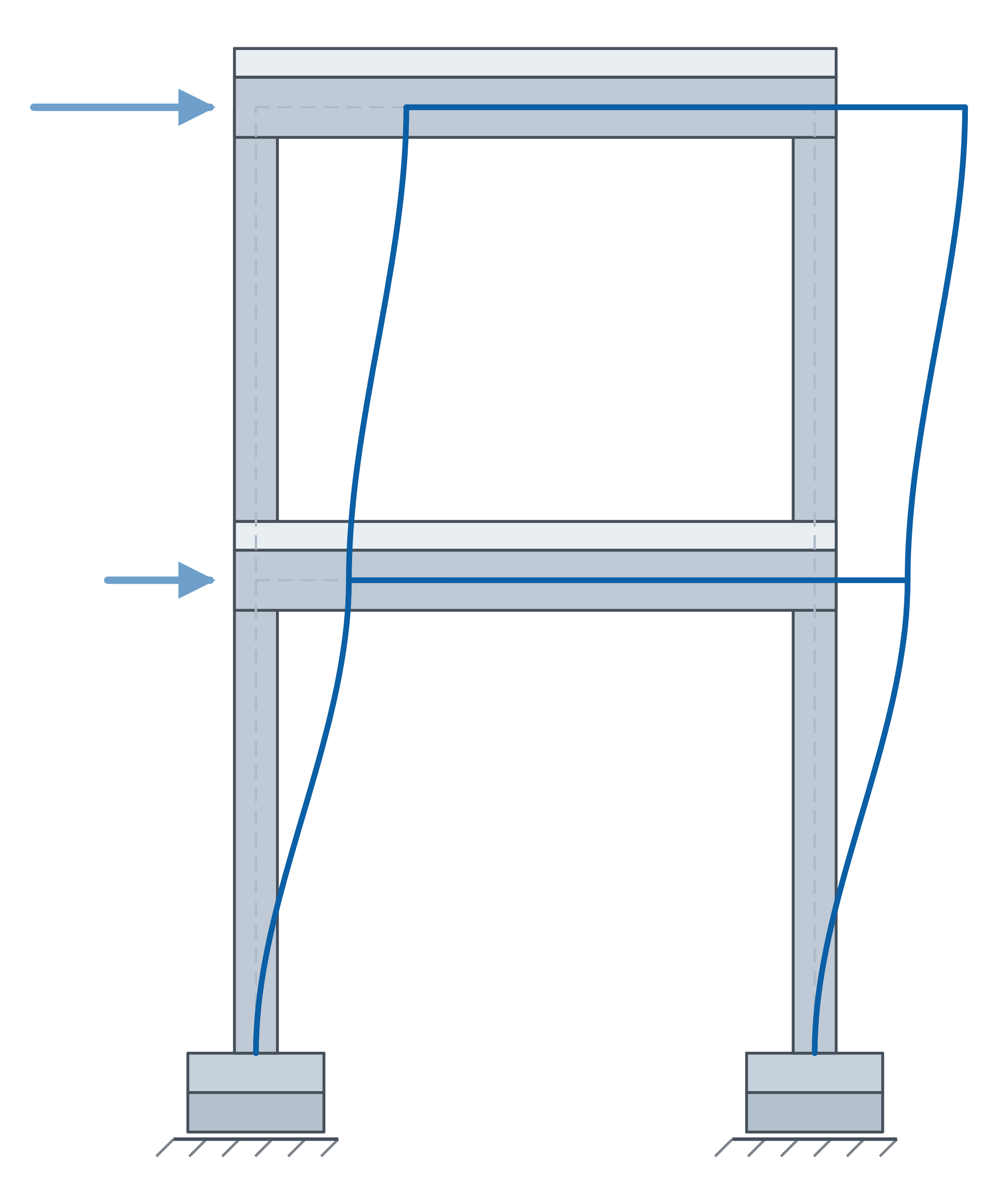
Running a pushover analysis on a two-storey steel frame with the first mode shape as load pattern and checking the results against a hand calculation from EN 1998-1 Annex B (N2 method):
Keywords:
pushover N2 method EN 1998-1 Annex B target displacement capacity curve load increment modal load pattern plastic hinge |
"""
Pushover analysis of a two-storey steel frame (N2 method, EN 1998-1 Annex B).

Benchmark: a two-storey shear frame, HEB 200 columns with rigid floor beams and
30 t per floor, pushed with the first mode shape as load pattern. Plastic hinges
at the column ends yield at M_pl. Every value RFEM reports can be checked by hand:

  - two degrees of freedom, so the transformation factor Gamma differs from 1
  - modal load pattern (automatic mode shape)
  - long period, T* >= T_C: equal displacement rule, Annex B (B.9)
  - the frame stays elastic at the target displacement, inside the capacity curve,
    which ends when the ground storey forms the sway mechanism

Hand calculation:
  - Frame theory: storey stiffness k = 24 E I / h^3 (rigid floor beams)
  - Two-mass system: first mode omega_1, Phi = (Phi_1, 1), normalised at the roof
  - Plastic theory: the ground storey forms the mechanism, F_b = 4 M_pl / h
  - EN 1998-1:2004, 3.2.2.2: elastic response spectrum Type 1, ground type B
  - EN 1998-1:2004, Annex B: m* = sum m_i Phi_i, Gamma = m* / sum m_i Phi_i^2,
    F*_y = F_b / Gamma, d*_y = F*_y / (m* omega_1^2), T* = 2 pi sqrt(m* d*_y / F*_y)

With the load pattern proportional to M Phi, the frame deforms in the mode shape,
so T* equals the first natural period. At the target the frame is elastic, so the
base shear there is Gamma m* S_e(T*), the first-mode base shear of a response
spectrum analysis.

The example reads the results with get_result_table():
  - the normalized lateral forces, compared with m_i Phi_i
  - support forces and nodal deformations of every load increment (load_increment_no),
    giving the capacity curve, read at the target displacement
  - the target displacement table, compared with Annex B; it does not depend on the
    load increment, so asking for one returns an empty table and a warning
  - support forces, deformations and member forces of the master increment
    (load_increment_no not set): the load increment at the target displacement,
    the performance point. Here the frame is still elastic; if the target lies
    beyond the end of the capacity curve, the master increment is the last one.

Reference vs. RFEM (the deviations stay below 1 %):
  - Phi_1 = 0.618, Gamma = 1.171, m* = 48.5 t, F*_y = 129.0 kN, T* = 0.831 s
  - T* >= T_C: d*_t = d*_et = 31.0 mm and d_t = 36.3 mm (RFEM 36.5 mm), below the
    mechanism at 54.9 mm, so no warning; the base shear at d_t is 100.6 kN
  - The hand calculation neglects the axial strain of the columns. With it the
    frame gives T_1 = 0.835 s and Phi_1 = 0.614, as RFEM does.

In the target displacement table, 'mass' is m* = sum m_i Phi_i and 'modal_mass'
is sum m_i Phi_i^2, the denominator of Gamma.
"""
from math import inf, pi, sqrt

import grpc
import numpy as np
import pandas as pd
from dlubal.api import rfem, common

# --- Benchmark input -------------------------------------------------------
SPAN = 6.0                      # m
STOREY_HEIGHT = 4.0             # m, h
FLOOR_MASS = 30_000.0           # kg per floor (15 t at each column)
GRAVITY = 9.81                  # m/s2

# HEB 200 in S235 (EN 10365): I_y = 5696 cm4, W_pl,y = 642.5 cm3
COLUMN_SECTION = 'HEB 200'
E = 210e9                       # Pa
I_Y = 5696e-8                   # m4
W_PL_Y = 642.5e-6               # m3
F_Y = 235e6                     # Pa
M_PL = W_PL_Y * F_Y             # Nm, 151.0 kNm
HINGE_SPRING = 1e12             # Nm/rad, rigid until the hinge yields at M_pl

# EN 1998-1, Table 3.2: elastic spectrum Type 1, ground type B
A_G = 0.10 * GRAVITY            # m/s2, low seismicity
S, T_B, T_C, T_D = 1.20, 0.15, 0.50, 2.00
ETA = 1.0                       # 5 % viscous damping


def elastic_spectrum(period: float) -> float:
    """S_e(T) [m/s2], EN 1998-1 expressions (3.2) to (3.5)."""
    if period <= T_B:
        return A_G * S * (1 + period / T_B * (ETA * 2.5 - 1))
    if period <= T_C:
        return A_G * S * ETA * 2.5
    if period <= T_D:
        return A_G * S * ETA * 2.5 * T_C / period
    return A_G * S * ETA * 2.5 * T_C * T_D / period**2


def first_mode() -> tuple[float, float]:
    """omega_1^2 [1/s2] and Phi_1 (roof = 1) of the two-mass shear frame."""
    k = 24 * E * I_Y / STOREY_HEIGHT**3                     # both storeys alike
    m = FLOOR_MASS
    # det(K - omega^2 M) = 0 with K = [[2k, -k], [-k, k]], M = diag(m, m)
    a, b, c = m * m, -3 * k * m, k * k
    omega2 = (-b - sqrt(b * b - 4 * a * c)) / (2 * a)
    phi_1 = k / (2 * k - omega2 * m)
    return omega2, phi_1


def annex_b_reference() -> dict:
    """Hand calculation of the benchmark, EN 1998-1 Annex B."""
    omega2, phi_1 = first_mode()
    m_star = FLOOR_MASS * phi_1 + FLOOR_MASS                # (B.2)
    modal_mass = FLOOR_MASS * phi_1**2 + FLOOR_MASS         # sum m_i Phi_i^2
    gamma = m_star / modal_mass                             # (B.3)
    f_y_star = 4 * M_PL / STOREY_HEIGHT / gamma             # (B.4), ground-storey mechanism
    d_y_star = f_y_star / (m_star * omega2)                 # elastic branch along the mode
    t_star = 2 * pi * sqrt(m_star * d_y_star / f_y_star)    # (B.7)
    s_e = elastic_spectrum(t_star)
    d_et_star = s_e * (t_star / (2 * pi))**2                # (B.8)

    if t_star >= T_C or f_y_star / m_star >= s_e:           # (B.9), (B.10)
        d_t_star = d_et_star
    else:                                                   # (B.11)
        q_u = s_e * m_star / f_y_star
        d_t_star = max(d_et_star, d_et_star / q_u * (1 + (q_u - 1) * T_C / t_star))

    return {
        'Phi_1 [-]': phi_1,
        'Gamma [-]': gamma,
        'm* [t]': m_star / 1000,
        'sum m_i Phi_i^2 [t]': modal_mass / 1000,
        'F*_y [kN]': f_y_star / 1000,
        'd*_y [mm]': d_y_star * 1000,
        'T* [s]': t_star,
        'S_e(T*) [m/s2]': s_e,
        'd*_et [mm]': d_et_star * 1000,
        'd*_t [mm]': d_t_star * 1000,
        'd_t [mm]': gamma * d_t_star * 1000,
        'F_b at d_t [kN]': gamma * m_star * s_e / 1000,
    }


def define_structure() -> list:
    """Two-storey frame in the XZ plane, plastic hinges at all column ends."""

    plastic_hinge = rfem.types_for_members.MemberHinge(
        no=1,
        user_defined_name_enabled=True,
        name='Plastic hinge | M_pl,y',
        axial_release_n=inf,
        axial_release_vy=inf,
        axial_release_vz=inf,
        moment_release_mt=inf,
        # Yielding needs a finite spring: with inf the calculation fails without a listed error
        moment_release_my=HINGE_SPRING,
        moment_release_mz=inf,
        moment_release_my_nonlinearity=rfem.types_for_members.MemberHinge.MOMENT_RELEASE_MY_NONLINEARITY_PARTIAL_ACTIVITY,
        partial_activity_around_y_negative_type=rfem.types_for_members.MemberHinge.PARTIAL_ACTIVITY_AROUND_Y_NEGATIVE_TYPE_YIELDING_FROM_FORCE_OR_MOMENT,
        partial_activity_around_y_negative_moment=M_PL,
        partial_activity_around_y_positive_type=rfem.types_for_members.MemberHinge.PARTIAL_ACTIVITY_AROUND_Y_POSITIVE_TYPE_YIELDING_FROM_FORCE_OR_MOMENT,
        partial_activity_around_y_positive_moment=M_PL,
    )

    def column(no: int, line: int) -> rfem.structure_core.Member:
        return rfem.structure_core.Member(no=no, line=line, cross_section_start=1, member_hinge_start=1, member_hinge_end=1)

    return [
        rfem.structure_core.Material(no=1, name='S235'),
        rfem.structure_core.CrossSection(no=1, name=COLUMN_SECTION, material=1, shear_stiffness_deactivated=True),

        # Global Z points down (RFEM default): floor 1 at Z = -h, roof at Z = -2h
        rfem.structure_core.Node(no=1, coordinate_1=0.0),
        rfem.structure_core.Node(no=2, coordinate_1=SPAN),
        rfem.structure_core.Node(no=3, coordinate_1=0.0, coordinate_3=-STOREY_HEIGHT),
        rfem.structure_core.Node(no=4, coordinate_1=SPAN, coordinate_3=-STOREY_HEIGHT),
        rfem.structure_core.Node(no=5, coordinate_1=0.0, coordinate_3=-2 * STOREY_HEIGHT),
        rfem.structure_core.Node(no=6, coordinate_1=SPAN, coordinate_3=-2 * STOREY_HEIGHT),

        rfem.structure_core.Line(no=1, definition_nodes=[1, 3]),
        rfem.structure_core.Line(no=2, definition_nodes=[3, 5]),
        rfem.structure_core.Line(no=3, definition_nodes=[2, 4]),
        rfem.structure_core.Line(no=4, definition_nodes=[4, 6]),
        rfem.structure_core.Line(no=5, definition_nodes=[3, 4]),
        rfem.structure_core.Line(no=6, definition_nodes=[5, 6]),

        plastic_hinge,
        column(no=1, line=1),
        column(no=2, line=2),
        column(no=3, line=3),
        column(no=4, line=4),
        rfem.structure_core.Member(no=5, line=5, type=rfem.structure_core.Member.TYPE_RIGID),
        rfem.structure_core.Member(no=6, line=6, type=rfem.structure_core.Member.TYPE_RIGID),

        rfem.types_for_nodes.NodalSupport(
            no=1,
            nodes=[1, 2],
            spring=common.Vector3d(x=inf, y=inf, z=inf),
            rotational_restraint=common.Vector3d(x=inf, y=inf, z=inf),
        ),
        # The benchmark is a plane frame: hold the floors out of plane
        rfem.types_for_nodes.NodalSupport(
            no=2,
            nodes=[3, 4, 5, 6],
            spring=common.Vector3d(x=0, y=inf, z=0),
            rotational_restraint=common.Vector3d(x=0, y=0, z=0),
        ),
    ]


def define_loading() -> list:
    """Floor weights (= floor masses), modal analysis, EC8 spectrum and the pushover combination."""

    spectrum_rows = [
        rfem.dynamic_loads.ResponseSpectrum.UserDefinedResponseSpectrumRow(
            period=period, acceleration=elastic_spectrum(period),
        )
        for period in [0.0, T_B, T_C] + [round(0.05 * i, 2) for i in range(11, 81)]
    ]

    return [
        rfem.loading.StaticAnalysisSettings(
            no=1,
            analysis_type=rfem.loading.StaticAnalysisSettings.ANALYSIS_TYPE_GEOMETRICALLY_LINEAR,
            mass_conversion_enabled=True,
        ),
        # The floor masses act in X only: two floors give exactly two sway modes
        rfem.loading.ModalAnalysisSettings(
            no=1,
            number_of_modes=2,
            solution_method=rfem.loading.ModalAnalysisSettings.SOLUTION_METHOD_LANCZOS,
            acting_masses_in_direction_x_enabled=True,
            acting_masses_in_direction_y_enabled=False,
            acting_masses_in_direction_z_enabled=False,
            acting_masses_about_axis_x_enabled=False,
            acting_masses_about_axis_y_enabled=False,
            acting_masses_about_axis_z_enabled=False,
        ),
        rfem.loading.PushoverAnalysisSettings(
            no=1,
            considering_iterative_procedure=False,              # Annex B.5 iteration off
            end_of_capacity_curve=rfem.loading.PushoverAnalysisSettings.END_OF_CAPACITY_CURVE_COLAPS,
            automatic_selection_of_the_highest_node=True,
            initial_load_factor=0.1,
            load_factor_increment=0.1,
            refinement_of_the_last_load_increment=10,
            maximum_number_of_load_increments=200,
        ),
        rfem.dynamic_loads.ResponseSpectrum(
            no=1,
            user_defined_name_enabled=True,
            name='EN 1998-1 | Type 1 | ground B | a_g = 0.10 g',
            definition_type=rfem.dynamic_loads.ResponseSpectrum.DEFINITION_TYPE_USER_DEFINED,
            user_defined_response_spectrum_step_enabled=False,
            is_g_factor_mode=False,
            user_defined_spectrum_sorted=True,
            user_defined_response_spectrum=rfem.dynamic_loads.ResponseSpectrum.UserDefinedResponseSpectrumTable(
                rows=spectrum_rows,
            ),
        ),

        # LC1: floor weights, converted into the floor masses
        rfem.loading.LoadCase(
            no=1,
            name='Vertical loads | floor masses',
            static_analysis_settings=1,
            self_weight_active=False,
        ),
        rfem.loads.NodalLoad(
            no=1,
            load_case=1,
            nodes=[3, 4, 5, 6],
            load_direction=rfem.loads.NodalLoad.LOAD_DIRECTION_GLOBAL_Z_OR_USER_DEFINED_W_TRUE_LENGTH,
            force_magnitude=FLOOR_MASS / 2 * GRAVITY,
        ),

        # LC2: modal analysis with the masses of LC1
        rfem.loading.LoadCase(
            no=2,
            name='Modal analysis',
            analysis_type=rfem.loading.LoadCase.ANALYSIS_TYPE_MODAL_ANALYSIS,
            modal_analysis_settings=1,
            import_masses_from=rfem.ObjectId(no=1, object_type=rfem.OBJECT_TYPE_LOAD_CASE),
        ),

        # CO1: pushover in +X, load pattern from the first mode shape
        rfem.loading.LoadCombination(
            no=1,
            name='Pushover | +X | mode 1',
            user_defined_name_enabled=True,
            analysis_type=rfem.loading.LoadCombination.ANALYSIS_TYPE_PUSHOVER,
            static_analysis_settings=1,
            pushover_analysis_settings=1,
            pushover_vertical_loads_case=rfem.ObjectId(no=1, object_type=rfem.OBJECT_TYPE_LOAD_CASE),
            pushover_modal_analysis_from_load_case=2,
            pushover_direction=rfem.loading.LoadCombination.PUSHOVER_DIRECTION_X,
            pushover_normalized_displacements=rfem.loading.LoadCombination.PUSHOVER_NORMALIZED_DISPLACEMENTS_MODAL_AUTOMATIC_MODAL_SHAPE,
            pushover_response_spectrum=1,
            pushover_response_spectrum_scale_factor=1.0,
        ),
    ]


def base_shear(support_forces: pd.DataFrame) -> float:
    """Sum of the horizontal support forces [N]."""
    return support_forces.loc[support_forces['specification'].str.lower() == 'support forces', 'p_x'].iloc[0]


with rfem.Application() as rfem_app:

    # Step 1: Create a new model with the Modal and Pushover Analysis add-ons
    rfem_app.close_all_models(save_changes=False)
    rfem_app.create_model(name='pushover_two_storey_frame')

    base_data = rfem_app.get_base_data()
    base_data.addons.modal_analysis_active = True
    base_data.addons.pushover_analysis_active = True
    base_data.general_settings.gravitational_acceleration = GRAVITY
    rfem_app.set_base_data(base_data=base_data)

    # Step 2: Create the structure and the loading
    rfem_app.delete_all_objects()
    rfem_app.create_object_list(define_structure() + define_loading())

    # Step 3: Run the pushover analysis
    calculation = rfem_app.calculate_all(skip_warnings=True)
    print(f"\nCalculation:\n{calculation}")

    co1 = rfem.ObjectId(no=1, object_type=rfem.OBJECT_TYPE_LOAD_COMBINATION)
    reference = annex_b_reference()

    # Step 4: Load pattern - the normalized lateral forces are m_i * Phi_i
    lateral_forces = rfem_app.get_result_table(
        table=rfem.results.ResultTable.PUSHOVER_ANALYSIS_NORMALIZED_LATERAL_FORCES_TABLE,
        loading=co1,
    ).data
    floor_1 = lateral_forces.loc[lateral_forces['position_z'] == -STOREY_HEIGHT, 'force_x'].sum()
    roof = lateral_forces.loc[lateral_forces['position_z'] == -2 * STOREY_HEIGHT, 'force_x'].sum()
    print(f"\nLoad pattern: floor 1 / roof = {floor_1 / roof:.3f} (Phi_1 = {reference['Phi_1 [-]']:.3f})")

    # Step 5: Capacity curve, one load increment at a time.
    # load_increment_no starts at 1; a number past the last increment is rejected
    # with INVALID_ARGUMENT, which ends the loop.
    curve = []
    increment_no = 1
    while True:
        try:
            support_forces = rfem_app.get_result_table(
                table=rfem.results.ResultTable.PUSHOVER_ANALYSIS_NODES_SUPPORT_FORCES_TABLE,
                loading=co1,
                load_increment_no=increment_no,
            ).data
        except grpc.RpcError as error:
            if error.code() == grpc.StatusCode.INVALID_ARGUMENT:
                break
            raise

        deformations = rfem_app.get_result_table(
            table=rfem.results.ResultTable.PUSHOVER_ANALYSIS_NODES_GLOBAL_DEFORMATIONS_TABLE,
            loading=co1,
            load_increment_no=increment_no,
        ).data

        curve.append({
            'increment': increment_no,
            'base shear [kN]': base_shear(support_forces) / 1000,
            'roof displacement [mm]': deformations.loc[deformations['node_no'] == 5, 'u_x'].iloc[0] * 1000,
            'floor 1 displacement [mm]': deformations.loc[deformations['node_no'] == 3, 'u_x'].iloc[0] * 1000,
        })
        increment_no += 1

    curve = pd.DataFrame(curve)
    print(f"\nCapacity curve ({len(curve)} increments, every 10th and the last):")
    print(curve.iloc[list(range(0, len(curve), 10)) + [len(curve) - 1]].to_string(index=False, float_format='{:.2f}'.format))

    # Step 6: Target displacement (N2 method) - compare with the Annex B hand calculation
    target = rfem_app.get_result_table(
        table=rfem.results.ResultTable.PUSHOVER_ANALYSIS_TARGET_DISPLACEMENT_TABLE,
        loading=co1,
    ).data.iloc[-1]     # last iteration; with the iterative procedure off there is one

    d_t = target['target_displacement_mdof'] * 1000
    rfem_values = {
        'Phi_1 [-]': floor_1 / roof,
        'Gamma [-]': target['transformation_factor'],
        'm* [t]': target['mass'] / 1000,
        'sum m_i Phi_i^2 [t]': target['modal_mass'] / 1000,
        'F*_y [kN]': target['force_equivalent'] / 1000,
        'd*_y [mm]': target['yield_displacement'] * 1000,
        'T* [s]': target['period_equivalent'],
        'S_e(T*) [m/s2]': target['elastic_acceleration'],
        'd*_et [mm]': target['displacement_elastic'] * 1000,
        'd*_t [mm]': target['target_displacement_sdof'] * 1000,
        'd_t [mm]': d_t,
        # The capacity curve read at the target displacement
        'F_b at d_t [kN]': np.interp(d_t, curve['roof displacement [mm]'], curve['base shear [kN]']),
    }
    comparison = pd.DataFrame({'EN 1998-1 Annex B': reference, 'RFEM': rfem_values})
    comparison['deviation [%]'] = (comparison['RFEM'] / comparison['EN 1998-1 Annex B'] - 1) * 100
    print(f"\nTarget displacement vs. benchmark:\n{comparison.to_string(float_format='{:.3f}'.format)}")

    yield_displacement = curve['roof displacement [mm]'].iloc[-1]
    print(f"\nd_t = {d_t:.1f} mm lies inside the capacity curve, which ends at the mechanism, "
          f"{yield_displacement:.1f} mm: the frame stays elastic.")

    # The target displacement does not depend on the load increment. Asking for one
    # returns an empty table and a warning instead of an error.
    target_for_increment = rfem_app.get_result_table(
        table=rfem.results.ResultTable.PUSHOVER_ANALYSIS_TARGET_DISPLACEMENT_TABLE,
        loading=co1,
        load_increment_no=2,
    )
    print(f"Target displacement for increment 2: {len(target_for_increment.data)} rows, warning: {target_for_increment.warning}")

    # Step 7: Master increment (load_increment_no not set) - the load increment at
    # the target displacement, i.e. the performance point. The frame is elastic
    # there, so each column end carries the storey shear x h / 4: the ground storey
    # takes the base shear F_b, the upper storey the roof force F_b / (1 + Phi_1).
    master_support_forces = rfem_app.get_result_table(
        table=rfem.results.ResultTable.PUSHOVER_ANALYSIS_NODES_SUPPORT_FORCES_TABLE,
        loading=co1,
    ).data
    master_deformations = rfem_app.get_result_table(
        table=rfem.results.ResultTable.PUSHOVER_ANALYSIS_NODES_GLOBAL_DEFORMATIONS_TABLE,
        loading=co1,
    ).data
    forces = rfem_app.get_result_table(
        table=rfem.results.ResultTable.PUSHOVER_ANALYSIS_MEMBERS_INTERNAL_FORCES_TABLE,
        loading=co1,
    ).data

    master_shear = base_shear(master_support_forces) / 1000
    master_roof = master_deformations.loc[master_deformations['node_no'] == 5, 'u_x'].iloc[0] * 1000
    master_no = curve.loc[(curve['roof displacement [mm]'] - master_roof).abs().idxmin(), 'increment']
    print(f"\nMaster increment = increment {master_no} of {len(curve)}: roof {master_roof:.1f} mm "
          f"(d_t = {d_t:.1f} mm), base shear {master_shear:.1f} kN")

    storey_shear = {1: master_shear, 3: master_shear,                          # ground storey columns
                    2: master_shear * roof / (floor_1 + roof), 4: master_shear * roof / (floor_1 + roof)}
    ends = forces[forces['tag'].isna() & forces['node_no'].notna()].drop_duplicates(['member_no', 'node_no'])
    ends = ends.assign(**{
        '|M_y| [kNm]': ends['m_y'].abs() / 1000,
        'V h / 4 [kNm]': ends['member_no'].map(storey_shear) * STOREY_HEIGHT / 4,
        'M_pl [kNm]': M_PL / 1000,
    })
    print("Column end moments (members 1, 3: ground storey; 2, 4: upper storey):")
    print(ends[['member_no', 'node_no', '|M_y| [kNm]', 'V h / 4 [kNm]', 'M_pl [kNm]']].to_string(index=False, float_format='{:.1f}'.format))
using System.Globalization;
using Google.Protobuf;
using Grpc.Core;
using Common = Dlubal.Api.Common;
using Rfem = Dlubal.Api.Rfem;

// -------------------------------------------------------
// Pushover analysis of a two-storey steel frame (N2 method, EN 1998-1 Annex B).
//
// Benchmark: a two-storey shear frame, HEB 200 columns with rigid floor beams and
// 30 t per floor, pushed with the first mode shape as load pattern. Plastic hinges
// at the column ends yield at M_pl. Every value RFEM reports can be checked by hand:
//
//   - two degrees of freedom, so the transformation factor Gamma differs from 1
//   - modal load pattern (automatic mode shape)
//   - long period, T* >= T_C: equal displacement rule, Annex B (B.9)
//   - the frame stays elastic at the target displacement, inside the capacity curve,
//     which ends when the ground storey forms the sway mechanism
//
// Hand calculation:
//   - Frame theory: storey stiffness k = 24 E I / h^3 (rigid floor beams)
//   - Two-mass system: first mode omega_1, Phi = (Phi_1, 1), normalised at the roof
//   - Plastic theory: the ground storey forms the mechanism, F_b = 4 M_pl / h
//   - EN 1998-1:2004, 3.2.2.2: elastic response spectrum Type 1, ground type B
//   - EN 1998-1:2004, Annex B: m* = sum m_i Phi_i, Gamma = m* / sum m_i Phi_i^2,
//     F*_y = F_b / Gamma, d*_y = F*_y / (m* omega_1^2), T* = 2 pi sqrt(m* d*_y / F*_y)
//
// With the load pattern proportional to M Phi, the frame deforms in the mode shape,
// so T* equals the first natural period. At the target the frame is elastic, so the
// base shear there is Gamma m* S_e(T*), the first-mode base shear of a response
// spectrum analysis.
//
// The example reads the results with get_result_table():
//   - the normalized lateral forces, compared with m_i Phi_i
//   - support forces and nodal deformations of every load increment (loadIncrementNo),
//     giving the capacity curve, read at the target displacement
//   - the target displacement table, compared with Annex B; it does not depend on the
//     load increment, so asking for one returns an empty table
//   - support forces, deformations and member forces of the master increment
//     (loadIncrementNo not set): the load increment at the target displacement,
//     the performance point. Here the frame is still elastic; if the target lies
//     beyond the end of the capacity curve, the master increment is the last one.
//
// Reference vs. RFEM (the deviations stay below 1 %):
//   - Phi_1 = 0.618, Gamma = 1.171, m* = 48.5 t, F*_y = 129.0 kN, T* = 0.831 s
//   - T* >= T_C: d*_t = d*_et = 31.0 mm and d_t = 36.3 mm (RFEM 36.5 mm), below the
//     mechanism at 54.9 mm, so no warning; the base shear at d_t is 100.6 kN
//   - The hand calculation neglects the axial strain of the columns. With it the
//     frame gives T_1 = 0.835 s and Phi_1 = 0.614, as RFEM does.
//
// In the target displacement table, 'mass' is m* = sum m_i Phi_i and 'modal_mass'
// is sum m_i Phi_i^2, the denominator of Gamma.
// -------------------------------------------------------

// --- Benchmark input -----------------------------------
const double Span = 6.0;                    // m
const double StoreyHeight = 4.0;            // m, h
const double FloorMass = 30_000.0;          // kg per floor (15 t at each column)
const double Gravity = 9.81;                // m/s2

// HEB 200 in S235 (EN 10365): I_y = 5696 cm4, W_pl,y = 642.5 cm3
const string ColumnSection = "HEB 200";
const double E = 210e9;                     // Pa
const double IY = 5696e-8;                  // m4
const double WPlY = 642.5e-6;               // m3
const double FY = 235e6;                    // Pa
const double MPl = WPlY * FY;               // Nm, 151.0 kNm
const double HingeSpring = 1e12;            // Nm/rad, rigid until the hinge yields at M_pl

// EN 1998-1, Table 3.2: elastic spectrum Type 1, ground type B
const double AG = 0.10 * Gravity;           // m/s2, low seismicity
const double S = 1.20, TB = 0.15, TC = 0.50, TD = 2.00;
const double Eta = 1.0;                     // 5 % viscous damping

static double ElasticSpectrum(double period)
{
    // S_e(T) [m/s2], EN 1998-1 expressions (3.2) to (3.5)
    if (period <= TB) return AG * S * (1 + period / TB * (Eta * 2.5 - 1));
    if (period <= TC) return AG * S * Eta * 2.5;
    if (period <= TD) return AG * S * Eta * 2.5 * TC / period;
    return AG * S * Eta * 2.5 * TC * TD / (period * period);
}

static (double Omega2, double Phi1) FirstMode()
{
    // omega_1^2 [1/s2] and Phi_1 (roof = 1) of the two-mass shear frame
    var k = 24 * E * IY / Math.Pow(StoreyHeight, 3);                // both storeys alike
    var m = FloorMass;
    // det(K - omega^2 M) = 0 with K = [[2k, -k], [-k, k]], M = diag(m, m)
    double a = m * m, b = -3 * k * m, c = k * k;
    var omega2 = (-b - Math.Sqrt(b * b - 4 * a * c)) / (2 * a);
    return (omega2, k / (2 * k - omega2 * m));
}

static Dictionary<string, double> AnnexBReference()
{
    // Hand calculation of the benchmark, EN 1998-1 Annex B
    var (omega2, phi1) = FirstMode();
    var mStar = FloorMass * phi1 + FloorMass;                       // (B.2)
    var modalMass = FloorMass * phi1 * phi1 + FloorMass;            // sum m_i Phi_i^2
    var gamma = mStar / modalMass;                                  // (B.3)
    var fYStar = 4 * MPl / StoreyHeight / gamma;                    // (B.4), ground-storey mechanism
    var dYStar = fYStar / (mStar * omega2);                         // elastic branch along the mode
    var tStar = 2 * Math.PI * Math.Sqrt(mStar * dYStar / fYStar);   // (B.7)
    var sE = ElasticSpectrum(tStar);
    var dEtStar = sE * Math.Pow(tStar / (2 * Math.PI), 2);          // (B.8)

    double dTStar;
    if (tStar >= TC || fYStar / mStar >= sE)                        // (B.9), (B.10)
    {
        dTStar = dEtStar;
    }
    else                                                            // (B.11)
    {
        var qU = sE * mStar / fYStar;
        dTStar = Math.Max(dEtStar, dEtStar / qU * (1 + (qU - 1) * TC / tStar));
    }

    return new Dictionary<string, double>
    {
        ["Phi_1 [-]"] = phi1,
        ["Gamma [-]"] = gamma,
        ["m* [t]"] = mStar / 1000,
        ["sum m_i Phi_i^2 [t]"] = modalMass / 1000,
        ["F*_y [kN]"] = fYStar / 1000,
        ["d*_y [mm]"] = dYStar * 1000,
        ["T* [s]"] = tStar,
        ["S_e(T*) [m/s2]"] = sE,
        ["d*_et [mm]"] = dEtStar * 1000,
        ["d*_t [mm]"] = dTStar * 1000,
        ["d_t [mm]"] = gamma * dTStar * 1000,
        ["F_b at d_t [kN]"] = gamma * mStar * sE / 1000,
    };
}

static List<IMessage> DefineStructure()
{
    // Two-storey frame in the XZ plane, plastic hinges at all column ends.
    // Global Z points down (RFEM default): floor 1 at Z = -h, roof at Z = -2h.
    Rfem.StructureCore.Member Column(int no, int line) =>
        new Rfem.StructureCore.Member { No = no, Line = line, CrossSectionStart = 1, MemberHingeStart = 1, MemberHingeEnd = 1 };

    return new List<IMessage>
    {
        new Rfem.StructureCore.Material { No = 1, Name = "S235" },
        new Rfem.StructureCore.CrossSection { No = 1, Name = ColumnSection, Material = 1, ShearStiffnessDeactivated = true },

        new Rfem.StructureCore.Node { No = 1, Coordinate1 = 0.0 },
        new Rfem.StructureCore.Node { No = 2, Coordinate1 = Span },
        new Rfem.StructureCore.Node { No = 3, Coordinate1 = 0.0, Coordinate3 = -StoreyHeight },
        new Rfem.StructureCore.Node { No = 4, Coordinate1 = Span, Coordinate3 = -StoreyHeight },
        new Rfem.StructureCore.Node { No = 5, Coordinate1 = 0.0, Coordinate3 = -2 * StoreyHeight },
        new Rfem.StructureCore.Node { No = 6, Coordinate1 = Span, Coordinate3 = -2 * StoreyHeight },

        new Rfem.StructureCore.Line { No = 1, DefinitionNodes = { 1, 3 } },
        new Rfem.StructureCore.Line { No = 2, DefinitionNodes = { 3, 5 } },
        new Rfem.StructureCore.Line { No = 3, DefinitionNodes = { 2, 4 } },
        new Rfem.StructureCore.Line { No = 4, DefinitionNodes = { 4, 6 } },
        new Rfem.StructureCore.Line { No = 5, DefinitionNodes = { 3, 4 } },
        new Rfem.StructureCore.Line { No = 6, DefinitionNodes = { 5, 6 } },

        new Rfem.TypesForMembers.MemberHinge
        {
            No = 1,
            UserDefinedNameEnabled = true,
            Name = "Plastic hinge | M_pl,y",
            AxialReleaseN = double.PositiveInfinity,
            AxialReleaseVy = double.PositiveInfinity,
            AxialReleaseVz = double.PositiveInfinity,
            MomentReleaseMt = double.PositiveInfinity,
            // Yielding needs a finite spring: with infinity the calculation fails without a listed error
            MomentReleaseMy = HingeSpring,
            MomentReleaseMz = double.PositiveInfinity,
            MomentReleaseMyNonlinearity = Rfem.TypesForMembers.MemberHinge.Types.MomentReleaseMyNonlinearity.PartialActivity,
            PartialActivityAroundYNegativeType = Rfem.TypesForMembers.MemberHinge.Types.PartialActivityAroundYNegativeType.YieldingFromForceOrMoment,
            PartialActivityAroundYNegativeMoment = MPl,
            PartialActivityAroundYPositiveType = Rfem.TypesForMembers.MemberHinge.Types.PartialActivityAroundYPositiveType.YieldingFromForceOrMoment,
            PartialActivityAroundYPositiveMoment = MPl,
        },
        Column(no: 1, line: 1),
        Column(no: 2, line: 2),
        Column(no: 3, line: 3),
        Column(no: 4, line: 4),
        new Rfem.StructureCore.Member { No = 5, Line = 5, Type = Rfem.StructureCore.Member.Types.Type.Rigid },
        new Rfem.StructureCore.Member { No = 6, Line = 6, Type = Rfem.StructureCore.Member.Types.Type.Rigid },

        new Rfem.TypesForNodes.NodalSupport
        {
            No = 1,
            Nodes = { 1, 2 },
            Spring = new Common.Vector3d { X = double.PositiveInfinity, Y = double.PositiveInfinity, Z = double.PositiveInfinity },
            RotationalRestraint = new Common.Vector3d { X = double.PositiveInfinity, Y = double.PositiveInfinity, Z = double.PositiveInfinity },
        },
        // The benchmark is a plane frame: hold the floors out of plane
        new Rfem.TypesForNodes.NodalSupport
        {
            No = 2,
            Nodes = { 3, 4, 5, 6 },
            Spring = new Common.Vector3d { X = 0, Y = double.PositiveInfinity, Z = 0 },
            RotationalRestraint = new Common.Vector3d { X = 0, Y = 0, Z = 0 },
        },
    };
}

static List<IMessage> DefineLoading()
{
    // Floor weights (= floor masses), modal analysis, EC8 spectrum and the pushover combination.
    var spectrum = new Rfem.DynamicLoads.ResponseSpectrum.Types.UserDefinedResponseSpectrumTable();
    var periods = new List<double> { 0.0, TB, TC };
    for (var i = 11; i <= 80; i++) periods.Add(Math.Round(0.05 * i, 2));
    foreach (var period in periods)
    {
        spectrum.Rows.Add(new Rfem.DynamicLoads.ResponseSpectrum.Types.UserDefinedResponseSpectrumRow
        {
            Period = period,
            Acceleration = ElasticSpectrum(period),
        });
    }

    return new List<IMessage>
    {
        new Rfem.Loading.StaticAnalysisSettings
        {
            No = 1,
            AnalysisType = Rfem.Loading.StaticAnalysisSettings.Types.AnalysisType.GeometricallyLinear,
            MassConversionEnabled = true,
        },
        // The floor masses act in X only: two floors give exactly two sway modes
        new Rfem.Loading.ModalAnalysisSettings
        {
            No = 1,
            NumberOfModes = 2,
            SolutionMethod = Rfem.Loading.ModalAnalysisSettings.Types.SolutionMethod.Lanczos,
            ActingMassesInDirectionXEnabled = true,
            ActingMassesInDirectionYEnabled = false,
            ActingMassesInDirectionZEnabled = false,
            ActingMassesAboutAxisXEnabled = false,
            ActingMassesAboutAxisYEnabled = false,
            ActingMassesAboutAxisZEnabled = false,
        },
        new Rfem.Loading.PushoverAnalysisSettings
        {
            No = 1,
            ConsideringIterativeProcedure = false,      // Annex B.5 iteration off
            EndOfCapacityCurve = Rfem.Loading.PushoverAnalysisSettings.Types.EndOfCapacityCurve.Colaps,
            AutomaticSelectionOfTheHighestNode = true,
            InitialLoadFactor = 0.1,
            LoadFactorIncrement = 0.1,
            RefinementOfTheLastLoadIncrement = 10,
            MaximumNumberOfLoadIncrements = 200,
        },
        new Rfem.DynamicLoads.ResponseSpectrum
        {
            No = 1,
            UserDefinedNameEnabled = true,
            Name = "EN 1998-1 | Type 1 | ground B | a_g = 0.10 g",
            DefinitionType = Rfem.DynamicLoads.ResponseSpectrum.Types.DefinitionType.UserDefined,
            UserDefinedResponseSpectrumStepEnabled = false,
            IsGFactorMode = false,
            UserDefinedSpectrumSorted = true,
            UserDefinedResponseSpectrum = spectrum,
        },

        // LC1: floor weights, converted into the floor masses
        new Rfem.Loading.LoadCase
        {
            No = 1,
            Name = "Vertical loads | floor masses",
            StaticAnalysisSettings = 1,
            SelfWeightActive = false,
        },
        new Rfem.Loads.NodalLoad
        {
            No = 1,
            LoadCase = 1,
            Nodes = { 3, 4, 5, 6 },
            LoadDirection = Rfem.Loads.NodalLoad.Types.LoadDirection.GlobalZOrUserDefinedWTrueLength,
            ForceMagnitude = FloorMass / 2 * Gravity,
        },

        // LC2: modal analysis with the masses of LC1
        new Rfem.Loading.LoadCase
        {
            No = 2,
            Name = "Modal analysis",
            AnalysisType = Rfem.Loading.LoadCase.Types.AnalysisType.ModalAnalysis,
            ModalAnalysisSettings = 1,
            ImportMassesFrom = new Rfem.ObjectId { No = 1, ObjectType = Rfem.ObjectType.LoadCase },
        },

        // CO1: pushover in +X, load pattern from the first mode shape
        new Rfem.Loading.LoadCombination
        {
            No = 1,
            Name = "Pushover | +X | mode 1",
            UserDefinedNameEnabled = true,
            AnalysisType = Rfem.Loading.LoadCombination.Types.AnalysisType.Pushover,
            StaticAnalysisSettings = 1,
            PushoverAnalysisSettings = 1,
            PushoverVerticalLoadsCase = new Rfem.ObjectId { No = 1, ObjectType = Rfem.ObjectType.LoadCase },
            PushoverModalAnalysisFromLoadCase = 2,
            PushoverDirection = Rfem.Loading.LoadCombination.Types.PushoverDirection.X,
            PushoverNormalizedDisplacements = Rfem.Loading.LoadCombination.Types.PushoverNormalizedDisplacements.ModalAutomaticModalShape,
            PushoverResponseSpectrum = 1,
            PushoverResponseSpectrumScaleFactor = 1.0,
        },
    };
}

static string Text(object? value) => Convert.ToString(value, CultureInfo.InvariantCulture) ?? "";

static double ParseDouble(object? value)
{
    // Table cells are strings formatted with the current culture; fall back to the invariant one.
    var text = Text(value);
    if (double.TryParse(text, NumberStyles.Float, CultureInfo.CurrentCulture, out var parsed)) return parsed;
    return double.TryParse(text, NumberStyles.Float, CultureInfo.InvariantCulture, out parsed) ? parsed : double.NaN;
}

static IEnumerable<Microsoft.Data.Analysis.DataFrameRow> RowsWhere(Common.Table table, string columnId, string value)
{
    return table.Data.Rows.Where(row => string.Equals(Text(row[columnId]), value, StringComparison.OrdinalIgnoreCase));
}

static double BaseShear(Common.Table supportForces)
{
    // Sum of the horizontal support forces [kN]
    var row = RowsWhere(supportForces, "specification", "support forces").FirstOrDefault();
    return row is null ? double.NaN : ParseDouble(row["p_x"]) / 1000;
}

static double SwayAt(Common.Table deformations, int nodeNo)
{
    // Horizontal displacement u_x [mm] of a node
    var row = RowsWhere(deformations, "node_no", nodeNo.ToString(CultureInfo.InvariantCulture)).FirstOrDefault();
    return row is null ? double.NaN : ParseDouble(row["u_x"]) * 1000;
}

static double LateralForceAt(Common.Table lateralForces, double z)
{
    // Sum of the normalized lateral forces at the floor with global Z = z
    return lateralForces.Data.Rows
        .Where(row => Math.Abs(ParseDouble(row["position_z"]) - z) < 1e-6)
        .Sum(row => ParseDouble(row["force_x"]));
}

static double Interpolate(double x, IReadOnlyList<double> xs, IReadOnlyList<double> ys)
{
    // Linear interpolation in a rising table (the capacity curve)
    for (var i = 1; i < xs.Count; i++)
    {
        if (x <= xs[i]) return ys[i - 1] + (ys[i] - ys[i - 1]) * (x - xs[i - 1]) / (xs[i] - xs[i - 1]);
    }
    return double.NaN;
}

// -------------------------------------------------------
// MAIN SCRIPT
// -------------------------------------------------------

ApplicationRfem? rfemApp = null;

try
{
    // Step 1: Create a new model with the Modal and Pushover Analysis add-ons
    rfemApp = new ApplicationRfem();
    rfemApp.close_all_models(saveChanges: false);
    rfemApp.create_model(name: "pushover_two_storey_frame");

    var baseData = rfemApp.get_base_data();
    baseData.Addons.ModalAnalysisActive = true;
    baseData.Addons.PushoverAnalysisActive = true;
    baseData.GeneralSettings.GravitationalAcceleration = Gravity;
    rfemApp.set_base_data(baseData: baseData);

    // Step 2: Create the structure and the loading
    rfemApp.delete_all_objects();
    var objects = DefineStructure();
    objects.AddRange(DefineLoading());
    rfemApp.create_object_list(objects);

    // Step 3: Run the pushover analysis
    var calculation = rfemApp.calculate_all(skipWarnings: true);
    Console.WriteLine($"\nCalculation:\n{calculation}");

    var co1 = new Rfem.ObjectId { No = 1, ObjectType = Rfem.ObjectType.LoadCombination };
    var reference = AnnexBReference();

    // Step 4: Load pattern - the normalized lateral forces are m_i * Phi_i
    var lateralForces = rfemApp.get_result_table(
        table: Rfem.Results.ResultTable.PushoverAnalysisNormalizedLateralForcesTable,
        loading: co1);
    var floor1 = LateralForceAt(lateralForces, -StoreyHeight);
    var roof = LateralForceAt(lateralForces, -2 * StoreyHeight);
    Console.WriteLine($"\nLoad pattern: floor 1 / roof = {floor1 / roof:F3} (Phi_1 = {reference["Phi_1 [-]"]:F3})");

    // Step 5: Capacity curve, one load increment at a time.
    // loadIncrementNo starts at 1; a number past the last increment is rejected
    // with INVALID_ARGUMENT, which ends the loop.
    var curve = new List<(int Increment, double BaseShear, double Roof, double Floor1)>();
    for (var incrementNo = 1; ; incrementNo++)
    {
        Common.Table supportForces;
        try
        {
            supportForces = rfemApp.get_result_table(
                table: Rfem.Results.ResultTable.PushoverAnalysisNodesSupportForcesTable,
                loading: co1,
                loadIncrementNo: incrementNo);
        }
        catch (RpcException ex) when (ex.StatusCode == StatusCode.InvalidArgument)
        {
            break;
        }

        var deformations = rfemApp.get_result_table(
            table: Rfem.Results.ResultTable.PushoverAnalysisNodesGlobalDeformationsTable,
            loading: co1,
            loadIncrementNo: incrementNo);

        curve.Add((incrementNo, BaseShear(supportForces), SwayAt(deformations, nodeNo: 5), SwayAt(deformations, nodeNo: 3)));
    }

    Console.WriteLine($"\nCapacity curve ({curve.Count} increments, every 10th and the last):");
    Console.WriteLine($"{"increment",10}{"base shear [kN]",17}{"roof displacement [mm]",24}{"floor 1 displacement [mm]",27}");
    for (var i = 0; i < curve.Count; i++)
    {
        if (i % 10 != 0 && i != curve.Count - 1) continue;
        Console.WriteLine($"{curve[i].Increment,10}{curve[i].BaseShear,17:F2}{curve[i].Roof,24:F2}{curve[i].Floor1,27:F2}");
    }

    // Step 6: Target displacement (N2 method) - compare with the Annex B hand calculation
    var targetTable = rfemApp.get_result_table(
        table: Rfem.Results.ResultTable.PushoverAnalysisTargetDisplacementTable,
        loading: co1);
    var target = targetTable.Data.Rows.Last();      // last iteration; with the iterative procedure off there is one

    var dT = ParseDouble(target["target_displacement_mdof"]) * 1000;
    var rfemValues = new Dictionary<string, double>
    {
        ["Phi_1 [-]"] = floor1 / roof,
        ["Gamma [-]"] = ParseDouble(target["transformation_factor"]),
        ["m* [t]"] = ParseDouble(target["mass"]) / 1000,
        ["sum m_i Phi_i^2 [t]"] = ParseDouble(target["modal_mass"]) / 1000,
        ["F*_y [kN]"] = ParseDouble(target["force_equivalent"]) / 1000,
        ["d*_y [mm]"] = ParseDouble(target["yield_displacement"]) * 1000,
        ["T* [s]"] = ParseDouble(target["period_equivalent"]),
        ["S_e(T*) [m/s2]"] = ParseDouble(target["elastic_acceleration"]),
        ["d*_et [mm]"] = ParseDouble(target["displacement_elastic"]) * 1000,
        ["d*_t [mm]"] = ParseDouble(target["target_displacement_sdof"]) * 1000,
        ["d_t [mm]"] = dT,
        // The capacity curve read at the target displacement
        ["F_b at d_t [kN]"] = Interpolate(dT, curve.Select(p => p.Roof).ToList(), curve.Select(p => p.BaseShear).ToList()),
    };

    Console.WriteLine("\nTarget displacement vs. benchmark:");
    Console.WriteLine($"{"",-21}{"EN 1998-1 Annex B",19}{"RFEM",10}{"deviation [%]",15}");
    foreach (var (name, referenceValue) in reference)
    {
        var rfemValue = rfemValues[name];
        Console.WriteLine($"{name,-21}{referenceValue,19:F3}{rfemValue,10:F3}{(rfemValue / referenceValue - 1) * 100,15:F3}");
    }

    Console.WriteLine($"\nd_t = {dT:F1} mm lies inside the capacity curve, which ends at the mechanism, "
        + $"{curve[^1].Roof:F1} mm: the frame stays elastic.");

    // The target displacement does not depend on the load increment. Asking for one
    // returns an empty table instead of an error.
    var targetForIncrement = rfemApp.get_result_table(
        table: Rfem.Results.ResultTable.PushoverAnalysisTargetDisplacementTable,
        loading: co1,
        loadIncrementNo: 2);
    Console.WriteLine($"Target displacement for increment 2: {targetForIncrement.Data.Rows.Count} rows");

    // Step 7: Master increment (loadIncrementNo not set) - the load increment at
    // the target displacement, i.e. the performance point. The frame is elastic
    // there, so each column end carries the storey shear x h / 4: the ground storey
    // takes the base shear F_b, the upper storey the roof force F_b / (1 + Phi_1).
    var masterSupportForces = rfemApp.get_result_table(
        table: Rfem.Results.ResultTable.PushoverAnalysisNodesSupportForcesTable,
        loading: co1);
    var masterDeformations = rfemApp.get_result_table(
        table: Rfem.Results.ResultTable.PushoverAnalysisNodesGlobalDeformationsTable,
        loading: co1);
    var forces = rfemApp.get_result_table(
        table: Rfem.Results.ResultTable.PushoverAnalysisMembersInternalForcesTable,
        loading: co1);

    var masterShear = BaseShear(masterSupportForces);
    var masterRoof = SwayAt(masterDeformations, nodeNo: 5);
    var masterNo = curve.MinBy(p => Math.Abs(p.Roof - masterRoof)).Increment;
    Console.WriteLine($"\nMaster increment = increment {masterNo} of {curve.Count}: roof {masterRoof:F1} mm "
        + $"(d_t = {dT:F1} mm), base shear {masterShear:F1} kN");

    var upperShear = masterShear * roof / (floor1 + roof);
    var storeyShear = new Dictionary<string, double> { ["1"] = masterShear, ["3"] = masterShear, ["2"] = upperShear, ["4"] = upperShear };
    Console.WriteLine("Column end moments (members 1, 3: ground storey; 2, 4: upper storey):");
    Console.WriteLine($"{"member_no",10}{"node_no",9}{"|M_y| [kNm]",13}{"V h / 4 [kNm]",15}{"M_pl [kNm]",12}");
    var ends = forces.Data.Rows
        .Where(row => Text(row["tag"]) == "" && Text(row["node_no"]) != "")
        .GroupBy(row => (Text(row["member_no"]), Text(row["node_no"])))
        .Select(group => group.First());
    foreach (var row in ends)
    {
        var memberNo = Text(row["member_no"]);
        Console.WriteLine($"{memberNo,10}{Text(row["node_no"]),9}{Math.Abs(ParseDouble(row["m_y"])) / 1000,13:F1}"
            + $"{storeyShear[memberNo] * StoreyHeight / 4,15:F1}{MPl / 1000,12:F1}");
    }
}
catch (Exception ex)
{
    Console.WriteLine($"Error: {ex.Message}");
}
finally
{
    if (rfemApp != null) rfemApp.close_connection();
}