
Portal Frame – Eigenvalue Method#
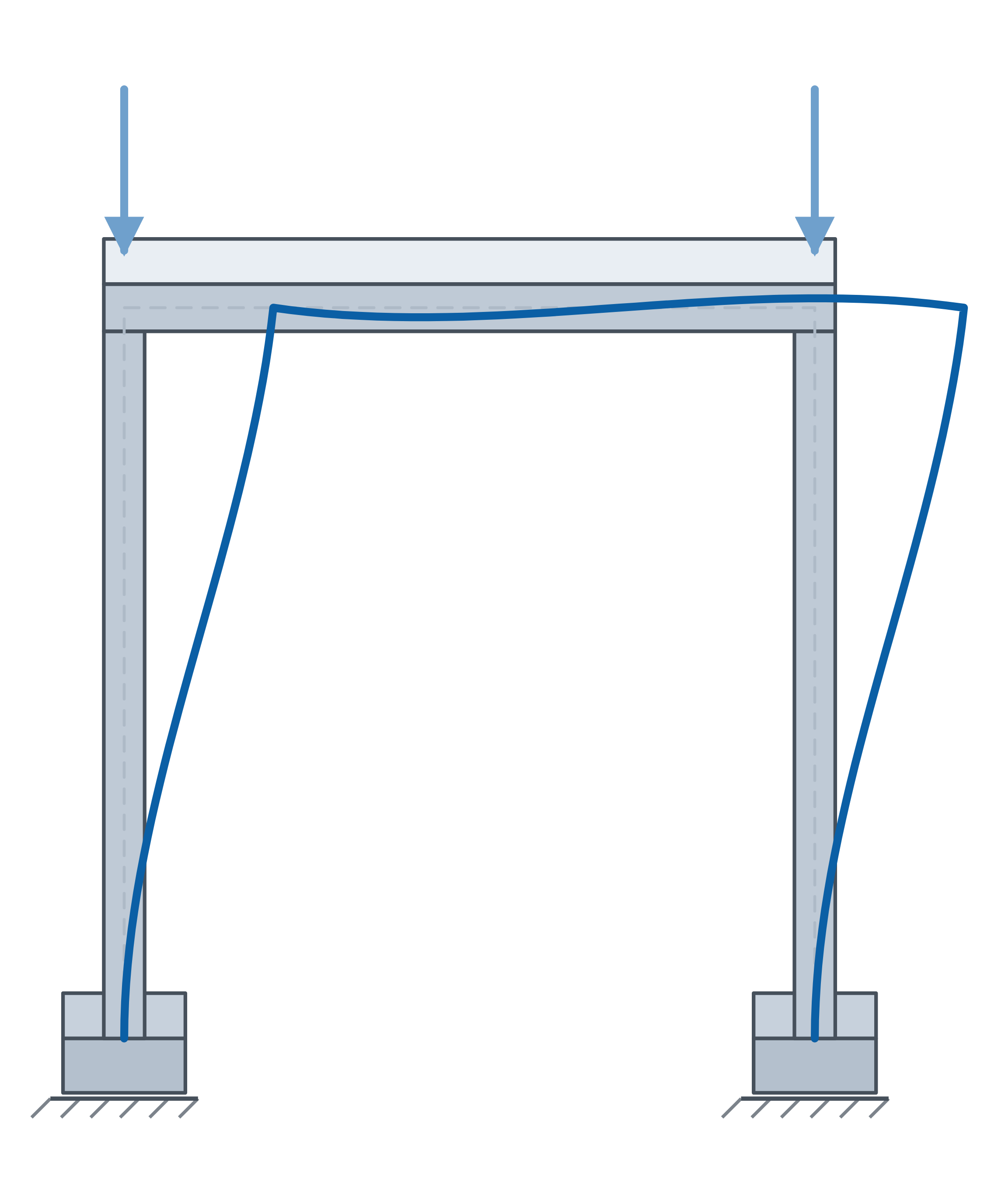
|
Running the eigenvalue method on a published steel benchmark frame (Ziemian & Ziemian, Frame 1) and reading critical load factors and effective lengths:
Keywords:
stability analysis eigenvalue method critical load factor effective length direct analysis method AISC 360-16 |
"""
Linear stability (eigenvalue) analysis of a steel portal frame.

Benchmark: Frame 1 "Single story portal frame" of the steel benchmark frames by
R.D. Ziemian and C.W. Ziemian, Benchmark Frames for Structural Analysis,
Mendeley Data, V1 (2021), doi:10.17632/39sjhchwtx.1 (CC BY 4.0). The frames
accompany C.W. Ziemian, R.D. Ziemian, Efficient geometric nonlinear elastic
analysis for design of steel structures: Benchmark studies, Journal of
Constructional Steel Research 186 (2021) 106870.

A fixed-base frame (span 30 ft, height 15 ft, W14x68 columns, W18x35 beam) carries
the LRFD combination 1.2D + 1.6Lr + 0.5W as point loads at the column tops. The
Structure Stability add-on computes the critical load factors with the eigenvalue
method twice:
  - load case 1 with the nominal stiffness EI
  - load case 2 with the stiffness reduction of the AISC 360-16 direct analysis
    method (0.8 tau_b EI), which is the stiffness the benchmark uses for its
    critical buckling load ratio

The example reads the results with get_result_table():
  - the critical load factors of both load cases, and the benchmark comparison
  - the effective lengths and critical loads of the members in the governing mode

Reference values for the critical load factor of load case 2:
  - Ziemian & Ziemian, linear buckling analysis           -> 7.857
  - RFEM eigenvalue method (this example)                  -> 7.855
"""
from math import inf

import pandas as pd
from dlubal.api import rfem, common

# --- Benchmark input (US customary units, converted to SI) ----------------
INCH = 0.0254                   # m
KIP = 4448.2216152605           # N

SPAN = 360 * INCH               # 30 ft
HEIGHT = 180 * INCH             # 15 ft
GRAVITY_LOAD = 348.49 * KIP     # 1.2D + 1.6Lr at each column top
WIND_LOAD = 34.849 * KIP        # 0.5W at the left column top

# The benchmark uses A36. Its elastic modulus E = 29,000 ksi is the only material
# property an eigenvalue analysis needs, and A992 from the RFEM library has the same E.
MATERIAL = 'A992 | ASTM A992/A992M-20'
COLUMN_SECTION = 'W 14x68'      # A = 20.0 in2, I = 722 in4
BEAM_SECTION = 'W 18x35'        # A = 10.3 in2, I = 510 in4

# Ziemian & Ziemian, critical buckling load ratio of Frame 1 (linear buckling analysis)
REFERENCE_CRITICAL_LOAD_FACTOR = 7.857


def define_structure() -> list:
    """Fixed-base portal frame in the XZ plane of a 2D model."""

    return [
        rfem.structure_core.Material(no=1, name=MATERIAL),
        # The benchmark neglects shear deformation
        rfem.structure_core.CrossSection(no=1, name=COLUMN_SECTION, material=1, shear_stiffness_deactivated=True),
        rfem.structure_core.CrossSection(no=2, name=BEAM_SECTION, material=1, shear_stiffness_deactivated=True),

        # Global Z points down (RFEM default), so the column tops lie at Z = -HEIGHT
        rfem.structure_core.Node(no=1, coordinate_1=0.0),
        rfem.structure_core.Node(no=2, coordinate_1=SPAN),
        rfem.structure_core.Node(no=3, coordinate_1=0.0, coordinate_3=-HEIGHT),
        rfem.structure_core.Node(no=4, coordinate_1=SPAN, coordinate_3=-HEIGHT),

        rfem.structure_core.Line(no=1, definition_nodes=[1, 3]),
        rfem.structure_core.Line(no=2, definition_nodes=[3, 4]),
        rfem.structure_core.Line(no=3, definition_nodes=[2, 4]),

        rfem.structure_core.Member(no=1, line=1, cross_section_start=1),     # left column
        rfem.structure_core.Member(no=2, line=2, cross_section_start=2),     # beam
        rfem.structure_core.Member(no=3, line=3, cross_section_start=1),     # right column

        rfem.types_for_nodes.NodalSupport(
            no=1,
            nodes=[1, 2],
            spring=common.Vector3d(x=inf, y=inf, z=inf),
            rotational_restraint=common.Vector3d(x=inf, y=inf, z=inf),
        ),
    ]


def define_stiffness_reduction() -> list:
    """AISC 360-16 direct analysis method stiffness reduction for all members."""

    return [
        rfem.types_for_members.MemberStiffnessModification(
            no=1,
            type=rfem.types_for_members.MemberStiffnessModification.TYPE_STEEL_STRUCTURES_AISC_360_16,
            structure_design_method=rfem.types_for_members.MemberStiffnessModification.STRUCTURE_DESIGN_METHOD_LRFD,
            structure_determine_tau_b=rfem.types_for_members.MemberStiffnessModification.STRUCTURE_DETERMINE_TAU_B_ITERATIVE,
        ),
        rfem.structure_advanced.StructureModification(
            no=1,
            user_defined_name_enabled=True,
            name='AISC 360-16 | 0.8 tau_b EI',
            modify_stiffnesses_members=True,
            modify_stiffnesses_member_table=rfem.structure_advanced.StructureModification.ModifyStiffnessesMemberTable(
                rows=[
                    rfem.structure_advanced.StructureModification.ModifyStiffnessesMemberTableRow(
                        no=1,
                        member_modification=1,
                        members=[1, 2, 3],
                    ),
                ]
            ),
        ),
    ]


def define_loading() -> list:
    """The benchmark loads in two load cases: nominal and reduced stiffness."""

    loading = [
        rfem.loading.StaticAnalysisSettings(
            no=1,
            analysis_type=rfem.loading.StaticAnalysisSettings.ANALYSIS_TYPE_GEOMETRICALLY_LINEAR,
        ),
        rfem.loading.StabilityAnalysisSettings(
            no=1,
            analysis_type=rfem.loading.StabilityAnalysisSettings.ANALYSIS_TYPE_EIGENVALUE_METHOD,
            number_of_lowest_eigenvalues=4,
        ),
        rfem.loading.LoadCase(
            no=1,
            name='1.2D + 1.6Lr + 0.5W | nominal EI',
            static_analysis_settings=1,
            stability_analysis_settings=1,
            calculate_critical_load=True,
            self_weight_active=False,
        ),
        rfem.loading.LoadCase(
            no=2,
            name='1.2D + 1.6Lr + 0.5W | AISC 360-16 reduced EI',
            static_analysis_settings=1,
            stability_analysis_settings=1,
            calculate_critical_load=True,
            self_weight_active=False,
            structure_modification_enabled=True,
            structure_modification=1,
        ),
    ]

    for lc in (1, 2):
        loading += [
            rfem.loads.NodalLoad(
                no=1,
                load_case=lc,
                nodes=[3, 4],
                load_direction=rfem.loads.NodalLoad.LOAD_DIRECTION_GLOBAL_Z_OR_USER_DEFINED_W_TRUE_LENGTH,
                force_magnitude=GRAVITY_LOAD,
            ),
            rfem.loads.NodalLoad(
                no=2,
                load_case=lc,
                nodes=[3],
                load_direction=rfem.loads.NodalLoad.LOAD_DIRECTION_GLOBAL_X_OR_USER_DEFINED_U_TRUE_LENGTH,
                force_magnitude=WIND_LOAD,
            ),
        ]
    return loading


with rfem.Application() as rfem_app:

    # Step 1: Create a new 2D model with the Structure Stability add-on.
    # The benchmark frame is planar and braced out of plane, so a 2D model in the
    # XZ plane excludes out-of-plane buckling of the members.
    rfem_app.close_all_models(save_changes=False)
    rfem_app.create_model(name='linear_stability_portal_frame')

    base_data = rfem_app.get_base_data()
    base_data.main.model_type = rfem.BaseData.Main.MODEL_TYPE_2D_XZ_PLANE_STRESS
    base_data.main.surfaces_active = False
    base_data.main.solids_active = False      # solids are not available in 2D models
    base_data.addons.structure_stability_active = True
    rfem_app.set_base_data(base_data=base_data)

    # Step 2: Create the structure, the stiffness reduction and the loading
    rfem_app.delete_all_objects()
    rfem_app.create_object_list(define_structure() + define_stiffness_reduction() + define_loading())

    # Step 3: Run the eigenvalue analysis
    calculation = rfem_app.calculate_all(skip_warnings=True)
    print(f"\nCalculation:\n{calculation}")

    # Step 4: Critical load factors of both load cases
    critical_load_factors = {}
    for lc in (1, 2):
        factors = rfem_app.get_result_table(
            table=rfem.results.ResultTable.STABILITY_ANALYSIS_CRITICAL_LOAD_FACTORS_TABLE,
            loading=rfem.ObjectId(no=lc, object_type=rfem.OBJECT_TYPE_LOAD_CASE),
        ).data
        print(f"\nCritical load factors | LC{lc}:\n{factors.to_string(index=False)}")
        critical_load_factors[lc] = float(factors.loc[pd.to_numeric(factors['mode_no']) == 1, 'f'].iloc[0])

    # 'f' is the critical load factor alpha_cr; 'alpha' is the amplification
    # factor 1 / (1 - 1 / alpha_cr) that second-order effects add to the forces.
    ratio = critical_load_factors[2] / critical_load_factors[1]
    deviation = (critical_load_factors[2] / REFERENCE_CRITICAL_LOAD_FACTOR - 1) * 100
    print(f"\nalpha_cr nominal EI:        {critical_load_factors[1]:.3f}")
    print(f"alpha_cr AISC 360-16 EI:    {critical_load_factors[2]:.3f}  (ratio {ratio:.3f})")
    print(f"Ziemian & Ziemian, Frame 1: {REFERENCE_CRITICAL_LOAD_FACTOR:.3f}  (deviation {deviation:+.2f} %)")

    # Step 5: Effective lengths and critical loads of the columns in mode 1 (sway).
    # The beam carries almost no axial force, so its values have no physical meaning.
    effective_lengths = rfem_app.get_result_table(
        table=rfem.results.ResultTable.STABILITY_ANALYSIS_EFFECTIVE_LENGTHS_AND_CRITICAL_LOADS_BY_MEMBER_TABLE,
        loading=rfem.ObjectId(no=2, object_type=rfem.OBJECT_TYPE_LOAD_CASE),
    ).data
    columns = effective_lengths[(pd.to_numeric(effective_lengths['mode_no']) == 1) & effective_lengths['member_no'].isin([1, 3])].copy()
    columns['L [ft]'] = columns['length'] / (12 * INCH)
    columns['L_cr [ft]'] = columns['effective_length_y'] / (12 * INCH)
    columns['K [-]'] = columns['effective_length_factor_y']
    columns['N_cr [kip]'] = columns['critical_load'] / KIP
    print("\nEffective lengths and critical loads of the columns | LC2, mode 1:")
    print(columns[['member_no', 'L [ft]', 'L_cr [ft]', 'K [-]', 'N_cr [kip]']].to_string(index=False, float_format='{:.2f}'.format))
using System.Globalization;
using Google.Protobuf;
using Common = Dlubal.Api.Common;
using Rfem = Dlubal.Api.Rfem;

// -------------------------------------------------------
// Linear stability (eigenvalue) analysis of a steel portal frame.
//
// Benchmark: Frame 1 "Single story portal frame" of the steel benchmark frames by
// R.D. Ziemian and C.W. Ziemian, Benchmark Frames for Structural Analysis,
// Mendeley Data, V1 (2021), doi:10.17632/39sjhchwtx.1 (CC BY 4.0). The frames
// accompany C.W. Ziemian, R.D. Ziemian, Efficient geometric nonlinear elastic
// analysis for design of steel structures: Benchmark studies, Journal of
// Constructional Steel Research 186 (2021) 106870.
//
// A fixed-base frame (span 30 ft, height 15 ft, W14x68 columns, W18x35 beam) carries
// the LRFD combination 1.2D + 1.6Lr + 0.5W as point loads at the column tops. The
// Structure Stability add-on computes the critical load factors with the eigenvalue
// method twice:
//   - load case 1 with the nominal stiffness EI
//   - load case 2 with the stiffness reduction of the AISC 360-16 direct analysis
//     method (0.8 tau_b EI), which is the stiffness the benchmark uses for its
//     critical buckling load ratio
//
// The example reads the results with get_result_table():
//   - the critical load factors of both load cases, and the benchmark comparison
//   - the effective lengths and critical loads of the members in the governing mode
//
// Reference values for the critical load factor of load case 2:
//   - Ziemian & Ziemian, linear buckling analysis           -> 7.857
//   - RFEM eigenvalue method (this example)                  -> 7.855
// -------------------------------------------------------

// --- Benchmark input (US customary units, converted to SI) ---
const double Inch = 0.0254;                     // m
const double Kip = 4448.2216152605;             // N

const double Span = 360 * Inch;                 // 30 ft
const double Height = 180 * Inch;               // 15 ft
const double GravityLoad = 348.49 * Kip;        // 1.2D + 1.6Lr at each column top
const double WindLoad = 34.849 * Kip;           // 0.5W at the left column top

// The benchmark uses A36. Its elastic modulus E = 29,000 ksi is the only material
// property an eigenvalue analysis needs, and A992 from the RFEM library has the same E.
const string Material = "A992 | ASTM A992/A992M-20";
const string ColumnSection = "W 14x68";         // A = 20.0 in2, I = 722 in4
const string BeamSection = "W 18x35";           // A = 10.3 in2, I = 510 in4

// Ziemian & Ziemian, critical buckling load ratio of Frame 1 (linear buckling analysis)
const double ReferenceCriticalLoadFactor = 7.857;

static List<IMessage> DefineStructure()
{
    // Fixed-base portal frame in the XZ plane of a 2D model.
    // Global Z points down (RFEM default), so the column tops lie at Z = -Height.
    return new List<IMessage>
    {
        new Rfem.StructureCore.Material { No = 1, Name = Material },
        // The benchmark neglects shear deformation
        new Rfem.StructureCore.CrossSection { No = 1, Name = ColumnSection, Material = 1, ShearStiffnessDeactivated = true },
        new Rfem.StructureCore.CrossSection { No = 2, Name = BeamSection, Material = 1, ShearStiffnessDeactivated = true },

        new Rfem.StructureCore.Node { No = 1, Coordinate1 = 0.0 },
        new Rfem.StructureCore.Node { No = 2, Coordinate1 = Span },
        new Rfem.StructureCore.Node { No = 3, Coordinate1 = 0.0, Coordinate3 = -Height },
        new Rfem.StructureCore.Node { No = 4, Coordinate1 = Span, Coordinate3 = -Height },

        new Rfem.StructureCore.Line { No = 1, DefinitionNodes = { 1, 3 } },
        new Rfem.StructureCore.Line { No = 2, DefinitionNodes = { 3, 4 } },
        new Rfem.StructureCore.Line { No = 3, DefinitionNodes = { 2, 4 } },

        new Rfem.StructureCore.Member { No = 1, Line = 1, CrossSectionStart = 1 },     // left column
        new Rfem.StructureCore.Member { No = 2, Line = 2, CrossSectionStart = 2 },     // beam
        new Rfem.StructureCore.Member { No = 3, Line = 3, CrossSectionStart = 1 },     // right column

        new Rfem.TypesForNodes.NodalSupport
        {
            No = 1,
            Nodes = { 1, 2 },
            Spring = new Common.Vector3d { X = double.PositiveInfinity, Y = double.PositiveInfinity, Z = double.PositiveInfinity },
            RotationalRestraint = new Common.Vector3d { X = double.PositiveInfinity, Y = double.PositiveInfinity, Z = double.PositiveInfinity },
        },
    };
}

static List<IMessage> DefineStiffnessReduction()
{
    // AISC 360-16 direct analysis method stiffness reduction for all members.
    return new List<IMessage>
    {
        new Rfem.TypesForMembers.MemberStiffnessModification
        {
            No = 1,
            Type = Rfem.TypesForMembers.MemberStiffnessModification.Types.Type.SteelStructuresAisc36016,
            StructureDesignMethod = Rfem.TypesForMembers.MemberStiffnessModification.Types.StructureDesignMethod.Lrfd,
            StructureDetermineTauB = Rfem.TypesForMembers.MemberStiffnessModification.Types.StructureDetermineTauB.Iterative,
        },
        new Rfem.StructureAdvanced.StructureModification
        {
            No = 1,
            UserDefinedNameEnabled = true,
            Name = "AISC 360-16 | 0.8 tau_b EI",
            ModifyStiffnessesMembers = true,
            ModifyStiffnessesMemberTable = new Rfem.StructureAdvanced.StructureModification.Types.ModifyStiffnessesMemberTable
            {
                Rows =
                {
                    new Rfem.StructureAdvanced.StructureModification.Types.ModifyStiffnessesMemberTableRow
                    {
                        No = 1,
                        MemberModification = 1,
                        Members = { 1, 2, 3 },
                    },
                },
            },
        },
    };
}

static List<IMessage> DefineLoading()
{
    // The benchmark loads in two load cases: nominal and reduced stiffness.
    var loading = new List<IMessage>
    {
        new Rfem.Loading.StaticAnalysisSettings
        {
            No = 1,
            AnalysisType = Rfem.Loading.StaticAnalysisSettings.Types.AnalysisType.GeometricallyLinear,
        },
        new Rfem.Loading.StabilityAnalysisSettings
        {
            No = 1,
            AnalysisType = Rfem.Loading.StabilityAnalysisSettings.Types.AnalysisType.EigenvalueMethod,
            NumberOfLowestEigenvalues = 4,
        },
        new Rfem.Loading.LoadCase
        {
            No = 1,
            Name = "1.2D + 1.6Lr + 0.5W | nominal EI",
            StaticAnalysisSettings = 1,
            StabilityAnalysisSettings = 1,
            CalculateCriticalLoad = true,
            SelfWeightActive = false,
        },
        new Rfem.Loading.LoadCase
        {
            No = 2,
            Name = "1.2D + 1.6Lr + 0.5W | AISC 360-16 reduced EI",
            StaticAnalysisSettings = 1,
            StabilityAnalysisSettings = 1,
            CalculateCriticalLoad = true,
            SelfWeightActive = false,
            StructureModificationEnabled = true,
            StructureModification = 1,
        },
    };

    foreach (var lc in new[] { 1, 2 })
    {
        loading.Add(new Rfem.Loads.NodalLoad
        {
            No = 1,
            LoadCase = lc,
            Nodes = { 3, 4 },
            LoadDirection = Rfem.Loads.NodalLoad.Types.LoadDirection.GlobalZOrUserDefinedWTrueLength,
            ForceMagnitude = GravityLoad,
        });
        loading.Add(new Rfem.Loads.NodalLoad
        {
            No = 2,
            LoadCase = lc,
            Nodes = { 3 },
            LoadDirection = Rfem.Loads.NodalLoad.Types.LoadDirection.GlobalXOrUserDefinedUTrueLength,
            ForceMagnitude = WindLoad,
        });
    }
    return loading;
}

static string Text(object? value) => Convert.ToString(value, CultureInfo.InvariantCulture) ?? "";

static double ParseDouble(object? value)
{
    // Table cells are strings formatted with the current culture; fall back to the invariant one.
    var text = Text(value);
    if (double.TryParse(text, NumberStyles.Float, CultureInfo.CurrentCulture, out var parsed)) return parsed;
    return double.TryParse(text, NumberStyles.Float, CultureInfo.InvariantCulture, out parsed) ? parsed : double.NaN;
}

// -------------------------------------------------------
// MAIN SCRIPT
// -------------------------------------------------------

ApplicationRfem? rfemApp = null;

try
{
    // Step 1: Create a new 2D model with the Structure Stability add-on.
    // The benchmark frame is planar and braced out of plane, so a 2D model in the
    // XZ plane excludes out-of-plane buckling of the members.
    rfemApp = new ApplicationRfem();
    rfemApp.close_all_models(saveChanges: false);
    rfemApp.create_model(name: "linear_stability_portal_frame");

    var baseData = rfemApp.get_base_data();
    baseData.Main.ModelType = Rfem.BaseData.Types.Main.Types.ModelType._2DXzPlaneStress;
    baseData.Main.SurfacesActive = false;
    baseData.Main.SolidsActive = false;     // solids are not available in 2D models
    baseData.Addons.StructureStabilityActive = true;
    rfemApp.set_base_data(baseData: baseData);

    // Step 2: Create the structure, the stiffness reduction and the loading
    rfemApp.delete_all_objects();
    var objects = DefineStructure();
    objects.AddRange(DefineStiffnessReduction());
    objects.AddRange(DefineLoading());
    rfemApp.create_object_list(objects);

    // Step 3: Run the eigenvalue analysis
    var calculation = rfemApp.calculate_all(skipWarnings: true);
    Console.WriteLine($"\nCalculation:\n{calculation}");

    // Step 4: Critical load factors of both load cases
    var criticalLoadFactors = new Dictionary<int, double>();
    foreach (var lc in new[] { 1, 2 })
    {
        var factors = rfemApp.get_result_table(
            table: Rfem.Results.ResultTable.StabilityAnalysisCriticalLoadFactorsTable,
            loading: new Rfem.ObjectId { No = lc, ObjectType = Rfem.ObjectType.LoadCase });
        Console.WriteLine($"\nCritical load factors | LC{lc}:");
        factors.Print();

        var mode1 = factors.Data.Rows.FirstOrDefault(row => ParseDouble(row["mode_no"]) == 1);
        if (mode1 is null) { Console.WriteLine($"Mode 1 not found for LC{lc}."); return; }
        criticalLoadFactors[lc] = ParseDouble(mode1["f"]);
    }

    // 'f' is the critical load factor alpha_cr; 'alpha' is the amplification
    // factor 1 / (1 - 1 / alpha_cr) that second-order effects add to the forces.
    var ratio = criticalLoadFactors[2] / criticalLoadFactors[1];
    var deviation = (criticalLoadFactors[2] / ReferenceCriticalLoadFactor - 1) * 100;
    Console.WriteLine($"\nalpha_cr nominal EI:        {criticalLoadFactors[1]:F3}");
    Console.WriteLine($"alpha_cr AISC 360-16 EI:    {criticalLoadFactors[2]:F3}  (ratio {ratio:F3})");
    Console.WriteLine($"Ziemian & Ziemian, Frame 1: {ReferenceCriticalLoadFactor:F3}  (deviation {deviation:+0.00;-0.00} %)");

    // Step 5: Effective lengths and critical loads of the columns in mode 1 (sway).
    // The beam carries almost no axial force, so its values have no physical meaning.
    var effectiveLengths = rfemApp.get_result_table(
        table: Rfem.Results.ResultTable.StabilityAnalysisEffectiveLengthsAndCriticalLoadsByMemberTable,
        loading: new Rfem.ObjectId { No = 2, ObjectType = Rfem.ObjectType.LoadCase });

    Console.WriteLine("\nEffective lengths and critical loads of the columns | LC2, mode 1:");
    Console.WriteLine($"{"member_no",10}{"L [ft]",9}{"L_cr [ft]",11}{"K [-]",8}{"N_cr [kip]",12}");
    foreach (var row in effectiveLengths.Data.Rows.Where(row => ParseDouble(row["mode_no"]) == 1))
    {
        var memberNo = (int)ParseDouble(row["member_no"]);
        if (memberNo != 1 && memberNo != 3) continue;

        Console.WriteLine(
            $"{memberNo,10}" +
            $"{ParseDouble(row["length"]) / (12 * Inch),9:F2}" +
            $"{ParseDouble(row["effective_length_y"]) / (12 * Inch),11:F2}" +
            $"{ParseDouble(row["effective_length_factor_y"]),8:F2}" +
            $"{ParseDouble(row["critical_load"]) / Kip,12:F2}");
    }
}
catch (Exception ex)
{
    Console.WriteLine($"Error: {ex.Message}");
}
finally
{
    if (rfemApp != null) rfemApp.close_connection();
}