
Column Flexural Buckling#
|
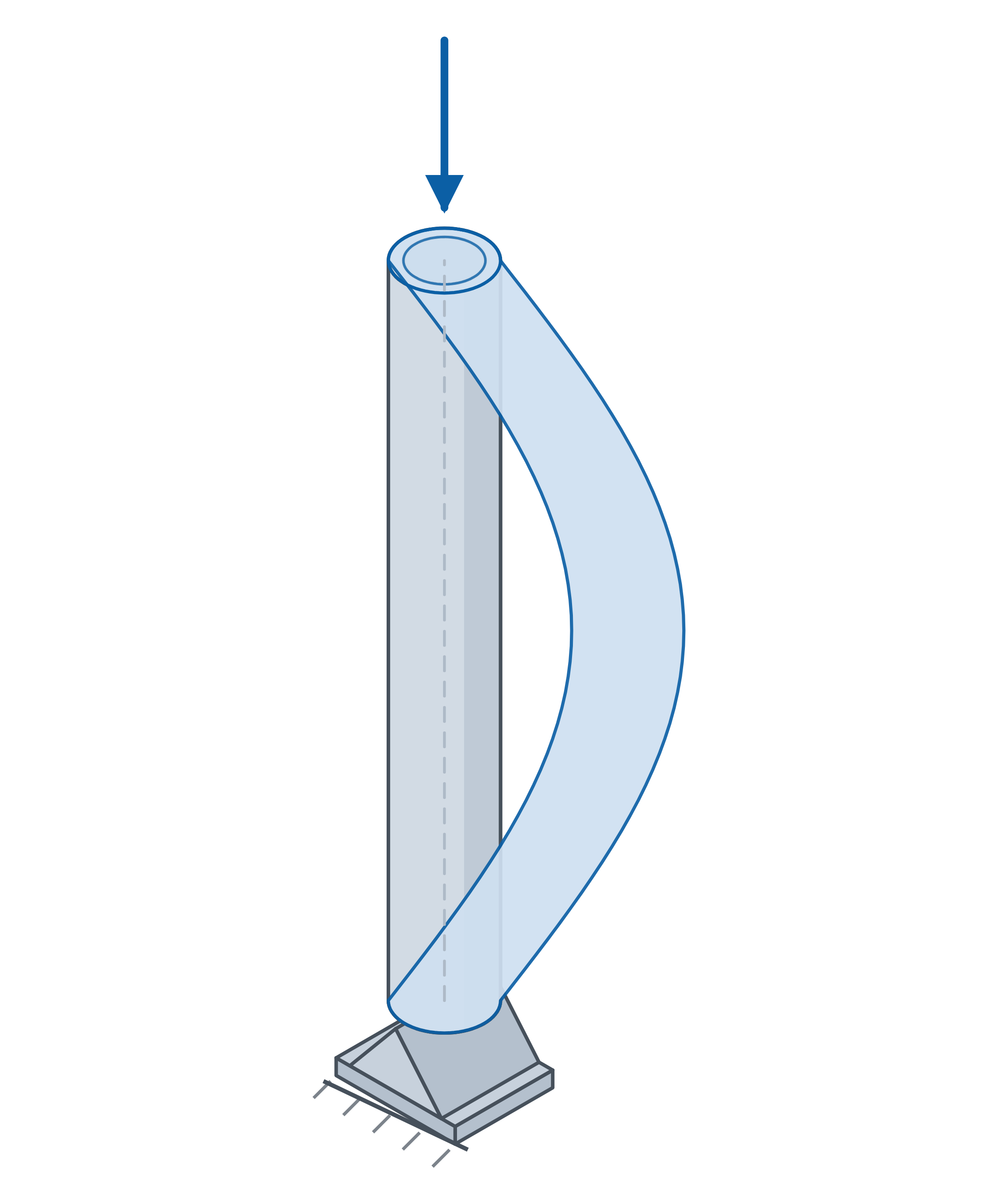
Checking a pinned aluminum column with a circular hollow section for flexural buckling acc. to EN 1999-1-1, 6.3.1:
Keywords:
aluminum design material library EN 1999 flexural buckling effective lengths buckling class |
Note
The material library contains several aluminum materials with the same name, for
example from the product standards. Only the materials of EN 1999-1-1 are valid in the
Aluminum Design add-on, therefore the standard is part of the material name:
EN AW-6082 T4 | EN 1999-1-1:2007.
Reference: hand calculation acc. to EN 1999-1-1:2007 printed by the script. The example is taken from the JRC workshop on EN 1999-1-1 (2025), which follows the second generation EN 1999-1-1:2023 with a different buckling class. The results of RFEM agree with the hand calculation within 0.1 %.
from dlubal.api import rfem, common
from math import inf, pi, sqrt
import pandas

# -------------------------------------------------------
# This example demonstrates the flexural buckling check of a pinned aluminium column
# with a circular hollow section acc. to EN 1999-1-1 (CEN, recommended values), 6.3.1.
#
# Reference:
#   JRC / BSI workshop on the second generation of Eurocodes, EN 1999-1-1
#   (June 2025), worked example "Buckling resistance - aluminium column".
#
#   CHS 89 x 4.7, EN AW-6082 T4 (f_o = 110 MPa), pinned at both ends, L = 3.0 m,
#   axial design force N_Ed = 30 kN, gamma_M1 = 1.1.
#
# RFEM implements EN 1999-1-1:2007+A1:2009, the workshop example follows EN 1999-1-1:2023,
# where 6082-T4 moves from buckling class B to class C. The reference values below are
# therefore recalculated with the formulas of the 2007 edition (class B: alpha = 0.32,
# lambda_0 = 0.0) and the section properties of the example; the result of the workshop
# (N_b,Rd = 46.65 kN, class C) is printed for information.
# -------------------------------------------------------


COLUMN_LENGTH = 3.0     # m
N_ED = 30.0e3           # N

# Reference calculation acc. to EN 1999-1-1:2007, 6.3.1 (SI units)
E = 70000e6             # Pa
F_O = 110e6             # Pa, 0.2 % proof strength of EN AW-6082 T4
GAMMA_M1 = 1.10
D, T = 0.089, 0.0047    # m
AREA = pi / 4 * (D**2 - (D - 2 * T)**2)
INERTIA = pi / 64 * (D**4 - (D - 2 * T)**4)
N_CR = pi**2 * E * INERTIA / COLUMN_LENGTH**2
LAMBDA = sqrt(AREA * F_O / N_CR)
ALPHA, LAMBDA_0 = 0.32, 0.0     # buckling class B, Table 6.6
PHI = 0.5 * (1 + ALPHA * (LAMBDA - LAMBDA_0) + LAMBDA**2)
CHI = 1 / (PHI + sqrt(PHI**2 - LAMBDA**2))
N_B_RD = CHI * AREA * F_O / GAMMA_M1

# Keys of the design check details (the section is symmetric, buckling about y governs equally)
REFERENCE = {
    "n_cr_y": (N_CR / 1e3, "kN", "Elastic critical force N_cr"),
    "lambdaand_773_y": (LAMBDA, "-", "Relative slenderness"),
    "phi": (PHI, "-", "Value phi"),
    "chi_y": (CHI, "-", "Reduction factor chi"),
    "n_y_b_rd": (N_B_RD / 1e3, "kN", "Buckling resistance N_b,Rd"),
    "eta": (N_ED / N_B_RD, "-", "Design ratio"),
}
REFERENCE_2023 = 46.65  # kN, workshop result acc. to EN 1999-1-1:2023 (buckling class C)
UNIT_SCALE = {"-": 1.0, "kN": 1e3}


def define_structure() -> list:

    return [

        # The suffix selects the material of EN 1999-1-1 in the library. Without it, the
        # entry of the product standard with the same name is used, which the aluminum
        # design add-on does not accept.
        rfem.structure_core.Material(
            no=1,
            name="EN AW-6082 T4 | EN 1999-1-1:2007",
        ),
        rfem.structure_core.CrossSection(
            no=1,
            name="CHS 89/4.7/H",
            material=1,
        ),

        rfem.structure_core.Node(no=1),
        rfem.structure_core.Node(no=2, coordinate_3=-COLUMN_LENGTH),
        rfem.structure_core.Line(no=1, definition_nodes=[1, 2]),
        rfem.structure_core.Member(no=1, line=1, cross_section_start=1),

        rfem.types_for_nodes.NodalSupport(
            no=1,
            user_defined_name_enabled=True,
            name="Pinned base",
            nodes=[1],
            spring=common.Vector3d(x=inf, y=inf, z=inf),
            rotational_restraint=common.Vector3d(x=0, y=0, z=inf),
        ),
        rfem.types_for_nodes.NodalSupport(
            no=2,
            user_defined_name_enabled=True,
            name="Held horizontally",
            nodes=[2],
            spring=common.Vector3d(x=inf, y=inf, z=0),
            rotational_restraint=common.Vector3d(x=0, y=0, z=0),
        ),
    ]


def define_loading() -> list:

    return [

        rfem.loading.StaticAnalysisSettings(no=1),
        rfem.loading.LoadCase(
            no=1,
            name="Design load N_Ed",
            static_analysis_settings=1,
            self_weight_active=False,
        ),
        rfem.loading.DesignSituation(
            no=1,
            design_situation_type=rfem.loading.DesignSituation.DESIGN_SITUATION_TYPE_STR_PERMANENT_AND_TRANSIENT_6_10,
        ),
        rfem.loading.LoadCombination(
            no=1,
            name="N_Ed",
            design_situation=1,
            static_analysis_settings=1,
            combination_rule_str="LC1",
        ),
        rfem.loads.NodalLoad(
            no=1,
            load_case=1,
            nodes=[2],
            load_direction=rfem.loads.NodalLoad.LOAD_DIRECTION_GLOBAL_Z_OR_USER_DEFINED_W_TRUE_LENGTH,
            force_magnitude=N_ED,
        ),
    ]


def define_aluminum_design() -> list:

    return [

        rfem.aluminum_design_objects.AluminumDesignUlsConfiguration(
            no=1,
            assigned_to_all_members=True,
        ),
        rfem.aluminum_design.AluminumEffectiveLengths(
            no=1,
            members=[1],
            flexural_buckling_about_y=True,
            flexural_buckling_about_z=True,
            torsional_buckling=False,
            lateral_torsional_buckling=False,
        ),
    ]


def get_check_details(rfem_app: rfem.Application, design_ratios_df: pandas.DataFrame, check_type: str) -> tuple:
    """
    Returns the governing row of the given check type and the rows of the section
    'Design Check Values' of its design check details.
    """
    rows = design_ratios_df[design_ratios_df["design_check_type"] == check_type]
    governing = rows.loc[rows["design_ratio"].idxmax()]
    details_df = rfem_app.get_results(
        results_type=rfem.results.ALUMINUM_DESIGN_DESIGN_CHECK_DETAILS,
        filters=[
            rfem.results.ResultsFilter(
                column_id="design_check_details_id",
                filter_expression=str(governing["design_check_details_id"]),
            )
        ],
    ).data
    start = details_df.index[details_df["key"] == "design_check_values"][0]
    return governing, details_df.loc[start:]


def print_comparison(check_values_df: pandas.DataFrame, reference: dict) -> None:
    """
    Prints the RFEM values next to the reference values with their deviation.
    The column 'value' holds the rounded display value as text, so the full-precision
    column 'value_si' is used and converted to the unit of the reference.
    """
    print(f"\n{'Quantity':<45}{'RFEM':>12}{'Reference':>12}{'Deviation':>12}")
    for key, (ref_value, unit, caption) in reference.items():
        row = check_values_df.loc[check_values_df["key"] == key].iloc[0]
        rfem_value = float(row["value_si"]) / UNIT_SCALE[unit]
        deviation = (rfem_value - ref_value) / ref_value * 100
        print(f"{caption + ' [' + unit + ']':<45}{rfem_value:>12.3f}{ref_value:>12.3f}{deviation:>11.1f}%")


# -------------------------------------------------------
# MAIN SCRIPT
# -------------------------------------------------------

with rfem.Application() as rfem_app:

    rfem_app.create_model(name="aluminum_design_column_flexural_buckling")

    base_data = rfem_app.get_base_data()
    base_data.addons.aluminum_design_active = True
    base_data.standards.aluminum_design_standard = rfem.BaseData.Standards.ALUMINUM_DESIGN_NATIONAL_ANNEX_AND_EDITION_EN_1999_CEN_2013_12_STANDARD
    rfem_app.set_base_data(base_data=base_data)

    rfem_app.delete_all_objects()
    rfem_app.create_object_list(
        objs=
            define_structure() +
            define_loading() +
            define_aluminum_design()
    )

    calculation_info = rfem_app.calculate_all(skip_warnings=True)
    if not calculation_info.succeeded:
        plausibility = rfem_app.plausibility_check(
            type=common.PlausibilityCheckType.PLAUSIBILITY_CHECK_PLAUSIBILITY_CHECK,
            skip_warnings=False,
        )
        raise RuntimeError(f"Calculation failed: {plausibility.message}\n{plausibility.data}")

    design_ratios_df = rfem_app.get_results(
        results_type=rfem.results.ALUMINUM_DESIGN_MEMBERS_DESIGN_RATIOS,
    ).data
    summary = design_ratios_df.sort_values("design_ratio", ascending=False).drop_duplicates("design_check_type")
    print("\nGoverning design ratios per check type:")
    print(summary[["design_check_type", "design_ratio", "design_check_description"]].to_string(index=False))

    # Details of flexural buckling, compared with the calculation acc. to EN 1999-1-1:2007
    check_type = "ST1100.00"  # Flexural buckling about principal y-axis acc. to 6.3.1.1 and 6.3.1.2
    governing, check_values_df = get_check_details(rfem_app, design_ratios_df, check_type)
    print(f"\n{check_type} | {governing['design_check_description']} | comparison with EN 1999-1-1:2007:")
    print_comparison(check_values_df, REFERENCE)
    print(f"\nFor information, N_b,Rd acc. to EN 1999-1-1:2023 (buckling class C, workshop): {REFERENCE_2023:.2f} kN")
using System.Globalization;
using Google.Protobuf;
using Microsoft.Data.Analysis;
using Common = Dlubal.Api.Common;
using Rfem = Dlubal.Api.Rfem;

// -------------------------------------------------------
// This example demonstrates the flexural buckling check of a pinned aluminium column
// with a circular hollow section acc. to EN 1999-1-1 (CEN, recommended values), 6.3.1.
//
// Reference:
//   JRC / BSI workshop on the second generation of Eurocodes, EN 1999-1-1
//   (June 2025), worked example "Buckling resistance - aluminium column".
//
//   CHS 89 x 4.7, EN AW-6082 T4 (f_o = 110 MPa), pinned at both ends, L = 3.0 m,
//   axial design force N_Ed = 30 kN, gamma_M1 = 1.1.
//
// RFEM implements EN 1999-1-1:2007+A1:2009, the workshop example follows EN 1999-1-1:2023,
// where 6082-T4 moves from buckling class B to class C. The reference values below are
// therefore recalculated with the formulas of the 2007 edition (class B: alpha = 0.32,
// lambda_0 = 0.0) and the section properties of the example; the result of the workshop
// (N_b,Rd = 46.65 kN, class C) is printed for information.
// -------------------------------------------------------


const double COLUMN_LENGTH = 3.0;     // m
const double N_ED = 30.0e3;           // N

// Reference calculation acc. to EN 1999-1-1:2007, 6.3.1 (SI units)
const double E = 70000e6;             // Pa
const double F_O = 110e6;             // Pa, 0.2 % proof strength of EN AW-6082 T4
const double GAMMA_M1 = 1.10;
const double D = 0.089, T = 0.0047;   // m
double AREA = Math.PI / 4 * (Math.Pow(D, 2) - Math.Pow(D - 2 * T, 2));
double INERTIA = Math.PI / 64 * (Math.Pow(D, 4) - Math.Pow(D - 2 * T, 4));
double N_CR = Math.Pow(Math.PI, 2) * E * INERTIA / Math.Pow(COLUMN_LENGTH, 2);
double LAMBDA = Math.Sqrt(AREA * F_O / N_CR);
const double ALPHA = 0.32, LAMBDA_0 = 0.0;     // buckling class B, Table 6.6
double PHI = 0.5 * (1 + ALPHA * (LAMBDA - LAMBDA_0) + Math.Pow(LAMBDA, 2));
double CHI = 1 / (PHI + Math.Sqrt(Math.Pow(PHI, 2) - Math.Pow(LAMBDA, 2)));
double N_B_RD = CHI * AREA * F_O / GAMMA_M1;

// Keys of the design check details (the section is symmetric, buckling about y governs equally)
var REFERENCE = new List<(string Key, double Value, string Unit, string Caption)>
{
    ("n_cr_y", N_CR / 1e3, "kN", "Elastic critical force N_cr"),
    ("lambdaand_773_y", LAMBDA, "-", "Relative slenderness"),
    ("phi", PHI, "-", "Value phi"),
    ("chi_y", CHI, "-", "Reduction factor chi"),
    ("n_y_b_rd", N_B_RD / 1e3, "kN", "Buckling resistance N_b,Rd"),
    ("eta", N_ED / N_B_RD, "-", "Design ratio"),
};
const double REFERENCE_2023 = 46.65;  // kN, workshop result acc. to EN 1999-1-1:2023 (buckling class C)


static List<IMessage> DefineStructure()
{
    return new List<IMessage>
    {
        // The suffix selects the material of EN 1999-1-1 in the library. Without it, the
        // entry of the product standard with the same name is used, which the aluminum
        // design add-on does not accept.
        new Rfem.StructureCore.Material
        {
            No = 1,
            Name = "EN AW-6082 T4 | EN 1999-1-1:2007",
        },
        new Rfem.StructureCore.CrossSection
        {
            No = 1,
            Name = "CHS 89/4.7/H",
            Material = 1,
        },

        new Rfem.StructureCore.Node { No = 1 },
        new Rfem.StructureCore.Node { No = 2, Coordinate3 = -COLUMN_LENGTH },
        new Rfem.StructureCore.Line { No = 1, DefinitionNodes = { 1, 2 } },
        new Rfem.StructureCore.Member { No = 1, Line = 1, CrossSectionStart = 1 },

        new Rfem.TypesForNodes.NodalSupport
        {
            No = 1,
            UserDefinedNameEnabled = true,
            Name = "Pinned base",
            Nodes = { 1 },
            SpringX = double.PositiveInfinity,
            SpringY = double.PositiveInfinity,
            SpringZ = double.PositiveInfinity,
            RotationalRestraintX = 0,
            RotationalRestraintY = 0,
            RotationalRestraintZ = double.PositiveInfinity,
        },
        new Rfem.TypesForNodes.NodalSupport
        {
            No = 2,
            UserDefinedNameEnabled = true,
            Name = "Held horizontally",
            Nodes = { 2 },
            SpringX = double.PositiveInfinity,
            SpringY = double.PositiveInfinity,
            SpringZ = 0,
            RotationalRestraintX = 0,
            RotationalRestraintY = 0,
            RotationalRestraintZ = 0,
        },
    };
}


static List<IMessage> DefineLoading()
{
    return new List<IMessage>
    {
        new Rfem.Loading.StaticAnalysisSettings { No = 1 },
        new Rfem.Loading.LoadCase
        {
            No = 1,
            Name = "Design load N_Ed",
            StaticAnalysisSettings = 1,
            SelfWeightActive = false,
        },
        new Rfem.Loading.DesignSituation
        {
            No = 1,
            DesignSituationType = Rfem.Loading.DesignSituation.Types.DesignSituationType.StrPermanentAndTransient610,
        },
        new Rfem.Loading.LoadCombination
        {
            No = 1,
            Name = "N_Ed",
            DesignSituation = 1,
            StaticAnalysisSettings = 1,
            CombinationRuleStr = "LC1",
        },
        new Rfem.Loads.NodalLoad
        {
            No = 1,
            LoadCase = 1,
            Nodes = { 2 },
            LoadDirection = Rfem.Loads.NodalLoad.Types.LoadDirection.GlobalZOrUserDefinedWTrueLength,
            ForceMagnitude = N_ED,
        },
    };
}


static List<IMessage> DefineAluminumDesign()
{
    return new List<IMessage>
    {
        new Rfem.AluminumDesignObjects.AluminumDesignUlsConfiguration
        {
            No = 1,
            AssignedToAllMembers = true,
        },
        new Rfem.AluminumDesign.AluminumEffectiveLengths
        {
            No = 1,
            Members = { 1 },
            FlexuralBucklingAboutY = true,
            FlexuralBucklingAboutZ = true,
            TorsionalBuckling = false,
            LateralTorsionalBuckling = false,
        },
    };
}


static double ToDouble(object? cell) => Convert.ToDouble(cell, CultureInfo.InvariantCulture);
static string ToText(object? cell) => cell?.ToString() ?? string.Empty;


// Returns the governing row of the given check type and the rows of the section
// 'Design Check Values' of its design check details.
static (DataFrameRow Governing, List<DataFrameRow> CheckValues) GetCheckDetails(
    ApplicationRfem rfemApp, DataFrame designRatios, string checkType)
{
    var governing = designRatios.Rows
        .Where(row => ToText(row["design_check_type"]) == checkType)
        .OrderByDescending(row => ToDouble(row["design_ratio"]))
        .First();
    Common.Table details = rfemApp.get_results(
        resultsType: Rfem.Results.ResultsType.AluminumDesignDesignCheckDetails,
        filters: new List<Rfem.Results.ResultsFilter>
        {
            new Rfem.Results.ResultsFilter
            {
                ColumnId = "design_check_details_id",
                FilterExpression = ToText(governing["design_check_details_id"]),
            },
        }
    );
    var checkValues = details.Data.Rows
        .SkipWhile(row => ToText(row["key"]) != "design_check_values")
        .ToList();
    return (governing, checkValues);
}


// Prints the RFEM values next to the reference values with their deviation.
// The column 'value' holds the rounded display value as text, so the full-precision
// column 'value_si' is used and converted to the unit of the reference.
static void PrintComparison(List<DataFrameRow> checkValues, List<(string Key, double Value, string Unit, string Caption)> reference)
{
    var unitScale = new Dictionary<string, double> { ["-"] = 1.0, ["kN"] = 1e3 };

    Console.WriteLine($"\n{"Quantity",-45}{"RFEM",12}{"Reference",12}{"Deviation",12}");
    foreach (var (key, refValue, unit, caption) in reference)
    {
        var row = checkValues.First(r => ToText(r["key"]) == key);
        double rfemValue = ToDouble(row["value_si"]) / unitScale[unit];
        double deviation = (rfemValue - refValue) / refValue * 100;
        Console.WriteLine(string.Format(CultureInfo.InvariantCulture,
            "{0,-45}{1,12:F3}{2,12:F3}{3,11:F1}%", $"{caption} [{unit}]", rfemValue, refValue, deviation));
    }
}


// -------------------------------------------------------
// MAIN SCRIPT
// -------------------------------------------------------

ApplicationRfem? rfemApp = null;

try
{
    rfemApp = new ApplicationRfem();

    rfemApp.create_model(name: "aluminum_design_column_flexural_buckling");

    var baseData = rfemApp.get_base_data();
    baseData.Addons.AluminumDesignActive = true;
    baseData.Standards.AluminumDesignStandard = Rfem.BaseData.Types.Standards.Types.AluminumDesignStandard.AluminumDesignNationalAnnexAndEditionEn1999Cen201312Standard;
    rfemApp.set_base_data(baseData: baseData);

    rfemApp.delete_all_objects();
    rfemApp.create_object_list(
        DefineStructure()
            .Concat(DefineLoading())
            .Concat(DefineAluminumDesign())
            .ToList()
    );

    var calculationInfo = rfemApp.calculate_all(skipWarnings: true);
    if (!calculationInfo.Succeeded)
    {
        var plausibility = rfemApp.plausibility_check(
            type: Common.PlausibilityCheckType.PlausibilityCheckPlausibilityCheck,
            skipWarnings: false
        );
        throw new Exception($"Calculation failed: {plausibility.Message}\n{plausibility.Data}");
    }

    Common.Table designRatios = rfemApp.get_results(
        resultsType: Rfem.Results.ResultsType.AluminumDesignMembersDesignRatios
    );
    Console.WriteLine("\nGoverning design ratios per check type:");
    foreach (var row in designRatios.Data.Rows
        .GroupBy(row => ToText(row["design_check_type"]))
        .Select(group => group.OrderByDescending(row => ToDouble(row["design_ratio"])).First())
        .OrderByDescending(row => ToDouble(row["design_ratio"])))
    {
        Console.WriteLine(string.Format(CultureInfo.InvariantCulture, "{0,-12}{1,8:F3}  {2}",
            row["design_check_type"], ToDouble(row["design_ratio"]), row["design_check_description"]));
    }

    // Details of flexural buckling, compared with the calculation acc. to EN 1999-1-1:2007
    string checkType = "ST1100.00";  // Flexural buckling about principal y-axis acc. to 6.3.1.1 and 6.3.1.2
    var (governing, checkValues) = GetCheckDetails(rfemApp, designRatios.Data, checkType);
    Console.WriteLine($"\n{checkType} | {governing["design_check_description"]} | comparison with EN 1999-1-1:2007:");
    PrintComparison(checkValues, REFERENCE);
    Console.WriteLine(string.Format(CultureInfo.InvariantCulture,
        "\nFor information, N_b,Rd acc. to EN 1999-1-1:2023 (buckling class C, workshop): {0:F2} kN", REFERENCE_2023));
}
catch (Exception ex)
{
    Console.WriteLine($"Error: {ex.Message}");
}
finally
{
    if (rfemApp != null) rfemApp.close_connection();
}