
Objects to Design and Exclude#
|
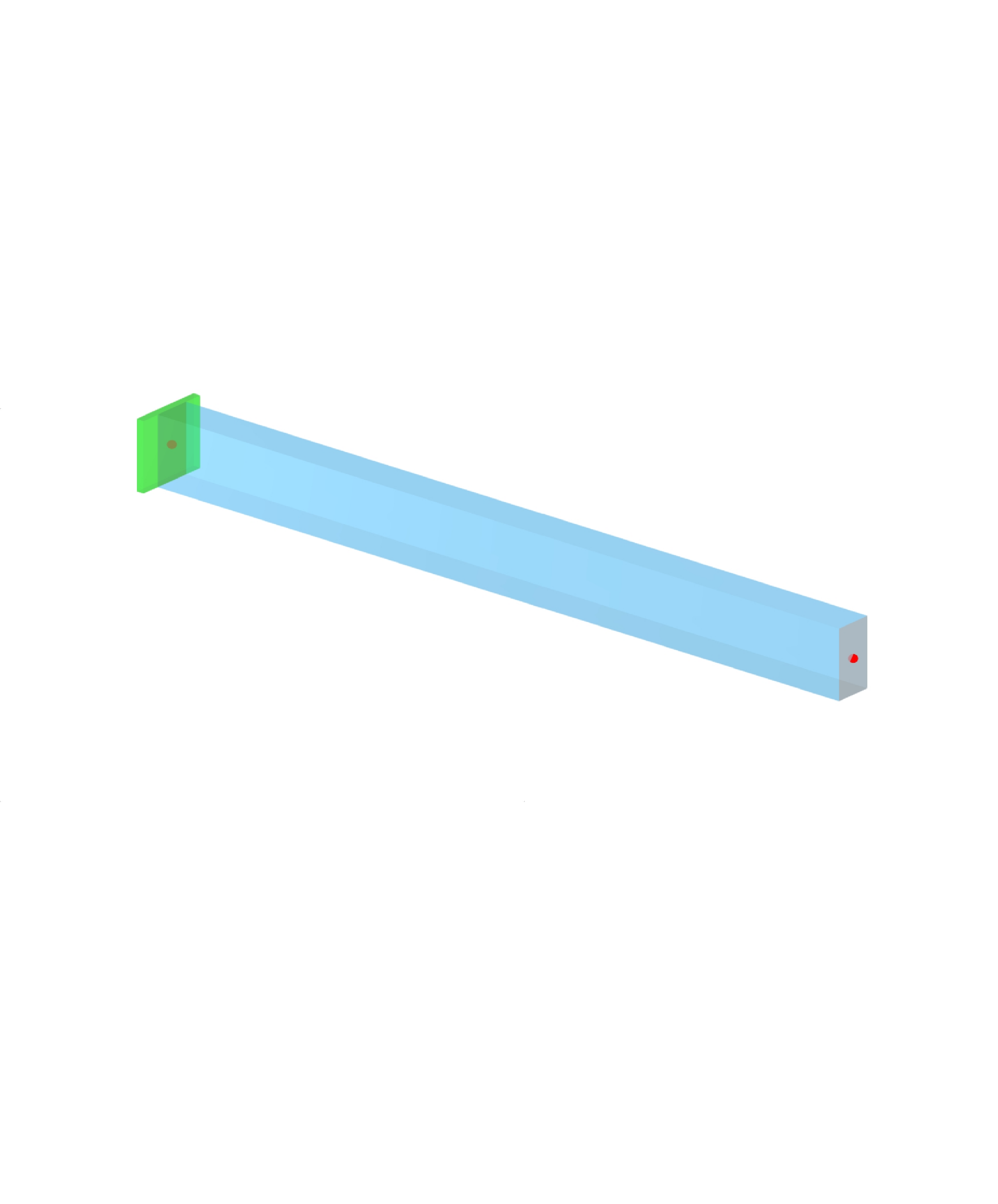
This example demonstrates how to read and modify the two input tables which every design add-on uses to narrow down what is designed:
Keywords:
objects to design objects to exclude design add-on steel design load combination design situation |
Note
Both tables are common to all design add-ons - the add-on is selected with the
addon argument of get_objects_to_design() / get_objects_to_exclude().
Add-ons which design whole model objects (Steel Joints, Component Design, Craneway
Design, Concrete Foundations) have no Objects to Design table; there the selection
is an attribute of the object itself (SteelJoint.to_design, Craneway.to_design, …).
The add-on has to be active in the base data, otherwise both methods report that it is not active.
from dlubal.api import rfem, common
from math import inf
import pandas


# -------------------------------------------------------
# This example demonstrates how to read and modify the two
# input tables of a design add-on:
#   Objects to Design  - which objects the add-on designs,
#                        one row per object type and role
#   Objects to Exclude - which objects are excluded from the
#                        design of a design situation or a
#                        load combination, one row per case object
#
# Add-ons which design whole model objects (Steel Joints,
# Component Design, Craneway Design, Concrete Foundations) have no
# Objects to Design table - there the selection is an attribute of
# the object itself (SteelJoint.to_design, Craneway.to_design, ...).
#
# The model is a two-span beam (members 1 and 2) loaded in two load
# combinations (CO1 and CO2), so all four member/combination pairs could
# be designed. Both tables narrow this down step by step:
#   Objects to Design  - member 2 is removed from the design
#   Objects to Exclude - member 1 is excluded from CO2
# After the calculation only member 1 in CO1 has design results.
# -------------------------------------------------------

ADDON = rfem.DesignAddons.STEEL_DESIGN

DISTRIBUTED_LOAD = 10000.0  # N/m


def define_structure_objects() -> list:

    # Two-span beam, 2 x 5 m: pinned at the left end, rollers at the middle
    # support and at the right end.

    return [
        rfem.structure_core.Material(no=1, name="S235 | EN 1993-1-1:2005-05"),
        rfem.structure_core.CrossSection(no=1, name="IPE 200", material=1),

        rfem.structure_core.Node(no=1, coordinate_1=0.0, coordinate_2=0.0, coordinate_3=0.0),
        rfem.structure_core.Node(no=2, coordinate_1=5.0, coordinate_2=0.0, coordinate_3=0.0),
        rfem.structure_core.Node(no=3, coordinate_1=10.0, coordinate_2=0.0, coordinate_3=0.0),

        rfem.structure_core.Line(no=1, definition_nodes=[1, 2]),
        rfem.structure_core.Line(no=2, definition_nodes=[2, 3]),

        rfem.structure_core.Member(no=1, line=1, cross_section_start=1),
        rfem.structure_core.Member(no=2, line=2, cross_section_start=1),

        rfem.types_for_nodes.NodalSupport(
            no=1,
            nodes=[1],
            spring=common.Vector3d(x=inf, y=inf, z=inf),
            rotational_restraint=common.Vector3d(x=inf, y=0.0, z=0.0),
        ),
        rfem.types_for_nodes.NodalSupport(
            no=2,
            nodes=[2, 3],
            spring=common.Vector3d(x=0.0, y=inf, z=inf),
            rotational_restraint=common.Vector3d(x=inf, y=0.0, z=0.0),
        ),
    ]


def define_loading_objects() -> list:

    # One load case with a uniform load on both spans, evaluated in two load
    # combinations. CO2 is the governing one - unless the member is excluded
    # from it further below.

    return [
        rfem.loading.StaticAnalysisSettings(no=1),

        rfem.loading.LoadCase(
            no=1,
            name="LC1",
            static_analysis_settings=1,
            self_weight_active=False,
        ),

        rfem.loading.DesignSituation(
            no=1,
            user_defined_name_enabled=True,
            name="ULS - Permanent and transient",
            design_situation_type=rfem.loading.DesignSituation.DESIGN_SITUATION_TYPE_STR_PERMANENT_AND_TRANSIENT_6_10,
        ),

        rfem.loading.LoadCombination(no=1, design_situation=1, name="CO1",
                                     static_analysis_settings=1, combination_rule_str="LC1"),
        rfem.loading.LoadCombination(no=2, design_situation=1, name="CO2",
                                     static_analysis_settings=1, combination_rule_str="1.35*LC1"),

        rfem.loads.MemberLoad(
            no=1,
            members=[1, 2],
            load_case=1,
            magnitude=DISTRIBUTED_LOAD,
        ),
    ]


def define_steel_design_objects() -> list:

    # delete_all_objects() removes the default configurations as well, so the
    # add-on needs at least the ULS configuration to design anything.

    return [
        rfem.steel_design_objects.SteelDesignUlsConfiguration(
            no=1,
            assigned_to_all_members=True,
        ),
    ]


# Connect to the RFEM application
with rfem.Application() as rfem_app:

    rfem_app.close_all_models(save_changes=False)
    rfem_app.create_model(name="objects_to_design_and_exclude")

    # Activate the add-on, otherwise both methods report that it is not active
    base_data = rfem_app.get_base_data()
    base_data.addons.steel_design_active = True
    rfem_app.set_base_data(base_data=base_data)

    rfem_app.delete_all_objects()

    rfem_app.create_object_list(
        objs=
            define_structure_objects() +
            define_loading_objects() +
            define_steel_design_objects()
    )

    # --- Objects to Design ---

    objects_to_design = rfem_app.get_objects_to_design(addon=ADDON)
    print(f"\nOBJECTS TO DESIGN:\n{objects_to_design}")

    # A row is addressed by its key: the object type and the role. The table has a row only for
    # object types which exist in the model, and Timber/Glass Design have two rows of the same
    # object type distinguished by the role.
    rfem_app.set_objects_to_design(
        addon=ADDON,
        objects_to_design=rfem.ObjectsToDesignTable(rows=[
            rfem.ObjectsToDesignRow(
                object_type=rfem.ObjectType.OBJECT_TYPE_MEMBER,
                role=rfem.ObjectsToDesignRow.Role.ROLE_DEFAULT,
                design_all=False,
                selected_objects=[1, 2],
                removed_from_design=[2],
                comment="set through the API",
            ),
        ]),
    )

    # Only the rows contained in the request are modified. 'to_design' and 'not_valid_deactivated'
    # are results of the selection and are read only. Member 2 is selected but removed again,
    # so 'to_design' contains member 1 only.
    objects_to_design = rfem_app.get_objects_to_design(addon=ADDON)
    print(f"\nOBJECTS TO DESIGN AFTER THE CHANGE:\n{objects_to_design}")

    # --- Objects to Exclude ---

    objects_to_exclude = rfem_app.get_objects_to_exclude(addon=ADDON)
    print(f"\nOBJECTS TO EXCLUDE:\n{objects_to_exclude}")

    # A row is addressed by its case object - the design situation or the load combination the row
    # belongs to. Every object type of the add-on has its own column with the excluded objects.
    co2_row = next(
        row for row in objects_to_exclude.rows
        if row.case_object.object_type == rfem.ObjectType.OBJECT_TYPE_LOAD_COMBINATION
        and row.case_object.no == 2
    )

    rfem_app.set_objects_to_exclude(
        addon=ADDON,
        objects_to_exclude=rfem.ObjectsToExcludeTable(rows=[
            rfem.ObjectsToExcludeRow(
                case_object=co2_row.case_object,
                members=[1],
                comment="excluded through the API",
            ),
        ]),
    )

    objects_to_exclude = rfem_app.get_objects_to_exclude(addon=ADDON)
    print(f"\nOBJECTS TO EXCLUDE AFTER THE CHANGE:\n{objects_to_exclude}")


    calculation_info = rfem_app.calculate_all(skip_warnings=True)

    if not calculation_info.succeeded:
        errors_and_warnings = rfem_app.get_result_table(
            table=rfem.results.ResultTable.ERRORS_AND_WARNINGS_TABLE,
            loading=None,
        ).data
        print(f"\nCALCULATION FAILED:\n{errors_and_warnings}")
    else:
        pandas.set_option("display.max_columns", None)
        pandas.set_option("display.width", 200)

        # Member 2 is not designed at all and member 1 is designed for CO1 only,
        # so one out of the four member/combination pairs is left in the results.
        design_ratios = rfem_app.get_result_table(
            table=rfem.results.ResultTable.STEEL_DESIGN_MEMBERS_DESIGN_RATIOS_BY_MEMBER_TABLE,
            loading=None,
        ).data
        print(f"\nSTEEL DESIGN | DESIGN RATIOS BY MEMBER:\n{design_ratios}")
using Rfem = Dlubal.Api.Rfem;
using Common = Dlubal.Api.Common;
using Google.Protobuf;

// -------------------------------------------------------
// This example demonstrates how to read and modify the two
// input tables of a design add-on:
//   Objects to Design  - which objects the add-on designs,
//                        one row per object type and role
//   Objects to Exclude - which objects are excluded from the
//                        design of a design situation or a
//                        load combination, one row per case object
//
// Add-ons which design whole model objects (Steel Joints,
// Component Design, Craneway Design, Concrete Foundations) have no
// Objects to Design table - there the selection is an attribute of
// the object itself (SteelJoint.ToDesign, Craneway.ToDesign, ...).
//
// The model is a two-span beam (members 1 and 2) loaded in two load
// combinations (CO1 and CO2), so all four member/combination pairs could
// be designed. Both tables narrow this down step by step:
//   Objects to Design  - member 2 is removed from the design
//   Objects to Exclude - member 1 is excluded from CO2
// After the calculation only member 1 in CO1 has design results.
// -------------------------------------------------------

const Rfem.DesignAddons ADDON = Rfem.DesignAddons.SteelDesign;

const double DISTRIBUTED_LOAD = 10000.0;  // N/m


static List<IMessage> DefineStructureObjects()
{
    // Two-span beam, 2 x 5 m: pinned at the left end, rollers at the middle
    // support and at the right end.

    double inf = double.PositiveInfinity;

    return new List<IMessage>
    {
        new Rfem.StructureCore.Material{No=1, Name="S235 | EN 1993-1-1:2005-05"},
        new Rfem.StructureCore.CrossSection{No=1, Name="IPE 200", Material=1},

        new Rfem.StructureCore.Node{No=1, Coordinate1=0.0, Coordinate2=0.0, Coordinate3=0.0},
        new Rfem.StructureCore.Node{No=2, Coordinate1=5.0, Coordinate2=0.0, Coordinate3=0.0},
        new Rfem.StructureCore.Node{No=3, Coordinate1=10.0, Coordinate2=0.0, Coordinate3=0.0},

        new Rfem.StructureCore.Line{No=1, DefinitionNodes={1, 2}},
        new Rfem.StructureCore.Line{No=2, DefinitionNodes={2, 3}},

        new Rfem.StructureCore.Member{No=1, Line=1, CrossSectionStart=1},
        new Rfem.StructureCore.Member{No=2, Line=2, CrossSectionStart=1},

        new Rfem.TypesForNodes.NodalSupport
        {
            No = 1,
            Nodes = { 1 },
            Spring = new Common.Vector3d{X=inf, Y=inf, Z=inf},
            RotationalRestraint = new Common.Vector3d{X=inf, Y=0.0, Z=0.0},
        },
        new Rfem.TypesForNodes.NodalSupport
        {
            No = 2,
            Nodes = { 2, 3 },
            Spring = new Common.Vector3d{X=0.0, Y=inf, Z=inf},
            RotationalRestraint = new Common.Vector3d{X=inf, Y=0.0, Z=0.0},
        },
    };
}

static List<IMessage> DefineLoadingObjects()
{
    // One load case with a uniform load on both spans, evaluated in two load
    // combinations. CO2 is the governing one - unless the member is excluded
    // from it further below.

    return new List<IMessage>
    {
        new Rfem.Loading.StaticAnalysisSettings{No=1},

        new Rfem.Loading.LoadCase
        {
            No = 1,
            Name = "LC1",
            StaticAnalysisSettings = 1,
            SelfWeightActive = false,
        },

        new Rfem.Loading.DesignSituation
        {
            No = 1,
            UserDefinedNameEnabled = true,
            Name = "ULS - Permanent and transient",
            DesignSituationType = Rfem.Loading.DesignSituation.Types.DesignSituationType.StrPermanentAndTransient610,
        },

        new Rfem.Loading.LoadCombination
        {
            No = 1, DesignSituation = 1, Name = "CO1",
            StaticAnalysisSettings = 1, CombinationRuleStr = "LC1",
        },
        new Rfem.Loading.LoadCombination
        {
            No = 2, DesignSituation = 1, Name = "CO2",
            StaticAnalysisSettings = 1, CombinationRuleStr = "1.35*LC1",
        },

        new Rfem.Loads.MemberLoad
        {
            No = 1,
            Members = { 1, 2 },
            LoadCase = 1,
            Magnitude = DISTRIBUTED_LOAD,
        },
    };
}

static List<IMessage> DefineSteelDesignObjects()
{
    // delete_all_objects() removes the default configurations as well, so the
    // add-on needs at least the ULS configuration to design anything.

    return new List<IMessage>
    {
        new Rfem.SteelDesignObjects.SteelDesignUlsConfiguration
        {
            No = 1,
            AssignedToAllMembers = true,
        },
    };
}


// --- MAIN SCRIPT ---

ApplicationRfem? rfemApp = null;

try
{
    // Connect to the RFEM application
    rfemApp = new ApplicationRfem();

    rfemApp.close_all_models(saveChanges: false);
    rfemApp.create_model(name: "objects_to_design_and_exclude");

    // Activate the add-on, otherwise both methods report that it is not active
    var baseData = rfemApp.get_base_data();
    baseData.Addons.SteelDesignActive = true;
    rfemApp.set_base_data(baseData: baseData);

    rfemApp.delete_all_objects();

    var modelObjects = new List<IMessage>();
    modelObjects.AddRange(DefineStructureObjects());
    modelObjects.AddRange(DefineLoadingObjects());
    modelObjects.AddRange(DefineSteelDesignObjects());
    rfemApp.create_object_list(objs: modelObjects);

    // --- Objects to Design ---

    var objectsToDesign = rfemApp.get_objects_to_design(addon: ADDON);
    Console.WriteLine($"\nOBJECTS TO DESIGN:\n{objectsToDesign}");

    // A row is addressed by its key: the object type and the role. The table has a row only for
    // object types which exist in the model, and Timber/Glass Design have two rows of the same
    // object type distinguished by the role.
    rfemApp.set_objects_to_design(
        addon: ADDON,
        objectsToDesign: new Rfem.ObjectsToDesignTable
        {
            Rows =
            {
                new Rfem.ObjectsToDesignRow
                {
                    ObjectType = Rfem.ObjectType.Member,
                    Role = Rfem.ObjectsToDesignRow.Types.Role.Default,
                    DesignAll = false,
                    SelectedObjects = { 1, 2 },
                    RemovedFromDesign = { 2 },
                    Comment = "set through the API",
                },
            },
        }
    );

    // Only the rows contained in the request are modified. 'to_design' and 'not_valid_deactivated'
    // are results of the selection and are read only. Member 2 is selected but removed again,
    // so 'to_design' contains member 1 only.
    objectsToDesign = rfemApp.get_objects_to_design(addon: ADDON);
    Console.WriteLine($"\nOBJECTS TO DESIGN AFTER THE CHANGE:\n{objectsToDesign}");

    // --- Objects to Exclude ---

    var objectsToExclude = rfemApp.get_objects_to_exclude(addon: ADDON);
    Console.WriteLine($"\nOBJECTS TO EXCLUDE:\n{objectsToExclude}");

    // A row is addressed by its case object - the design situation or the load combination the row
    // belongs to. Every object type of the add-on has its own column with the excluded objects.
    var co2Row = objectsToExclude.Rows.First(
        row => row.CaseObject.ObjectType == Rfem.ObjectType.LoadCombination
            && row.CaseObject.No == 2
    );

    rfemApp.set_objects_to_exclude(
        addon: ADDON,
        objectsToExclude: new Rfem.ObjectsToExcludeTable
        {
            Rows =
            {
                new Rfem.ObjectsToExcludeRow
                {
                    CaseObject = co2Row.CaseObject,
                    Members = { 1 },
                    Comment = "excluded through the API",
                },
            },
        }
    );

    objectsToExclude = rfemApp.get_objects_to_exclude(addon: ADDON);
    Console.WriteLine($"\nOBJECTS TO EXCLUDE AFTER THE CHANGE:\n{objectsToExclude}");


    var calculationInfo = rfemApp.calculate_all(skipWarnings: true);

    if (!calculationInfo.Succeeded)
    {
        var errorsAndWarnings = rfemApp.get_result_table(
            table: Rfem.Results.ResultTable.ErrorsAndWarningsTable,
            loading: null
        );
        Console.WriteLine("\nCALCULATION FAILED:");
        errorsAndWarnings.Print();
    }
    else
    {
        // Member 2 is not designed at all and member 1 is designed for CO1 only,
        // so one out of the four member/combination pairs is left in the results.
        var designRatios = rfemApp.get_result_table(
            table: Rfem.Results.ResultTable.SteelDesignMembersDesignRatiosByMemberTable,
            loading: null
        );
        Console.WriteLine("\nSTEEL DESIGN | DESIGN RATIOS BY MEMBER:");
        designRatios.Print();
    }
}

catch (Exception ex)
{
    Console.WriteLine($"Error: {ex.Message}");
}
finally
{
    if (rfemApp != null) rfemApp.close_connection();
}