
Plate Buckling#
|
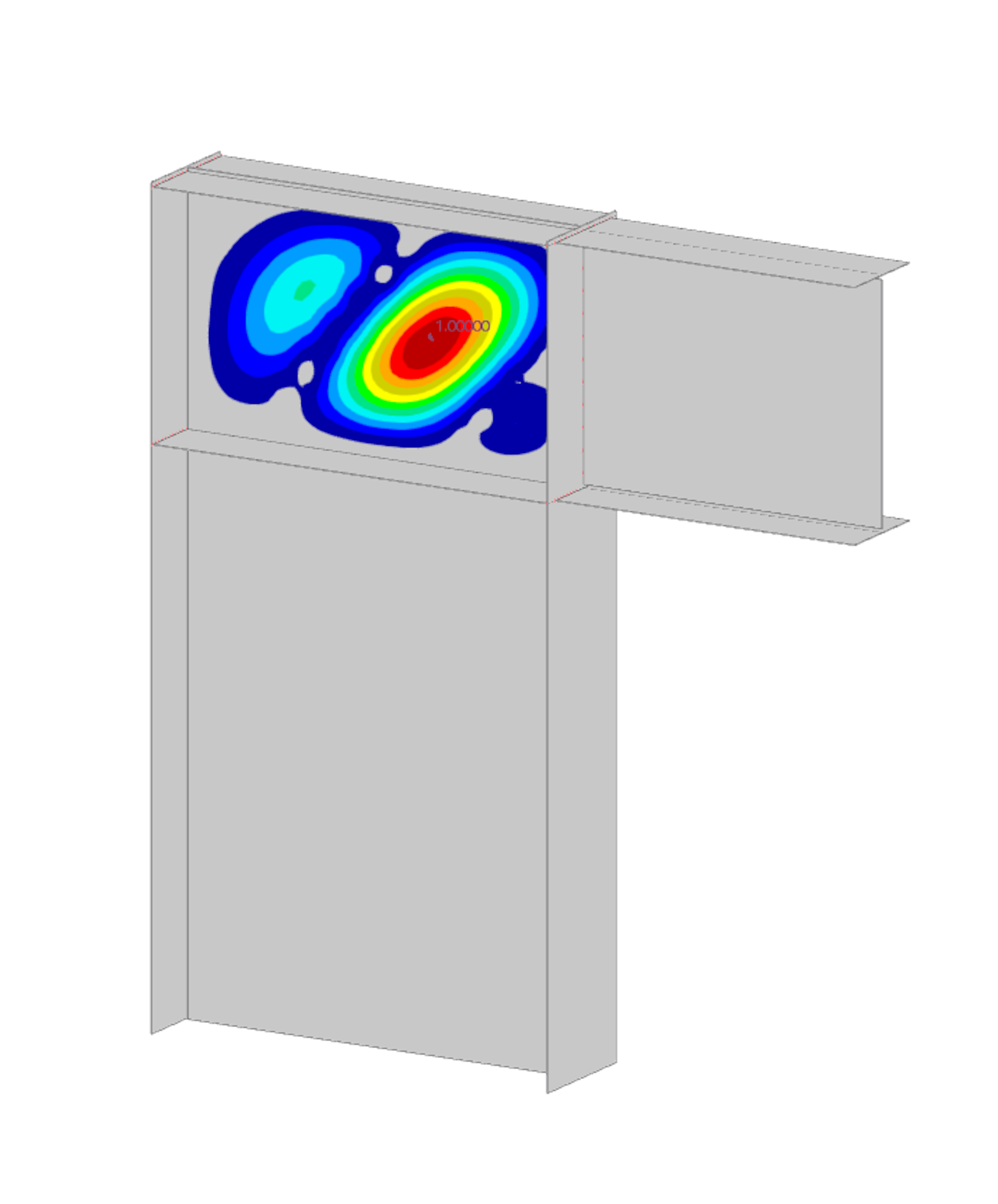
Creating a beam-to-beam steel joint and running its ULS design including the plate buckling check:
Keywords:
steel joint beam to beam member cut stiffener buckling analysis critical load factor design ratios |
from math import inf

from dlubal.api import rfem, common
from dlubal.api.common.packing import wrap_value

# -------------------------------------------------------
# This example creates a beam-to-beam steel joint and runs its ULS design
# including the buckling design check of the joint.
#
# A welded I-section column (member 1) meets an IPE 500 beam (member 2) at
# node 2. The joint connects them with two member cuts and one stiffener. The
# buckling analysis is enabled in the ULS configuration, and both the design
# ratios and the buckling critical load factors are read back.
# -------------------------------------------------------

# Editable parameters (SI units)

BEAM_CROSS_SECTION = "IPE 500"
STEEL_GRADE = "S235"
STIFFENER_THICKNESS = 0.016

# Welded parametric I-section for member 1: h/b/t_w/t_f in metres -> "I 840/250/4/10/0/0/H"
COLUMN_SECTION_H = 0.84
COLUMN_SECTION_B = 0.25
COLUMN_SECTION_TW = 0.004
COLUMN_SECTION_TF = 0.01

def define_structure() -> list:
    """Define the base RFEM model (column + beam) used for the analysis."""

    return [
        # Materials
        rfem.structure_core.Material(
            no=1,
            name=STEEL_GRADE,
        ),

        # Cross-Sections
        rfem.structure_core.CrossSection(
            no=1,
            material=1,
            type=rfem.structure_core.CrossSection.TYPE_PARAMETRIC_THIN_WALLED,
            parametrization_type=rfem.structure_core.CrossSection.PARAMETRIZATION_TYPE_PARAMETRIC_THIN_WALLED__I_SECTION__I,
            h=COLUMN_SECTION_H,
            b=COLUMN_SECTION_B,
            t_w=COLUMN_SECTION_TW,
            t_f=COLUMN_SECTION_TF,
            r_1=0.0,
            r_2=0.0,
        ),
        rfem.structure_core.CrossSection(
            no=2,
            material=1,
            name=BEAM_CROSS_SECTION,
        ),

        # Nodes
        rfem.structure_core.Node(
            no=1,
            coordinate_1=0.0,
            coordinate_2=0.0,
            coordinate_3=0.0,
        ),
        rfem.structure_core.Node(
            no=2,
            coordinate_1=0.0,
            coordinate_2=0.0,
            coordinate_3=-1.35,
        ),
        rfem.structure_core.Node(
            no=3,
            coordinate_1=1.045,
            coordinate_2=0.0,
            coordinate_3=-1.35,
        ),

        # Lines
        rfem.structure_core.Line(
            no=1,
            definition_nodes=[1, 2],
        ),
        rfem.structure_core.Line(
            no=2,
            definition_nodes=[2, 3],
        ),

        # Members
        rfem.structure_core.Member(
            no=1,
            line=1,
            type=rfem.structure_core.Member.TYPE_BEAM,
            cross_section_start=1,
        ),
        rfem.structure_core.Member(
            no=2,
            line=2,
            type=rfem.structure_core.Member.TYPE_BEAM,
            cross_section_start=2,
        ),

        # Nodal Supports
        rfem.types_for_nodes.NodalSupport(
            no=1,
            nodes=[1],
            spring_x=inf,
            spring_y=inf,
            spring_z=inf,
            rotational_restraint_x=inf,
            rotational_restraint_y=inf,
            rotational_restraint_z=inf,
        ),
    ]

def define_loading() -> list:
    """Define a load case, the ULS design situation and one load combination."""

    return [
        rfem.loading.StaticAnalysisSettings(
            no=1,
        ),
        rfem.loading.LoadCase(
            no=1,
            name="Moment",
            static_analysis_settings=1,
            action_category=rfem.loading.LoadCase.ACTION_CATEGORY_PERMANENT_G,
            self_weight_active=False,
        ),
        rfem.loading.DesignSituation(
            no=1,
            name="ULS (STR/GEO) - Permanent and transient - Eq. 6.10",
            design_situation_type=rfem.loading.DesignSituation.DESIGN_SITUATION_TYPE_STR_PERMANENT_AND_TRANSIENT_6_10,
            active_for_steel_joints=True,
        ),
        rfem.loading.LoadCombination(
            no=1,
            design_situation=1,
            name="Moment",
            static_analysis_settings=1,
            items=rfem.loading.LoadCombination.ItemsTable(
                rows=[
                    rfem.loading.LoadCombination.ItemsRow(
                        no=1,
                        factor=1.0,
                        load_case=1,
                    ),
                ]
            ),
            combination_rule_str="LC1",
        ),
        # Bending moment about the global Y axis at the free beam end (node 3)
        rfem.loads.NodalLoad(
            no=1,
            nodes=[3],
            load_case=1,
            load_type=rfem.loads.NodalLoad.LOAD_TYPE_MOMENT,
            moment_magnitude=-239190,
            load_direction=rfem.loads.NodalLoad.LOAD_DIRECTION_GLOBAL_Y_OR_USER_DEFINED_V_TRUE_LENGTH,
        ),
    ]

def define_joint_members():
    """Define members assigned inside the Steel Joint add-on table."""

    return rfem.steel_joints_objects.SteelJoint.MembersTable(
        rows=[
            rfem.steel_joints_objects.SteelJoint.MembersRow(
                no=1,
                is_active=True,
                members_no=[1],
                status="Member 1",
                end_type=rfem.steel_joints_objects.SteelJoint.MembersRow.EndType.END_TYPE_MEMBER_ENDED,
                supported=True,
            ),
            rfem.steel_joints_objects.SteelJoint.MembersRow(
                no=2,
                is_active=True,
                members_no=[2],
                status="Member 2",
                end_type=rfem.steel_joints_objects.SteelJoint.MembersRow.EndType.END_TYPE_MEMBER_ENDED,
                supported=False,
            ),
        ]
    )

def define_joint_components():
    """Define top-level Steel Joint components and their RFEM setting keys.

    Only the user-defined components are created here (two member cuts that
    connect the members plus one stiffener). RFEM auto-generates the derived
    plates, plate cuts and welds from these.
    """

    joint_components = [
        (
            rfem.steel_joints_objects.SteelJoint.ComponentsRow.Type.TYPE_MEMBER_CUT,
            "Member Cut 1",
            [
                ("member_to_cut", "Member 1"),
                ("type_of_cut", 0),
                ("cut_by", "Member 2"),
                ("cutting_method", 0),
                ("cutting_plane", 1),
                ("direction", 0),
                ("offset", 0.0),
            ],
        ),
        (
            rfem.steel_joints_objects.SteelJoint.ComponentsRow.Type.TYPE_MEMBER_CUT,
            "Member Cut 2",
            [
                ("member_to_cut", "Member 2"),
                ("type_of_cut", 0),
                ("cut_by", "Member 1"),
                ("cutting_method", 0),
                ("cutting_plane", 0),
                ("direction", 0),
                ("offset", 0.0),
                ("weld_is_active_1", True),
                ("weld_is_active_2", True),
                ("weld_is_active_3", True),
                ("weld_type_1", 3),
                ("weld_type_2", 3),
                ("weld_type_3", 3),
            ],
        ),
        (
            rfem.steel_joints_objects.SteelJoint.ComponentsRow.Type.TYPE_STIFFENER,
            "Stiffener 1",
            [
                ("stiffened_member", "Member 1"),
                ("reference_member", "Member 2"),
                ("plate_material", 1),
                ("plate_thickness", STIFFENER_THICKNESS),
                ("plate_count", 2),
                ("position", 2),
                ("direction", 1),
                ("location_offset", "0.0000 0.0000"),
                ("side", 2),
                ("inclination", 0.0),
                ("width_offset", 0.0),
                ("height_offset", 0.0),
                ("chamfer", 0.0),
                ("weld_is_active_1", True),
                ("weld_is_active_2", True),
                ("weld_is_active_3", True),
                ("weld_type_1", 3),
                ("weld_type_2", 3),
                ("weld_type_3", 3),
            ],
        ),
    ]

    joint_component_rows = []

    for component_no, joint_component in enumerate(joint_components, start=1):
        component_type, component_name, component_settings = joint_component
        setting_rows = []

        for setting_no, setting in enumerate(component_settings, start=1):
            setting_key, setting_value = setting

            setting_rows.append(
                rfem.steel_joints_objects.SteelJoint.ComponentsRow.SettingsTableRow(
                    no=setting_no,
                    key=setting_key,
                    value=wrap_value(setting_value),
                )
            )

        joint_component_rows.append(
            rfem.steel_joints_objects.SteelJoint.ComponentsRow(
                no=component_no,
                is_active=True,
                type=component_type,
                name=component_name,
                settings=rfem.steel_joints_objects.SteelJoint.ComponentsRow.SettingsTable(
                    rows=setting_rows,
                ),
            )
        )

    return rfem.steel_joints_objects.SteelJoint.ComponentsTable(
        rows=joint_component_rows,
    )

def define_steel_joint() -> list:
    """Define the steel joint and its design configuration."""

    return [
        rfem.steel_joints_design_addon_objects.JointUlsConfiguration(
            no=1,
            name="ULS Configuration",
        ),
        rfem.steel_joints_objects.SteelJoint(
            no=1,
            nodes=[2],
            user_defined_name_enabled=True,
            name="Nodes : 2 | Created via API",
            comment="Created via API",
            to_design=True,
            ultimate_configuration=1,
            members=define_joint_members(),
            components=define_joint_components(),
        ),
    ]

# -------------------------------------------------------
# MAIN SCRIPT
# -------------------------------------------------------

with rfem.Application() as rfem_app:

    # Initialize model
    rfem_app.close_all_models(save_changes=False)
    rfem_app.create_model(name='steel_joint_buckling_analysis')

    # Activate the Steel Joints add-on
    base_data = rfem_app.get_base_data()
    base_data.addons.steel_joints_active = True
    rfem_app.set_base_data(base_data=base_data)
    rfem_app.delete_all_objects()

    # Create structure, loading and the steel joint
    rfem_app.create_object_list(
        define_structure() +
        define_loading() +
        define_steel_joint()
    )

    # Enable the buckling analysis in the ULS configuration
    # (a freshly created configuration has it switched off by default)
    settings_tree = rfem_app.get_object(
        obj=rfem.steel_joints_design_addon_objects.JointUlsConfiguration(no=1)
    ).settings_ec3

    common.tree_table.set_values_by_key(settings_tree, "perform_buckling_analysis", values=[True])

    rfem_app.update_object(
        obj=rfem.steel_joints_design_addon_objects.JointUlsConfiguration(
            no=1,
            settings_ec3=settings_tree,
        )
    )

    # Calculate the ULS design situation
    rfem_app.calculate_all(skip_warnings=True)

    # --- Steel joint design checks (max ratios) ---
    design_ratios_df: common.Table = rfem_app.get_results(
        results_type=rfem.results.ResultsType.STEEL_JOINTS_DESIGN_RATIOS,
    ).data

    plate_ratio = design_ratios_df.loc[
        design_ratios_df["design_check_type"] == "UL1000.00", "design_ratio"
    ].dropna().max()

    print("Steel joint design check summary (max ratios):")
    print(f"Plates (UL1000.00): {plate_ratio:.3f}")

    # --- Steel joint buckling analysis (critical load factors) ---
    # Only available when perform_buckling_analysis is enabled.
    # design_check_type ST2000.00 -> "Buckling analysis"; f = critical load factor.
    buckling_df: common.Table = rfem_app.get_results(
        results_type=rfem.results.ResultsType.STEEL_JOINTS_BUCKLING_DESIGN_RATIOS,
    ).data

    print("\nSteel joint buckling analysis (critical load factors):")
    for row in buckling_df.itertuples():
        print(f"Mode {row.mode_shape_no}: f = {row.critical_load_factor:.3f}")

    lowest_factor = buckling_df["critical_load_factor"].dropna().min()
    print(f"Lowest critical load factor: {lowest_factor:.3f}")
using System;
using System.Collections.Generic;
using System.Globalization;
using System.Linq;
using Common = Dlubal.Api.Common;
using Google.Protobuf;
using Rfem = Dlubal.Api.Rfem;

// -------------------------------------------------------
// This example creates a beam-to-beam steel joint and runs its ULS design
// including the buckling design check of the joint.
//
// A welded I-section column (member 1) meets an IPE 500 beam (member 2) at
// node 2. The joint connects them with two member cuts and one stiffener. The
// buckling analysis is enabled in the ULS configuration, and both the design
// ratios and the buckling critical load factors are read back.
// -------------------------------------------------------

// Editable parameters (SI units)

const string BEAM_CROSS_SECTION = "IPE 500";
const string STEEL_GRADE = "S235";
const double STIFFENER_THICKNESS = 0.016;

// Welded parametric I-section for member 1: h/b/t_w/t_f in metres -> "I 840/250/4/10/0/0/H"
const double COLUMN_SECTION_H = 0.84;
const double COLUMN_SECTION_B = 0.25;
const double COLUMN_SECTION_TW = 0.004;
const double COLUMN_SECTION_TF = 0.01;

static List<IMessage> DefineStructure()
{
    // Define the base RFEM model (column + beam) used for the analysis.
    return new List<IMessage>
    {
        // Materials
        new Rfem.StructureCore.Material
        {
            No = 1,
            Name = STEEL_GRADE,
        },

        // Cross-Sections
        new Rfem.StructureCore.CrossSection
        {
            No = 1,
            Material = 1,
            Type = Rfem.StructureCore.CrossSection.Types.Type.ParametricThinWalled,
            ParametrizationType = Rfem.StructureCore.CrossSection.Types.ParametrizationType.ParametricThinWalledISectionI,
            H = COLUMN_SECTION_H,
            B = COLUMN_SECTION_B,
            TW = COLUMN_SECTION_TW,
            TF = COLUMN_SECTION_TF,
            R1 = 0.0,
            R2 = 0.0,
        },
        new Rfem.StructureCore.CrossSection
        {
            No = 2,
            Material = 1,
            Name = BEAM_CROSS_SECTION,
        },

        // Nodes
        new Rfem.StructureCore.Node
        {
            No = 1,
            Coordinate1 = 0.0,
            Coordinate2 = 0.0,
            Coordinate3 = 0.0,
        },
        new Rfem.StructureCore.Node
        {
            No = 2,
            Coordinate1 = 0.0,
            Coordinate2 = 0.0,
            Coordinate3 = -1.35,
        },
        new Rfem.StructureCore.Node
        {
            No = 3,
            Coordinate1 = 1.045,
            Coordinate2 = 0.0,
            Coordinate3 = -1.35,
        },

        // Lines
        new Rfem.StructureCore.Line
        {
            No = 1,
            DefinitionNodes = { 1, 2 },
        },
        new Rfem.StructureCore.Line
        {
            No = 2,
            DefinitionNodes = { 2, 3 },
        },

        // Members
        new Rfem.StructureCore.Member
        {
            No = 1,
            Line = 1,
            Type = Rfem.StructureCore.Member.Types.Type.Beam,
            CrossSectionStart = 1,
        },
        new Rfem.StructureCore.Member
        {
            No = 2,
            Line = 2,
            Type = Rfem.StructureCore.Member.Types.Type.Beam,
            CrossSectionStart = 2,
        },

        // Nodal Supports
        new Rfem.TypesForNodes.NodalSupport
        {
            No = 1,
            Nodes = { 1 },
            SpringX = double.PositiveInfinity,
            SpringY = double.PositiveInfinity,
            SpringZ = double.PositiveInfinity,
            RotationalRestraintX = double.PositiveInfinity,
            RotationalRestraintY = double.PositiveInfinity,
            RotationalRestraintZ = double.PositiveInfinity,
        },
    };
}

static List<IMessage> DefineLoading()
{
    // Define a load case, the ULS design situation and one load combination.
    return new List<IMessage>
    {
        new Rfem.Loading.StaticAnalysisSettings { No = 1 },
        new Rfem.Loading.LoadCase
        {
            No = 1,
            Name = "Moment",
            StaticAnalysisSettings = 1,
            ActionCategory = Rfem.Loading.LoadCase.Types.ActionCategory.PermanentG,
            SelfWeightActive = false,
        },
        new Rfem.Loading.DesignSituation
        {
            No = 1,
            Name = "ULS (STR/GEO) - Permanent and transient - Eq. 6.10",
            DesignSituationType = Rfem.Loading.DesignSituation.Types.DesignSituationType.StrPermanentAndTransient610,
            ActiveForSteelJoints = true,
        },
        new Rfem.Loading.LoadCombination
        {
            No = 1,
            DesignSituation = 1,
            Name = "Moment",
            StaticAnalysisSettings = 1,
            Items = new Rfem.Loading.LoadCombination.Types.ItemsTable
            {
                Rows =
                {
                    new Rfem.Loading.LoadCombination.Types.ItemsRow
                    {
                        No = 1,
                        Factor = 1.0,
                        LoadCase = 1,
                    },
                },
            },
            CombinationRuleStr = "LC1",
        },
        // Bending moment about the global Y axis at the free beam end (node 3)
        new Rfem.Loads.NodalLoad
        {
            No = 1,
            Nodes = { 3 },
            LoadCase = 1,
            LoadType = Rfem.Loads.NodalLoad.Types.LoadType.Moment,
            MomentMagnitude = -239190,
            LoadDirection = Rfem.Loads.NodalLoad.Types.LoadDirection.GlobalYOrUserDefinedVTrueLength,
        },
    };
}

static Rfem.SteelJointsObjects.SteelJoint.Types.MembersTable DefineJointMembers()
{
    // Members assigned inside the Steel Joint add-on table.
    return new Rfem.SteelJointsObjects.SteelJoint.Types.MembersTable
    {
        Rows =
        {
            new Rfem.SteelJointsObjects.SteelJoint.Types.MembersRow
            {
                No = 1,
                IsActive = true,
                MembersNo = { 1 },
                Status = "Member 1",
                EndType = Rfem.SteelJointsObjects.SteelJoint.Types.MembersRow.Types.EndType.MemberEnded,
                Supported = true,
            },
            new Rfem.SteelJointsObjects.SteelJoint.Types.MembersRow
            {
                No = 2,
                IsActive = true,
                MembersNo = { 2 },
                Status = "Member 2",
                EndType = Rfem.SteelJointsObjects.SteelJoint.Types.MembersRow.Types.EndType.MemberEnded,
                Supported = false,
            },
        },
    };
}

static Common.Value WrapValue(object value)
{
    // Create a generic Common.Value from a plain value, mirroring the Python
    // wrap_value() helper (bool / int / double / string oneof).
    return value switch
    {
        bool b => new Common.Value { BoolValue = b },
        int i => new Common.Value { IntValue = i },
        double d => new Common.Value { DoubleValue = d },
        string s => new Common.Value { StringValue = s },
        _ => new Common.Value { StringValue = value?.ToString() ?? string.Empty },
    };
}

static Rfem.SteelJointsObjects.SteelJoint.Types.ComponentsTable DefineJointComponents()
{
    // Define top-level Steel Joint components and their RFEM setting keys.
    //
    // Only the user-defined components are created here (two member cuts that
    // connect the members plus one stiffener). RFEM auto-generates the derived
    // plates, plate cuts and welds from these.
    var jointComponents = new List<(
        Rfem.SteelJointsObjects.SteelJoint.Types.ComponentsRow.Types.Type Type,
        string Name,
        List<(string Key, object Value)> Settings)>
    {
        (
            Rfem.SteelJointsObjects.SteelJoint.Types.ComponentsRow.Types.Type.MemberCut,
            "Member Cut 1",
            new List<(string, object)>
            {
                ("member_to_cut", "Member 1"),
                ("type_of_cut", 0),
                ("cut_by", "Member 2"),
                ("cutting_method", 0),
                ("cutting_plane", 1),
                ("direction", 0),
                ("offset", 0.0),
            }
        ),
        (
            Rfem.SteelJointsObjects.SteelJoint.Types.ComponentsRow.Types.Type.MemberCut,
            "Member Cut 2",
            new List<(string, object)>
            {
                ("member_to_cut", "Member 2"),
                ("type_of_cut", 0),
                ("cut_by", "Member 1"),
                ("cutting_method", 0),
                ("cutting_plane", 0),
                ("direction", 0),
                ("offset", 0.0),
                ("weld_is_active_1", true),
                ("weld_is_active_2", true),
                ("weld_is_active_3", true),
                ("weld_type_1", 3),
                ("weld_type_2", 3),
                ("weld_type_3", 3),
            }
        ),
        (
            Rfem.SteelJointsObjects.SteelJoint.Types.ComponentsRow.Types.Type.Stiffener,
            "Stiffener 1",
            new List<(string, object)>
            {
                ("stiffened_member", "Member 1"),
                ("reference_member", "Member 2"),
                ("plate_material", 1),
                ("plate_thickness", STIFFENER_THICKNESS),
                ("plate_count", 2),
                ("position", 2),
                ("direction", 1),
                ("location_offset", "0.0000 0.0000"),
                ("side", 2),
                ("inclination", 0.0),
                ("width_offset", 0.0),
                ("height_offset", 0.0),
                ("chamfer", 0.0),
                ("weld_is_active_1", true),
                ("weld_is_active_2", true),
                ("weld_is_active_3", true),
                ("weld_type_1", 3),
                ("weld_type_2", 3),
                ("weld_type_3", 3),
            }
        ),
    };

    var componentsTable = new Rfem.SteelJointsObjects.SteelJoint.Types.ComponentsTable();

    int componentNo = 1;
    foreach (var (type, name, settings) in jointComponents)
    {
        var settingsTable = new Rfem.SteelJointsObjects.SteelJoint.Types.ComponentsRow.Types.SettingsTable();

        int settingNo = 1;
        foreach (var (key, value) in settings)
        {
            settingsTable.Rows.Add(new Rfem.SteelJointsObjects.SteelJoint.Types.ComponentsRow.Types.SettingsTableRow
            {
                No = settingNo,
                Key = key,
                Value = WrapValue(value),
            });
            settingNo++;
        }

        componentsTable.Rows.Add(new Rfem.SteelJointsObjects.SteelJoint.Types.ComponentsRow
        {
            No = componentNo,
            IsActive = true,
            Type = type,
            Name = name,
            Settings = settingsTable,
        });
        componentNo++;
    }

    return componentsTable;
}

static List<IMessage> DefineSteelJoint()
{
    // Define the steel joint and its design configuration.
    return new List<IMessage>
    {
        new Rfem.SteelJointsDesignAddonObjects.JointUlsConfiguration
        {
            No = 1,
            Name = "ULS Configuration",
        },
        new Rfem.SteelJointsObjects.SteelJoint
        {
            No = 1,
            Nodes = { 2 },
            UserDefinedNameEnabled = true,
            Name = "Nodes : 2 | Created via API",
            Comment = "Created via API",
            ToDesign = true,
            UltimateConfiguration = 1,
            Members = DefineJointMembers(),
            Components = DefineJointComponents(),
        },
    };
}

// -------------------------------------------------------
// MAIN SCRIPT
// -------------------------------------------------------

ApplicationRfem? rfemApp = null;

try
{
    rfemApp = new ApplicationRfem();

    // Initialize model
    rfemApp.close_all_models(saveChanges: false);
    rfemApp.create_model(name: "steel_joint_buckling_analysis");

    // Activate the Steel Joints add-on
    var baseData = rfemApp.get_base_data();
    baseData.Addons.SteelJointsActive = true;
    rfemApp.set_base_data(baseData: baseData);
    rfemApp.delete_all_objects();

    // Create structure, loading and the steel joint
    rfemApp.create_object_list(
        DefineStructure()
            .Concat(DefineLoading())
            .Concat(DefineSteelJoint())
            .ToList()
    );

    // Enable the buckling analysis in the ULS configuration
    // (a freshly created configuration has it switched off by default)
    var settingsTree = rfemApp.get_object<Rfem.SteelJointsDesignAddonObjects.JointUlsConfiguration>(
        new Rfem.SteelJointsDesignAddonObjects.JointUlsConfiguration { No = 1 }
    ).SettingsEc3;

    Common.TreeTable.SetValuesByKey(settingsTree, "perform_buckling_analysis", new List<object> { true });

    rfemApp.update_object(
        obj: new Rfem.SteelJointsDesignAddonObjects.JointUlsConfiguration
        {
            No = 1,
            SettingsEc3 = settingsTree,
        }
    );

    // Calculate the ULS design situation
    rfemApp.calculate_all(skipWarnings: true);

    // --- Steel joint design checks (max ratios) ---
    var designRatios = rfemApp.get_results(
        resultsType: Rfem.Results.ResultsType.SteelJointsDesignRatios
    );

    var plateRatio = designRatios.Data.Rows
        .Where(row => Convert.ToString(row["design_check_type"], CultureInfo.InvariantCulture) == "UL1000.00")
        .Select(row => Convert.ToDouble(row["design_ratio"], CultureInfo.InvariantCulture))
        .Where(v => !double.IsNaN(v))
        .Max();

    Console.WriteLine("Steel joint design check summary (max ratios):");
    Console.WriteLine($"Plates (UL1000.00): {plateRatio:F3}");

    // --- Steel joint buckling analysis (critical load factors) ---
    // Only available when perform_buckling_analysis is enabled.
    // design_check_type ST2000.00 -> "Buckling analysis"; f = critical load factor.
    var bucklingResults = rfemApp.get_results(
        resultsType: Rfem.Results.ResultsType.SteelJointsBucklingDesignRatios
    );

    Console.WriteLine("\nSteel joint buckling analysis (critical load factors):");
    foreach (var row in bucklingResults.Data.Rows)
    {
        var critical = Convert.ToDouble(row["critical_load_factor"], CultureInfo.InvariantCulture);
        Console.WriteLine($"Mode {row["mode_shape_no"]}: f = {critical:F3}");
    }

    var lowestFactor = bucklingResults.Data.Rows
        .Select(row => Convert.ToDouble(row["critical_load_factor"], CultureInfo.InvariantCulture))
        .Where(v => !double.IsNaN(v))
        .Min();
    Console.WriteLine($"Lowest critical load factor: {lowestFactor:F3}");
}
catch (Exception ex)
{
    Console.WriteLine($"Error: {ex.Message}");
}
finally
{
    if (rfemApp != null) rfemApp.close_connection();
}