
Beam Load Duration and Creep#
|
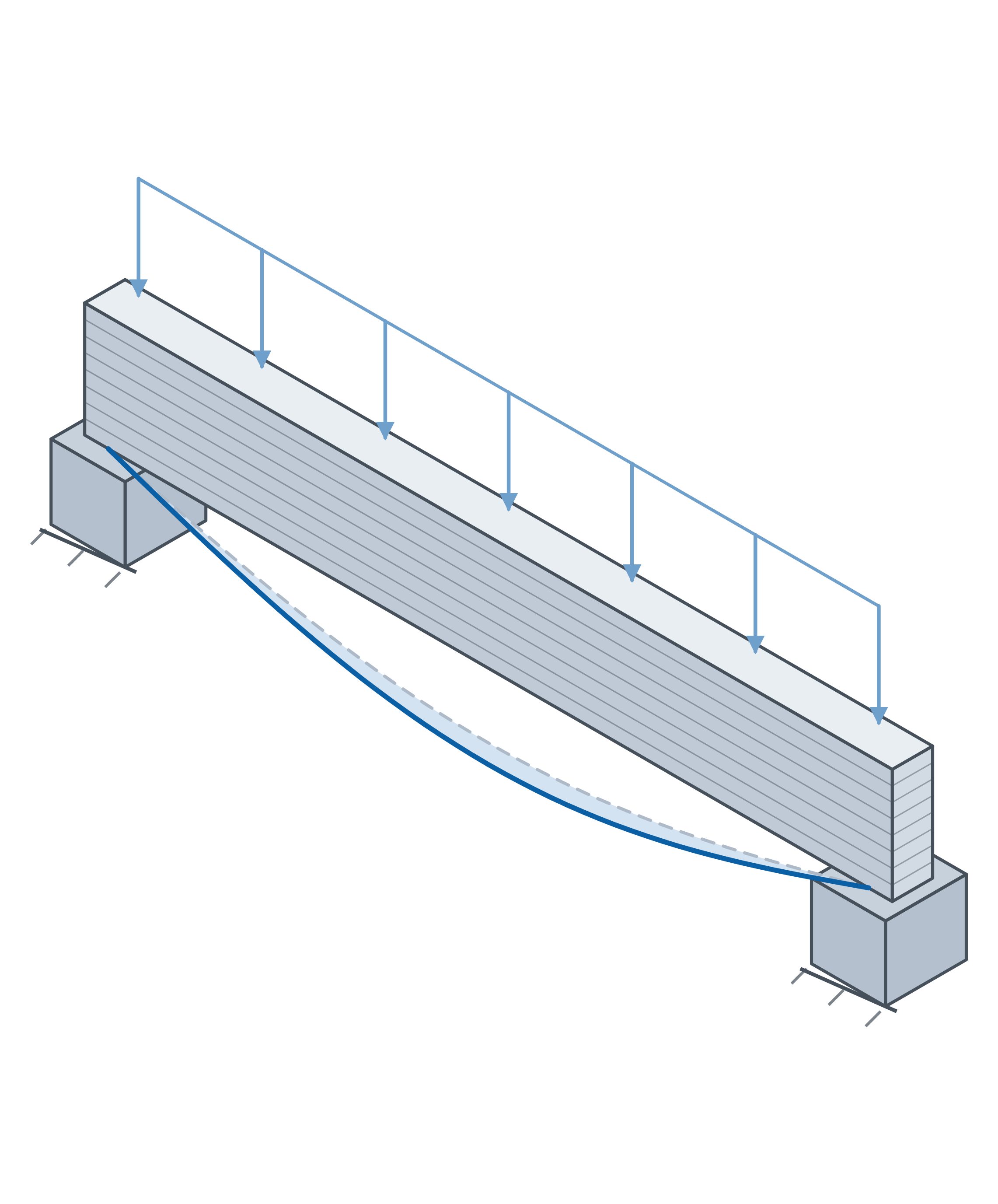
Designing a simply supported glulam floor beam acc. to EN 1995-1-1 with the Swedish National Annex, considering the load duration, the service class and creep:
Keywords:
timber design glulam load duration service class compression perpendicular to grain creep final deflection national annex |
Note
Reference: Swedish Wood - The Glulam Handbook, Volume 3 (2024), Example 1. The bending and compression stresses agree with the reference. The reference divides the compression perpendicular to the grain by the characteristic strength instead of the design strength; the corrected ratio is printed. For shear, the reference uses the reduced shear force and kcr = 0.86, RFEM the support shear force and kcr = 0.67. RFEM does not apply the size factor kh in bending, and its deflections include the shear deformation.
from dlubal.api import rfem, common
from math import inf
import pandas

# -------------------------------------------------------
# This example demonstrates the design of a simply supported glulam floor beam
# acc. to EN 1995-1-1 with the Swedish National Annex (SS-EN 1995-1-1, EKS):
# bending, shear, compression perpendicular to the grain at the supports, the
# instantaneous deflection and the final deflection including creep (k_def).
#
# Reference:
#   Swedish Wood - The Glulam Handbook, Volume 3 (Edition 1:2024), Example 1, pp. 81-84.
#
#   GL30c 90 x 360 mm, simply supported, span 6.0 m, bearing length 100 mm,
#   beam spacing 0.9 m, lateral-torsional buckling prevented by the floor.
#   Service class 1, imposed load of medium-term duration (k_mod = 0.8).
#   g_k = 0.20 + 0.45 = 0.65 kN/m, q_k = 1.80 kN/m.
#   ULS acc. to the Swedish rules (safety class 3): 1.2 G + 1.5 Q = 3.48 kN/m.
#   SLS: k_def = 0.6, psi_2 = 0.3.
#
# Expected deviations from the reference:
#   - Compression perpendicular to the grain: the reference divides by f_c,90,k = 2.5 MPa
#     instead of f_c,90,d = 1.6 MPa (k_mod = 0.8, gamma_M = 1.25); the corrected ratio is 0.32.
#   - Shear: the reference uses the shear force reduced at the distance h from the support
#     (9.01 kN) and k_cr = 0.86 (3.0 / f_v,k acc. to EKS). RFEM uses the support shear
#     force and k_cr = 0.67.
#   - Bending: the reference applies the size factor k_h = 1.05, RFEM does not.
#   - Deflections: RFEM includes the shear deformation, the reference neglects it and uses
#     g_k,2 = 0.5 kN/m in the SLS.
# -------------------------------------------------------


SPAN = 6.0                  # m
BEARING_LENGTH = 0.10       # m
G_K = 0.20e3 + 0.45e3       # N/m, self-weight of the beam and the floor
Q_K = 1.80e3                # N/m, imposed load (2.0 kN/m2 x 0.9 m)
PSI_2 = 0.3                 # imposed load category A
K_DEF = 0.6                 # glulam, service class 1
K_C_90 = 1.75               # glulam, bearing length l <= 400 mm (EN 1995-1-1, 6.1.5(4))

# Results published in the reference: (value, unit, caption)
REFERENCE = {
    "sigma_c_90_d": (0.89, "MPa", "Compression perp. stress sigma_c,90,d"),
    "eta_c_90": (0.32, "-", "Compression perp. ratio (corrected, see above)"),
    "tau_d": (0.42, "MPa", "Shear stress tau (ref.: reduced V = 9.01 kN)"),
    "eta_v": (0.22, "-", "Shear ratio"),
    "sigma_m_y_d": (8.06, "MPa", "Bending stress sigma_m,d"),
    "eta_m": (0.40, "-", "Bending ratio (with k_h = 1.05)"),
    "w_inst": (9.1, "mm", "Instantaneous deflection w_inst"),
    "w_fin": (11.7, "mm", "Final deflection w_fin"),
}


def define_structure() -> list:

    return [

        rfem.structure_core.Material(
            no=1,
            name="GL30c",
        ),
        rfem.structure_core.CrossSection(
            no=1,
            name="R_M1 90/360",
            material=1,
        ),

        rfem.structure_core.Node(no=1),
        rfem.structure_core.Node(no=2, coordinate_1=SPAN),
        rfem.structure_core.Line(no=1, definition_nodes=[1, 2]),
        rfem.structure_core.Member(no=1, line=1, cross_section_start=1),

        rfem.types_for_nodes.NodalSupport(
            no=1,
            nodes=[1],
            spring=common.Vector3d(x=inf, y=inf, z=inf),
            rotational_restraint=common.Vector3d(x=inf, y=0, z=0),
        ),
        rfem.types_for_nodes.NodalSupport(
            no=2,
            nodes=[2],
            spring=common.Vector3d(x=0, y=inf, z=inf),
            rotational_restraint=common.Vector3d(x=inf, y=0, z=0),
        ),
    ]


def define_loading() -> list:

    # The load duration class of each load case determines k_mod; a load combination
    # takes the shortest duration of its load cases (here medium-term, k_mod = 0.8).
    #
    # Serviceability acc. to the Swedish rules:
    #   - Characteristic: instantaneous deflection w_inst of G + Q.
    #   - Quasi-permanent: final deflection w_fin acc. to EN 1995-1-1, 2.3.2.2. RFEM evaluates
    #     it from a load combination with the creep factors (1 + k_def) and (1 + psi_2 k_def),
    #     the same factors the combination wizard generates for SS EN 1995-1-1.

    return [

        rfem.loading.StaticAnalysisSettings(no=1),

        rfem.loading.LoadCase(
            no=1,
            name="Permanent",
            static_analysis_settings=1,
            self_weight_active=False,
            action_category=rfem.loading.LoadCase.ACTION_CATEGORY_PERMANENT_G,
            load_duration=rfem.loading.LoadCase.LOAD_DURATION_PERMANENT,
        ),
        rfem.loading.LoadCase(
            no=2,
            name="Imposed",
            static_analysis_settings=1,
            action_category=rfem.loading.LoadCase.ACTION_CATEGORY_IMPOSED_LOADS_CATEGORY_A_DOMESTIC_RESIDENTIAL_AREAS_QI_A,
            load_duration=rfem.loading.LoadCase.LOAD_DURATION_MEDIUM_TERM,
        ),

        rfem.loading.DesignSituation(
            no=1,
            design_situation_type=rfem.loading.DesignSituation.DESIGN_SITUATION_TYPE_STR_PERMANENT_AND_TRANSIENT_6_10,
        ),
        rfem.loading.DesignSituation(
            no=2,
            design_situation_type=rfem.loading.DesignSituation.DESIGN_SITUATION_TYPE_SLS_CHARACTERISTIC,
        ),
        rfem.loading.DesignSituation(
            no=3,
            design_situation_type=rfem.loading.DesignSituation.DESIGN_SITUATION_TYPE_SLS_QUASI_PERMANENT,
        ),

        rfem.loading.LoadCombination(
            no=1,
            name="ULS 1.2 G + 1.5 Q",
            design_situation=1,
            static_analysis_settings=1,
            combination_rule_str="1.2*LC1 + 1.5*LC2",
        ),
        rfem.loading.LoadCombination(
            no=2,
            name="SLS w_inst: G + Q",
            design_situation=2,
            static_analysis_settings=1,
            combination_rule_str="LC1 + LC2",
        ),
        rfem.loading.LoadCombination(
            no=3,
            name="SLS w_fin: (1 + k_def) G + (1 + psi_2 k_def) Q",
            design_situation=3,
            static_analysis_settings=1,
            combination_rule_str=f"{1 + K_DEF:.2f}*LC1 + {1 + PSI_2 * K_DEF:.2f}*LC2",
        ),

        rfem.loads.MemberLoad(
            no=1,
            load_case=1,
            members=[1],
            load_distribution=rfem.loads.MemberLoad.LOAD_DISTRIBUTION_UNIFORM,
            magnitude=G_K,
        ),
        rfem.loads.MemberLoad(
            no=1,
            load_case=2,
            members=[1],
            load_distribution=rfem.loads.MemberLoad.LOAD_DISTRIBUTION_UNIFORM,
            magnitude=Q_K,
        ),
    ]


def define_timber_design() -> list:

    # The floor boards prevent lateral-torsional buckling, so no effective lengths are
    # assigned and RFEM performs the cross-section checks only.

    return [

        rfem.timber_design_objects.TimberDesignUlsConfiguration(
            no=1,
            assigned_to_all_members=True,
        ),
        rfem.timber_design_objects.TimberDesignSlsConfiguration(
            no=1,
            assigned_to_all_members=True,
        ),

        rfem.timber_design.TimberServiceClass(
            no=1,
            members=[1],
            service_class=rfem.timber_design.TimberServiceClass.SERVICE_CLASS_1,
        ),

        # Bearing length and factor k_c,90 for the check of compression perpendicular to the grain
        rfem.types_for_members.DesignSupport(
            no=1,
            type=rfem.types_for_members.DesignSupport.TYPE_TIMBER,
            assigned_to_members=[1],
            assigned_to_nodes=[1, 2],
            support_width_z=BEARING_LENGTH,
            timber_factor_of_compression_z=K_C_90,
        ),
    ]


def get_check_values(rfem_app: rfem.Application, design_ratios_df: pandas.DataFrame, check_type: str) -> dict:
    """
    Returns the full-precision SI values of the section 'Design Check Values' of the governing
    design check of the given type as a dictionary {key: value}. Keys that occur more than once
    in that section (for example the design strength) keep their last value.
    """
    rows = design_ratios_df[design_ratios_df["design_check_type"] == check_type]
    governing = rows.loc[rows["design_ratio"].idxmax()]
    details_df = rfem_app.get_results(
        results_type=rfem.results.TIMBER_DESIGN_DESIGN_CHECK_DETAILS,
        filters=[
            rfem.results.ResultsFilter(
                column_id="design_check_details_id",
                filter_expression=str(governing["design_check_details_id"]),
            )
        ],
    ).data
    start = details_df.index[details_df["key"] == "design_check_values"][0]
    values = {}
    for _, row in details_df.loc[start:].dropna(subset=["key"]).iterrows():
        try:
            values[row["key"]] = float(row["value_si"])
        except ValueError:
            pass    # group rows and text values
    return values


# -------------------------------------------------------
# MAIN SCRIPT
# -------------------------------------------------------

with rfem.Application() as rfem_app:

    rfem_app.create_model(name="timber_design_beam_load_duration_creep")

    base_data = rfem_app.get_base_data()
    base_data.addons.timber_design_active = True
    base_data.standards.timber_design_standard = rfem.BaseData.Standards.TIMBER_DESIGN_NATIONAL_ANNEX_AND_EDITION_EN_1995_SS_2018_02_STANDARD
    # Timber design requires the combination standard "EN 1990 | Base + Timber". The standard is
    # only applied together with its standard group; without the group it is silently ignored.
    base_data.standards.combination_wizard_standard_group = rfem.BaseData.Standards.COMBINATION_WIZARD_EN_1990_BASE___TIMBER_STANDARD_GROUP
    base_data.standards.combination_wizard_standard = rfem.BaseData.Standards.COMBINATION_WIZARD_NATIONAL_ANNEX_AND_EDITION_EN_1990_BASE_TIMBER_SS_2019_01_STANDARD
    rfem_app.set_base_data(base_data=base_data)

    rfem_app.delete_all_objects()
    rfem_app.create_object_list(
        objs=
            define_structure() +
            define_loading() +
            define_timber_design()
    )

    # If the input is incomplete (for example a missing service class), the calculation only
    # reports a general message; the plausibility check names the object and the input field.
    calculation_info = rfem_app.calculate_all(skip_warnings=True)
    if not calculation_info.succeeded:
        plausibility = rfem_app.plausibility_check(
            type=common.PlausibilityCheckType.PLAUSIBILITY_CHECK_PLAUSIBILITY_CHECK,
            skip_warnings=False,
        )
        raise RuntimeError(f"Calculation failed: {plausibility.message}\n{plausibility.data}")

    design_ratios_df = rfem_app.get_results(
        results_type=rfem.results.TIMBER_DESIGN_MEMBERS_DESIGN_RATIOS,
    ).data
    summary = design_ratios_df.sort_values("design_ratio", ascending=False).drop_duplicates("design_check_type")
    print("\nGoverning design ratios per check type:")
    print(summary[["design_check_type", "loading", "design_ratio", "location_x", "design_check_description"]].to_string(index=False))

    compression = get_check_values(rfem_app, design_ratios_df, "SP1400.00")  # Compression perpendicular to grain at design support
    shear = get_check_values(rfem_app, design_ratios_df, "SP3100.00")        # Shear in z-axis
    bending = get_check_values(rfem_app, design_ratios_df, "SP4100.00")      # Bending about y-axis
    w_inst = get_check_values(rfem_app, design_ratios_df, "SE1200.01")       # Characteristic deflection
    w_fin = get_check_values(rfem_app, design_ratios_df, "SE1200.02")        # Quasi-permanent deflection

    rfem_values = {
        "sigma_c_90_d": abs(compression["sigma_c_90_d"]) / 1e6,
        "eta_c_90": compression["eta"],
        "tau_d": abs(shear["tau_xz"]) / 1e6,     # shear stress without k_cr (tau_xz_d includes k_cr)
        "eta_v": shear["eta"],
        "sigma_m_y_d": abs(bending["sigma_m_y_d"]) / 1e6,
        "eta_m": bending["eta"],
        "w_inst": w_inst["w_inst_z"] * 1e3,
        "w_fin": w_fin["w_fin_z"] * 1e3,
    }

    print(f"\nk_c,90 = {compression['k_c_90']:.2f}, k_cr = {shear['k_cr']:.2f}, k_mod = {bending['k_mod']:.2f}")
    print(f"\n{'Quantity':<50}{'RFEM':>8}{'Reference':>11}")
    for key, (ref_value, unit, caption) in REFERENCE.items():
        print(f"{caption + ' [' + unit + ']':<50}{rfem_values[key]:>8.2f}{ref_value:>11.2f}")
using System.Globalization;
using Google.Protobuf;
using Microsoft.Data.Analysis;
using Common = Dlubal.Api.Common;
using Rfem = Dlubal.Api.Rfem;

// -------------------------------------------------------
// This example demonstrates the design of a simply supported glulam floor beam
// acc. to EN 1995-1-1 with the Swedish National Annex (SS-EN 1995-1-1, EKS):
// bending, shear, compression perpendicular to the grain at the supports, the
// instantaneous deflection and the final deflection including creep (k_def).
//
// Reference:
//   Swedish Wood - The Glulam Handbook, Volume 3 (Edition 1:2024), Example 1, pp. 81-84.
//
//   GL30c 90 x 360 mm, simply supported, span 6.0 m, bearing length 100 mm,
//   beam spacing 0.9 m, lateral-torsional buckling prevented by the floor.
//   Service class 1, imposed load of medium-term duration (k_mod = 0.8).
//   g_k = 0.20 + 0.45 = 0.65 kN/m, q_k = 1.80 kN/m.
//   ULS acc. to the Swedish rules (safety class 3): 1.2 G + 1.5 Q = 3.48 kN/m.
//   SLS: k_def = 0.6, psi_2 = 0.3.
//
// Expected deviations from the reference:
//   - Compression perpendicular to the grain: the reference divides by f_c,90,k = 2.5 MPa
//     instead of f_c,90,d = 1.6 MPa (k_mod = 0.8, gamma_M = 1.25); the corrected ratio is 0.32.
//   - Shear: the reference uses the shear force reduced at the distance h from the support
//     (9.01 kN) and k_cr = 0.86 (3.0 / f_v,k acc. to EKS). RFEM uses the support shear
//     force and k_cr = 0.67.
//   - Bending: the reference applies the size factor k_h = 1.05, RFEM does not.
//   - Deflections: RFEM includes the shear deformation, the reference neglects it and uses
//     g_k,2 = 0.5 kN/m in the SLS.
// -------------------------------------------------------


const double SPAN = 6.0;                  // m
const double BEARING_LENGTH = 0.10;       // m
const double G_K = 0.20e3 + 0.45e3;       // N/m, self-weight of the beam and the floor
const double Q_K = 1.80e3;                // N/m, imposed load (2.0 kN/m2 x 0.9 m)
const double PSI_2 = 0.3;                 // imposed load category A
const double K_DEF = 0.6;                 // glulam, service class 1
const double K_C_90 = 1.75;               // glulam, bearing length l <= 400 mm (EN 1995-1-1, 6.1.5(4))

// Results published in the reference: key -> (value, unit, caption)
var REFERENCE = new List<(string Key, double Value, string Unit, string Caption)>
{
    ("sigma_c_90_d", 0.89, "MPa", "Compression perp. stress sigma_c,90,d"),
    ("eta_c_90", 0.32, "-", "Compression perp. ratio (corrected, see above)"),
    ("tau_d", 0.42, "MPa", "Shear stress tau (ref.: reduced V = 9.01 kN)"),
    ("eta_v", 0.22, "-", "Shear ratio"),
    ("sigma_m_y_d", 8.06, "MPa", "Bending stress sigma_m,d"),
    ("eta_m", 0.40, "-", "Bending ratio (with k_h = 1.05)"),
    ("w_inst", 9.1, "mm", "Instantaneous deflection w_inst"),
    ("w_fin", 11.7, "mm", "Final deflection w_fin"),
};


static List<IMessage> DefineStructure()
{
    return new List<IMessage>
    {
        new Rfem.StructureCore.Material
        {
            No = 1,
            Name = "GL30c",
        },
        new Rfem.StructureCore.CrossSection
        {
            No = 1,
            Name = "R_M1 90/360",
            Material = 1,
        },

        new Rfem.StructureCore.Node { No = 1 },
        new Rfem.StructureCore.Node { No = 2, Coordinate1 = SPAN },
        new Rfem.StructureCore.Line { No = 1, DefinitionNodes = { 1, 2 } },
        new Rfem.StructureCore.Member { No = 1, Line = 1, CrossSectionStart = 1 },

        new Rfem.TypesForNodes.NodalSupport
        {
            No = 1,
            Nodes = { 1 },
            SpringX = double.PositiveInfinity,
            SpringY = double.PositiveInfinity,
            SpringZ = double.PositiveInfinity,
            RotationalRestraintX = double.PositiveInfinity,
            RotationalRestraintY = 0,
            RotationalRestraintZ = 0,
        },
        new Rfem.TypesForNodes.NodalSupport
        {
            No = 2,
            Nodes = { 2 },
            SpringX = 0,
            SpringY = double.PositiveInfinity,
            SpringZ = double.PositiveInfinity,
            RotationalRestraintX = double.PositiveInfinity,
            RotationalRestraintY = 0,
            RotationalRestraintZ = 0,
        },
    };
}


static List<IMessage> DefineLoading()
{
    // The load duration class of each load case determines k_mod; a load combination
    // takes the shortest duration of its load cases (here medium-term, k_mod = 0.8).
    //
    // Serviceability acc. to the Swedish rules:
    //   - Characteristic: instantaneous deflection w_inst of G + Q.
    //   - Quasi-permanent: final deflection w_fin acc. to EN 1995-1-1, 2.3.2.2. RFEM evaluates
    //     it from a load combination with the creep factors (1 + k_def) and (1 + psi_2 k_def),
    //     the same factors the combination wizard generates for SS EN 1995-1-1.

    return new List<IMessage>
    {
        new Rfem.Loading.StaticAnalysisSettings { No = 1 },

        new Rfem.Loading.LoadCase
        {
            No = 1,
            Name = "Permanent",
            StaticAnalysisSettings = 1,
            SelfWeightActive = false,
            ActionCategory = Rfem.Loading.LoadCase.Types.ActionCategory.PermanentG,
            LoadDuration = Rfem.Loading.LoadCase.Types.LoadDuration.Permanent,
        },
        new Rfem.Loading.LoadCase
        {
            No = 2,
            Name = "Imposed",
            StaticAnalysisSettings = 1,
            ActionCategory = Rfem.Loading.LoadCase.Types.ActionCategory.ImposedLoadsCategoryADomesticResidentialAreasQiA,
            LoadDuration = Rfem.Loading.LoadCase.Types.LoadDuration.MediumTerm,
        },

        new Rfem.Loading.DesignSituation
        {
            No = 1,
            DesignSituationType = Rfem.Loading.DesignSituation.Types.DesignSituationType.StrPermanentAndTransient610,
        },
        new Rfem.Loading.DesignSituation
        {
            No = 2,
            DesignSituationType = Rfem.Loading.DesignSituation.Types.DesignSituationType.SlsCharacteristic,
        },
        new Rfem.Loading.DesignSituation
        {
            No = 3,
            DesignSituationType = Rfem.Loading.DesignSituation.Types.DesignSituationType.SlsQuasiPermanent,
        },

        new Rfem.Loading.LoadCombination
        {
            No = 1,
            Name = "ULS 1.2 G + 1.5 Q",
            DesignSituation = 1,
            StaticAnalysisSettings = 1,
            CombinationRuleStr = "1.2*LC1 + 1.5*LC2",
        },
        new Rfem.Loading.LoadCombination
        {
            No = 2,
            Name = "SLS w_inst: G + Q",
            DesignSituation = 2,
            StaticAnalysisSettings = 1,
            CombinationRuleStr = "LC1 + LC2",
        },
        new Rfem.Loading.LoadCombination
        {
            No = 3,
            Name = "SLS w_fin: (1 + k_def) G + (1 + psi_2 k_def) Q",
            DesignSituation = 3,
            StaticAnalysisSettings = 1,
            CombinationRuleStr = string.Format(CultureInfo.InvariantCulture,
                "{0:F2}*LC1 + {1:F2}*LC2", 1 + K_DEF, 1 + PSI_2 * K_DEF),
        },

        new Rfem.Loads.MemberLoad
        {
            No = 1,
            LoadCase = 1,
            Members = { 1 },
            LoadDistribution = Rfem.Loads.MemberLoad.Types.LoadDistribution.Uniform,
            Magnitude = G_K,
        },
        new Rfem.Loads.MemberLoad
        {
            No = 1,
            LoadCase = 2,
            Members = { 1 },
            LoadDistribution = Rfem.Loads.MemberLoad.Types.LoadDistribution.Uniform,
            Magnitude = Q_K,
        },
    };
}


static List<IMessage> DefineTimberDesign()
{
    // The floor boards prevent lateral-torsional buckling, so no effective lengths are
    // assigned and RFEM performs the cross-section checks only.

    return new List<IMessage>
    {
        new Rfem.TimberDesignObjects.TimberDesignUlsConfiguration
        {
            No = 1,
            AssignedToAllMembers = true,
        },
        new Rfem.TimberDesignObjects.TimberDesignSlsConfiguration
        {
            No = 1,
            AssignedToAllMembers = true,
        },

        new Rfem.TimberDesign.TimberServiceClass
        {
            No = 1,
            Members = { 1 },
            ServiceClass = Rfem.TimberDesign.TimberServiceClass.Types.ServiceClass._1,
        },

        // Bearing length and factor k_c,90 for the check of compression perpendicular to the grain
        new Rfem.TypesForMembers.DesignSupport
        {
            No = 1,
            Type = Rfem.TypesForMembers.DesignSupport.Types.Type.Timber,
            AssignedToMembers = { 1 },
            AssignedToNodes = { 1, 2 },
            SupportWidthZ = BEARING_LENGTH,
            TimberFactorOfCompressionZ = K_C_90,
        },
    };
}


static double ToDouble(object? cell) => Convert.ToDouble(cell, CultureInfo.InvariantCulture);
static string ToText(object? cell) => cell?.ToString() ?? string.Empty;


// Returns the full-precision SI values of the section 'Design Check Values' of the governing
// design check of the given type as a dictionary {key: value}. Keys that occur more than once
// in that section (for example the design strength) keep their last value.
static Dictionary<string, double> GetCheckValues(ApplicationRfem rfemApp, DataFrame designRatios, string checkType)
{
    var governing = designRatios.Rows
        .Where(row => ToText(row["design_check_type"]) == checkType)
        .OrderByDescending(row => ToDouble(row["design_ratio"]))
        .First();
    Common.Table details = rfemApp.get_results(
        resultsType: Rfem.Results.ResultsType.TimberDesignDesignCheckDetails,
        filters: new List<Rfem.Results.ResultsFilter>
        {
            new Rfem.Results.ResultsFilter
            {
                ColumnId = "design_check_details_id",
                FilterExpression = ToText(governing["design_check_details_id"]),
            },
        }
    );
    var values = new Dictionary<string, double>();
    foreach (var row in details.Data.Rows
        .SkipWhile(row => ToText(row["key"]) != "design_check_values")
        .Where(row => row["key"] != null))
    {
        try
        {
            values[ToText(row["key"])] = ToDouble(row["value_si"]);
        }
        catch (Exception ex) when (ex is FormatException || ex is InvalidCastException)
        {
            // group rows and text values
        }
    }
    return values;
}


// -------------------------------------------------------
// MAIN SCRIPT
// -------------------------------------------------------

ApplicationRfem? rfemApp = null;

try
{
    rfemApp = new ApplicationRfem();

    rfemApp.create_model(name: "timber_design_beam_load_duration_creep");

    var baseData = rfemApp.get_base_data();
    baseData.Addons.TimberDesignActive = true;
    baseData.Standards.TimberDesignStandard = Rfem.BaseData.Types.Standards.Types.TimberDesignStandard.TimberDesignNationalAnnexAndEditionEn1995Ss201802Standard;
    // Timber design requires the combination standard "EN 1990 | Base + Timber". The standard is
    // only applied together with its standard group; without the group it is silently ignored.
    baseData.Standards.CombinationWizardStandardGroup = Rfem.BaseData.Types.Standards.Types.CombinationWizardStandardGroup.CombinationWizardEn1990BaseTimberStandardGroup;
    baseData.Standards.CombinationWizardStandard = Rfem.BaseData.Types.Standards.Types.CombinationWizardStandard.CombinationWizardNationalAnnexAndEditionEn1990BaseTimberSs201901Standard;
    rfemApp.set_base_data(baseData: baseData);

    rfemApp.delete_all_objects();
    rfemApp.create_object_list(
        DefineStructure()
            .Concat(DefineLoading())
            .Concat(DefineTimberDesign())
            .ToList()
    );

    // If the input is incomplete (for example a missing service class), the calculation only
    // reports a general message; the plausibility check names the object and the input field.
    var calculationInfo = rfemApp.calculate_all(skipWarnings: true);
    if (!calculationInfo.Succeeded)
    {
        var plausibility = rfemApp.plausibility_check(
            type: Common.PlausibilityCheckType.PlausibilityCheckPlausibilityCheck,
            skipWarnings: false
        );
        throw new Exception($"Calculation failed: {plausibility.Message}\n{plausibility.Data}");
    }

    Common.Table designRatios = rfemApp.get_results(
        resultsType: Rfem.Results.ResultsType.TimberDesignMembersDesignRatios
    );
    Console.WriteLine("\nGoverning design ratios per check type:");
    foreach (var row in designRatios.Data.Rows
        .GroupBy(row => ToText(row["design_check_type"]))
        .Select(group => group.OrderByDescending(row => ToDouble(row["design_ratio"])).First())
        .OrderByDescending(row => ToDouble(row["design_ratio"])))
    {
        Console.WriteLine(string.Format(CultureInfo.InvariantCulture, "{0,-12}{1,-6}{2,8:F3}{3,8:F3}  {4}",
            row["design_check_type"], row["loading"], ToDouble(row["design_ratio"]),
            ToDouble(row["location_x"]), row["design_check_description"]));
    }

    var compression = GetCheckValues(rfemApp, designRatios.Data, "SP1400.00");  // Compression perpendicular to grain at design support
    var shear = GetCheckValues(rfemApp, designRatios.Data, "SP3100.00");        // Shear in z-axis
    var bending = GetCheckValues(rfemApp, designRatios.Data, "SP4100.00");      // Bending about y-axis
    var wInst = GetCheckValues(rfemApp, designRatios.Data, "SE1200.01");        // Characteristic deflection
    var wFin = GetCheckValues(rfemApp, designRatios.Data, "SE1200.02");         // Quasi-permanent deflection

    var rfemValues = new Dictionary<string, double>
    {
        ["sigma_c_90_d"] = Math.Abs(compression["sigma_c_90_d"]) / 1e6,
        ["eta_c_90"] = compression["eta"],
        ["tau_d"] = Math.Abs(shear["tau_xz"]) / 1e6,     // shear stress without k_cr (tau_xz_d includes k_cr)
        ["eta_v"] = shear["eta"],
        ["sigma_m_y_d"] = Math.Abs(bending["sigma_m_y_d"]) / 1e6,
        ["eta_m"] = bending["eta"],
        ["w_inst"] = wInst["w_inst_z"] * 1e3,
        ["w_fin"] = wFin["w_fin_z"] * 1e3,
    };

    Console.WriteLine(string.Format(CultureInfo.InvariantCulture, "\nk_c,90 = {0:F2}, k_cr = {1:F2}, k_mod = {2:F2}",
        compression["k_c_90"], shear["k_cr"], bending["k_mod"]));
    Console.WriteLine($"\n{"Quantity",-50}{"RFEM",8}{"Reference",11}");
    foreach (var (key, refValue, unit, caption) in REFERENCE)
    {
        Console.WriteLine(string.Format(CultureInfo.InvariantCulture,
            "{0,-50}{1,8:F2}{2,11:F2}", $"{caption} [{unit}]", rfemValues[key], refValue));
    }
}
catch (Exception ex)
{
    Console.WriteLine($"Error: {ex.Message}");
}
finally
{
    if (rfemApp != null) rfemApp.close_connection();
}