
Curved Beam#
|
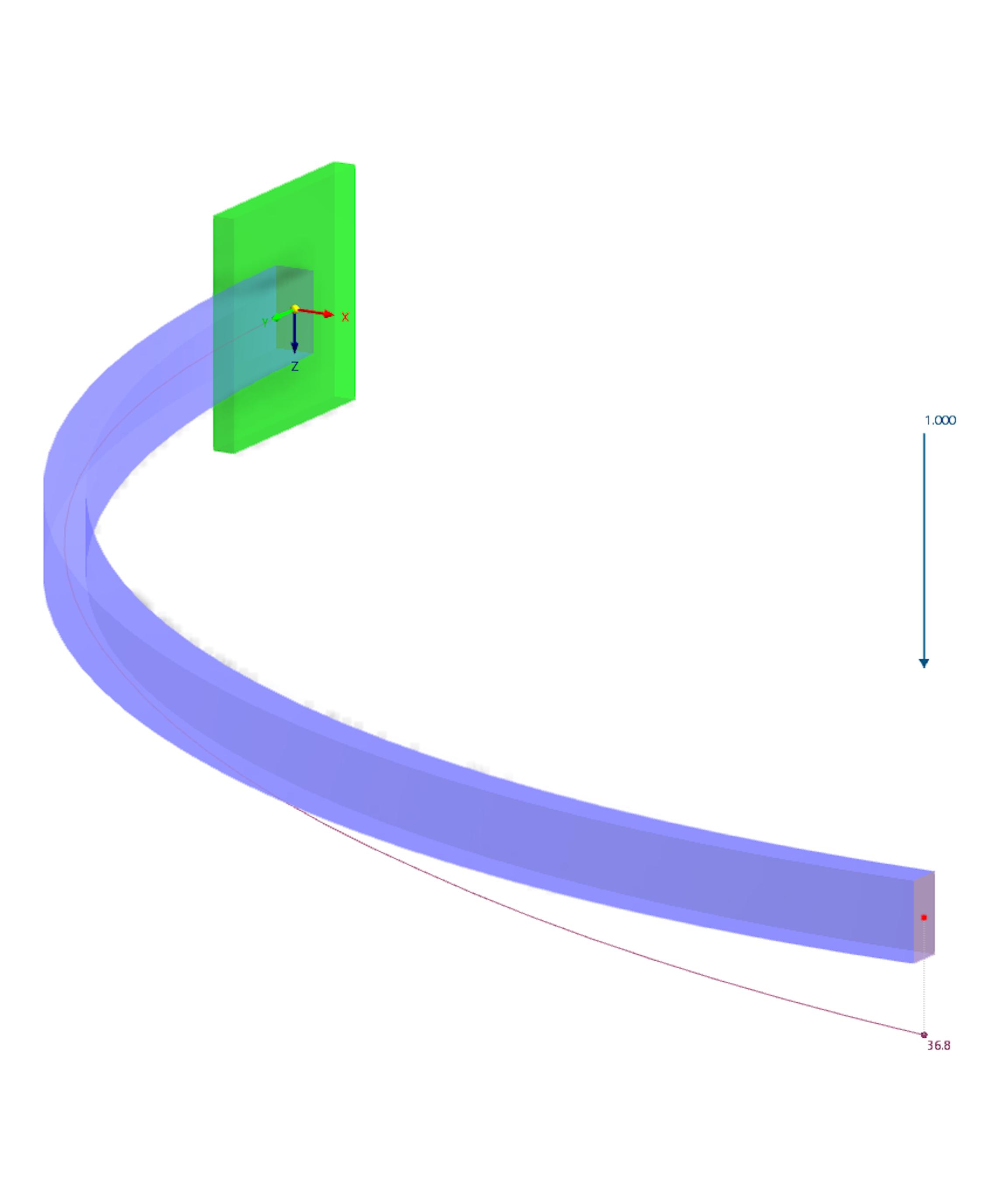
Modelling a curved beam subjected to eccentric out-of-plane loading and evaluating its deflection:
Keywords:
curved beam arc line nodal load force eccentricity deflection |
from dlubal.api import rfem, common
from math import inf, pi, cos, sin

# -------------------------------------------------------
# This example demonstrates how to modelling a
# quarter-circle beam with a rectangular cross-section
# which is loaded by means of an eccentric out-of-plane force.
# While neglecting self-weight, the total deflection
# of the curved beam is retrieved.
# -------------------------------------------------------


# Editable parameters (SI units)
BEAM_RADIUS = 1
MATERIAL = 'S235'
CSS_WIDTH = 0.025
CSS_HEIGHT = 0.050
LOAD_FZ = 1000


def define_structure() -> list:
    """Define and return a list of structural objects."""

    return [
        rfem.structure_core.Material(
            no=1,
            name=MATERIAL,
        ),

        # Cross-Sections
        rfem.structure_core.CrossSection(
            no=1,
            material=1,
            type=rfem.structure_core.CrossSection.TYPE_PARAMETRIC_MASSIVE_I,
            b=CSS_WIDTH,
            h=CSS_HEIGHT,
        ),

        # Nodes
        rfem.structure_core.Node(
            no=1,
            coordinate_1=0.0,
            coordinate_2=0.0,
        ),
        rfem.structure_core.Node(
            no=2,
            coordinate_1=BEAM_RADIUS,
            coordinate_2=BEAM_RADIUS,
        ),

        # Lines
        rfem.structure_core.Line(
            no=1,
            type=rfem.structure_core.Line.TYPE_ARC,
            definition_nodes=[1, 2],
            arc_control_point=common.Vector3d(
                x=BEAM_RADIUS + BEAM_RADIUS*cos(3*pi/4),
                y=BEAM_RADIUS*sin(3*pi/4),
                z=0
            ),
        ),

        # Members
        rfem.structure_core.Member(
            no=1,
            line=1,
            cross_section_start=1,
            rotation_specification_type=rfem.structure_core.Member.ROTATION_SPECIFICATION_TYPE_INSIDE,
        ),

        # Nodal Supports
        rfem.types_for_nodes.NodalSupport(
            no=1,
            specific_direction_enabled=True,
            nodes=[1],
            spring=common.Vector3d(x=inf, y=inf, z=inf),
            rotational_restraint=common.Vector3d(x=inf, y=inf, z=inf),
            axes_sequence=rfem.types_for_nodes.NodalSupport.AXES_SEQUENCE_ZYX,
            rotated_about_angle_1=pi/2,
        ),
    ]

def define_loading() -> list:
    """Define and return a list of loading objects."""

    return [

        # Static Analysis Settings
        rfem.loading.StaticAnalysisSettings(
            no=1,
        ),

        # Load Cases
        rfem.loading.LoadCase(
            no=1,
            static_analysis_settings=1,
            self_weight_active=False,
        ),

        # Nodal Loads | LC1
        rfem.loads.NodalLoad(
            no=1,
            load_type=rfem.loads.NodalLoad.LOAD_TYPE_COMPONENTS,
            nodes=[2],
            components_force=common.Vector3d(x=0, y=0, z=LOAD_FZ),
            load_case=1,
            force_eccentricity_enabled = True,
            force_eccentricity=common.Vector3d(x=0, y=-BEAM_RADIUS, z=0)
        ),
    ]

# Connect to the RFEM application
with rfem.Application() as rfem_app:

    app_info = rfem_app.get_application_info()
    print(f"\nApplication Info:\n{app_info}")

    # Modelling
    rfem_app.create_model(name="curved_beam")
    rfem_app.delete_all_objects()
    rfem_app.create_object_list(define_structure() + define_loading())

    # Calculation
    calculation_info = rfem_app.calculate_all(
        skip_warnings=True
    )
    print(f"\nCalculation Info:\n{calculation_info}")

    # Results
    member_deformation_df = rfem_app.get_results(
        results_type=rfem.results.STATIC_ANALYSIS_MEMBERS_LOCAL_DEFORMATIONS
    ).data

    # Maximum deflection
    max_u_z = member_deformation_df["u_z"].abs().max()
    print(f"Max |u_z|: {max_u_z}")
using Google.Protobuf;
using System.Globalization;
using System.Linq;
using Common = Dlubal.Api.Common;
using Rfem = Dlubal.Api.Rfem;

// -------------------------------------------------------
// This example demonstrates how to model a
// quarter-circle beam with a rectangular cross-section
// loaded by an eccentric out-of-plane force.
// While neglecting self-weight, the maximum member-local
// deflection |u_z| of the curved beam is retrieved.
// -------------------------------------------------------

// Editable parameters (SI units)
const string MODEL_NAME = "curved_beam";
const string MATERIAL = "S235";
const double BEAM_RADIUS = 1.0;
const double CROSS_SECTION_WIDTH = 0.025;
const double CROSS_SECTION_HEIGHT = 0.050;
const double LOAD_FZ = 1000.0;

static List<IMessage> DefineStructure()
{
    return new List<IMessage>
    {
        new Rfem.StructureCore.Material
        {
            No = 1,
            Name = MATERIAL,
        },
        new Rfem.StructureCore.CrossSection
        {
            No = 1,
            Type = Rfem.StructureCore.CrossSection.Types.Type.ParametricMassiveI,
            B = CROSS_SECTION_WIDTH,
            H = CROSS_SECTION_HEIGHT,
            Material = 1,
        },
        new Rfem.StructureCore.Node
        {
            No = 1,
            Coordinate1 = 0.0,
            Coordinate2 = 0.0,
        },
        new Rfem.StructureCore.Node
        {
            No = 2,
            Coordinate1 = BEAM_RADIUS,
            Coordinate2 = BEAM_RADIUS,
        },
        new Rfem.StructureCore.Line
        {
            No = 1,
            DefinitionNodes = { 1, 2 },
            ArcControlPoint = new Common.Vector3d
            {
                X = BEAM_RADIUS + BEAM_RADIUS * Math.Cos(3 * Math.PI / 4),
                Y = BEAM_RADIUS * Math.Sin(3 * Math.PI / 4),
                Z = 0.0,
            },
        },
        new Rfem.StructureCore.Member
        {
            No = 1,
            Line = 1,
            CrossSectionStart = 1,
            RotationSpecificationType = Rfem.StructureCore.Member.Types.RotationSpecificationType.Inside,
        },
        new Rfem.TypesForNodes.NodalSupport
        {
            No = 1,
            SpecificDirectionEnabled = true,
            Nodes = { 1 },
            Spring = new Common.Vector3d { X = double.PositiveInfinity, Y = double.PositiveInfinity, Z = double.PositiveInfinity },
            RotationalRestraint = new Common.Vector3d { X = double.PositiveInfinity, Y = double.PositiveInfinity, Z = double.PositiveInfinity },
            RotatedAboutAngle1 = Math.PI / 2.0,
        },
    };
}

static List<IMessage> DefineLoading()
{
    return new List<IMessage>
    {
        new Rfem.Loading.StaticAnalysisSettings
        {
            No = 1,
        },
        new Rfem.Loading.LoadCase
        {
            No = 1,
            StaticAnalysisSettings = 1,
            SelfWeightActive = false,
        },
        new Rfem.Loads.NodalLoad
        {
            No = 1,
            LoadType = Rfem.Loads.NodalLoad.Types.LoadType.Components,
            Nodes = { 2 },
            ComponentsForce = new Common.Vector3d { X = 0.0, Y = 0.0, Z = LOAD_FZ },
            ForceEccentricityEnabled = true,
            ForceEccentricity = new Common.Vector3d { X = 0.0, Y = -BEAM_RADIUS, Z = 0.0 },
            LoadCase = 1,
        },
    };
}

static double ParseDoubleInvariant(object? value)
{
    if (value is null) return double.NaN;

    if (value is double d) return d;

    return double.TryParse(
        Convert.ToString(value, CultureInfo.InvariantCulture),
        NumberStyles.Any,
        CultureInfo.InvariantCulture,
        out var parsed
    )
        ? parsed
        : double.NaN;
}

ApplicationRfem? rfemApp = null;

try
{
    rfemApp = new ApplicationRfem();

    var appInfo = rfemApp.get_application_info();
    Console.WriteLine($"\nApplication Info:\n{appInfo}");

    rfemApp.create_model(name: MODEL_NAME);
    rfemApp.delete_all_objects();

    rfemApp.create_object_list(
        DefineStructure()
            .Concat(DefineLoading())
            .ToList()
    );

    var calculationInfo = rfemApp.calculate_all(skipWarnings: true);
    Console.WriteLine($"\nCalculation Info:\n{calculationInfo}");

    var memberDeformation = rfemApp.get_results(
        resultsType: Rfem.Results.ResultsType.StaticAnalysisMembersLocalDeformations
    );

    var maxAbsUz = memberDeformation.Data.Rows
        .Select(row => ParseDoubleInvariant(row["u_z"]))
        .Where(v => !double.IsNaN(v))
        .Select(Math.Abs)
        .DefaultIfEmpty(double.NaN)
        .Max();

    Console.WriteLine($"Max |u_z|: {maxAbsUz}");
}
catch (Exception ex)
{
    Console.WriteLine($"Error: {ex.Message}");
}
finally
{
    if (rfemApp != null) rfemApp.close_connection();
}