
Finite Element Mesh#
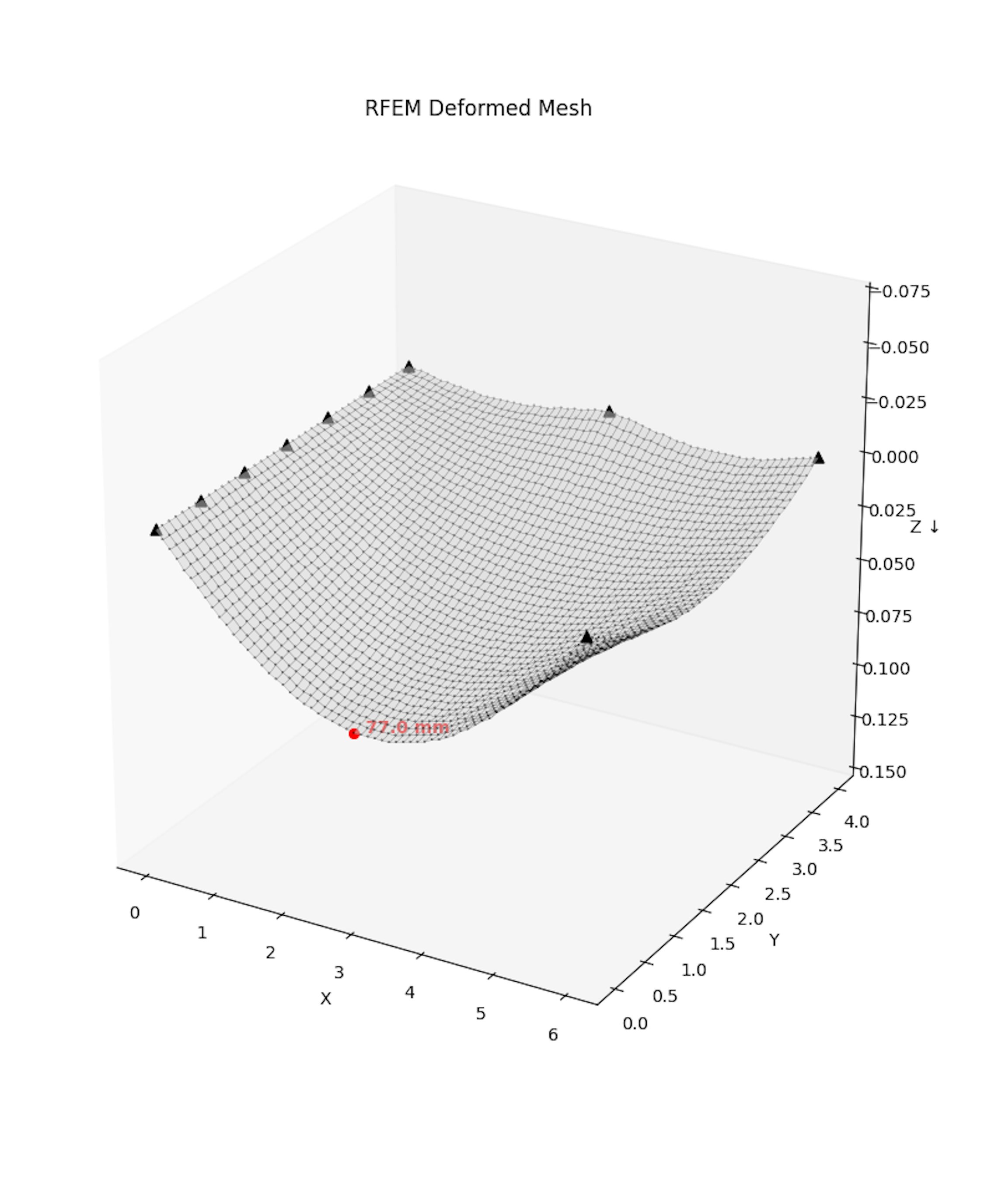
|
In this example we will demonstrate how to:
|
from dlubal.api import rfem, common
from math import inf
import re
import matplotlib.pyplot as plt
from mpl_toolkits.mplot3d.art3d import Poly3DCollection

# -------------------------------------------------------
# This example demonstrates creating a simple slab with loading,
# retrieving mesh data via get_mesh_table() and visualising it.
# -------------------------------------------------------


def define_structure() -> list:

    # Simple rectangular slab (6 x 4 m) with line support along one edge
    # and nodal hinged supports at the remaining corners.

    return [

        # Materials
        rfem.structure_core.Material(
            no=1,
            name="C25/30",
        ),

        # Thickness
        rfem.structure_core.Thickness(
            no=1,
            material=1,
            uniform_thickness=0.250
        ),

        # Nodes
        rfem.structure_core.Node(no=1, coordinate_1=0, coordinate_2=0),
        rfem.structure_core.Node(no=2, coordinate_1=0, coordinate_2=4),
        rfem.structure_core.Node(no=3, coordinate_1=3, coordinate_2=4),
        rfem.structure_core.Node(no=4, coordinate_1=6, coordinate_2=4),
        rfem.structure_core.Node(no=5, coordinate_1=6, coordinate_2=0),

        # Lines
        rfem.structure_core.Line(no=1, definition_nodes=[1, 2]),
        rfem.structure_core.Line(no=2, definition_nodes=[2, 3]),
        rfem.structure_core.Line(no=3, definition_nodes=[3, 4]),
        rfem.structure_core.Line(no=4, definition_nodes=[4, 5]),
        rfem.structure_core.Line(no=5, definition_nodes=[5, 1]),

        # Surface
        rfem.structure_core.Surface(
            no=1,
            thickness=1,
            material=1,
            boundary_lines=[1, 2, 3, 4, 5]
        ),

        # Nodal Supports
        rfem.types_for_nodes.NodalSupport(
            no=1,
            user_defined_name_enabled=True,
            name="Hinged",
            nodes=[3, 4, 5],
            spring=common.Vector3d(x=inf, y=inf, z=inf),
            rotational_restraint=common.Vector3d(x=0, y=0, z=inf),
        ),

        # Line Supports
        rfem.types_for_lines.LineSupport(
            no=1,
            user_defined_name_enabled=True,
            name="Hinged",
            lines=[1],
            spring=common.Vector3d(x=inf, y=inf, z=inf),
            rotational_restraint=common.Vector3d(x=0, y=0, z=0),
        ),

    ]


def define_loading() -> list:

    return [

        # Static Analysis Settings
        rfem.loading.StaticAnalysisSettings(
            no=1,
        ),

        # Load Cases
        rfem.loading.LoadCase(
            no=1,
            name="Self-weight",
            static_analysis_settings=1,
            self_weight_active=False,
        ),

        # Uniform surface load of 250 kN/m² in global Z direction
        rfem.loads.SurfaceLoad(
            no=1,
            surfaces=[1],
            load_case=1,
            uniform_magnitude=250000,
            load_type=rfem.loads.SurfaceLoad.LoadType.LOAD_TYPE_FORCE,
            load_distribution=rfem.loads.SurfaceLoad.LoadDistribution.LOAD_DISTRIBUTION_UNIFORM,
            load_direction=rfem.loads.SurfaceLoad.LoadDirection.LOAD_DIRECTION_GLOBAL_Z_OR_USER_DEFINED_W_TRUE_LENGTH
        )

    ]


def _get_col(df, *names):
    lower = {col.lower(): col for col in df.columns}
    for name in names:
        if name.lower() in lower:
            return lower[name.lower()]
    raise KeyError(f"None of columns {names} found in: {list(df.columns)}")


def _extract_node_cols(df):
    node_cols = []
    for col in df.columns:
        match = re.search(r"node\D*(\d+)", col.lower())
        if match:
            node_cols.append((int(match.group(1)), col))
    node_cols.sort(key=lambda item: item[0])
    return [col for _, col in node_cols]


def _parse_node_coords(df) -> dict:
    id_col = _get_col(df, "id", "no")
    x_col = _get_col(df, "x")
    y_col = _get_col(df, "y")
    z_col = _get_col(df, "z")
    coords = {}
    for _, row in df.iterrows():
        try:
            node_id = int(row[id_col])
        except (TypeError, ValueError):
            continue
        coords[node_id] = (float(row[x_col]), float(row[y_col]), float(row[z_col]))
    return coords


def plot_deformed_mesh(nodes_deformed_df, nodes_original_df, elements_2d_df,
                       nodal_support_nodes=None, line_support_node_pairs=None,
                       deformation_scale=0.9):
    node_positions = _parse_node_coords(nodes_deformed_df)
    node_positions_org = _parse_node_coords(nodes_original_df)

    # Actual deflections — used for labels and print output
    z_deflections = {
        node_id: node_positions[node_id][2] - node_positions_org[node_id][2]
        for node_id in node_positions
        if node_id in node_positions_org
    }

    # Visually scaled positions — deformation_scale < 1 reduces, > 1 exaggerates
    node_positions_plot = {
        node_id: (
            x_org + (node_positions[node_id][0] - x_org) * deformation_scale,
            y_org + (node_positions[node_id][1] - y_org) * deformation_scale,
            z_org + (node_positions[node_id][2] - z_org) * deformation_scale,
        )
        for node_id, (x_org, y_org, z_org) in node_positions_org.items()
        if node_id in node_positions
    }

    max_deflection_node = max(z_deflections, key=lambda nid: abs(z_deflections[nid])) if z_deflections else None

    fig = plt.figure()
    ax = fig.add_subplot(111, projection="3d")

    xs = [c[0] for c in node_positions_plot.values()]
    ys = [c[1] for c in node_positions_plot.values()]
    zs = [c[2] for c in node_positions_plot.values()]
    ax.scatter(xs, ys, zs, color="black", marker="o", s=0.1)

    node_cols_2d = _extract_node_cols(elements_2d_df)
    for _, row in elements_2d_df.iterrows():
        poly_ids = [node_positions_plot[int(row[col])] for col in node_cols_2d
                    if row[col] == row[col] and row[col] is not None  # skip NaN
                    and int(row[col]) in node_positions_plot]
        if len(poly_ids) >= 3:
            ax.add_collection3d(
                Poly3DCollection(
                    [poly_ids],
                    facecolors="lightgray",
                    linewidths=0.2,
                    edgecolors="gray",
                    alpha=0.5,
                )
            )

    # Draw nodal supports as triangles at original node positions
    if nodal_support_nodes:
        for nid in nodal_support_nodes:
            if nid in node_positions_org:
                x, y, z = node_positions_org[nid]
                ax.scatter([x], [y], [z], marker="^", color="black", s=40, zorder=50, depthshade=False)

    # Draw line supports as a row of triangles along each supported edge
    if line_support_node_pairs:
        for n1, n2 in line_support_node_pairs:
            if n1 in node_positions_org and n2 in node_positions_org:
                x1, y1, z1 = node_positions_org[n1]
                x2, y2, z2 = node_positions_org[n2]
                for t in [i / 6 for i in range(7)]:
                    ax.scatter(
                        [x1 + t * (x2 - x1)],
                        [y1 + t * (y2 - y1)],
                        [z1 + t * (z2 - z1)],
                        marker="^", color="black", s=40, zorder=50, depthshade=False,
                    )

    if max_deflection_node is not None:
        x_max, y_max, z_max = node_positions_plot[max_deflection_node]
        z_def_mm = abs(z_deflections[max_deflection_node]) * 1000.0
        print(f"Max deflection at node {max_deflection_node}: {z_def_mm:.1f} mm")

        ax.scatter([x_max], [y_max], [z_max], color="red", marker="o", s=30,
                   depthshade=False, zorder=100)
        ax.text(x_max, y_max, z_max, f"  {z_def_mm:.1f} mm", color="red", fontweight="bold")

    # Z axis: -1x max deflection above slab (margin), +2x max deflection below (e.g. -77mm to +154mm)
    max_def = max(abs(d) for d in z_deflections.values()) if z_deflections else 0.1
    ax.set_zlim(-max_def, 2 * max_def)

    ax.set_xlabel("X")
    ax.set_ylabel("Y")
    ax.set_zlabel("Z ↓")
    ax.set_title("RFEM Deformed Mesh")
    ax.set_box_aspect((1, 1, 1))
    ax.grid(False)
    ax.invert_zaxis()
    ax.view_init(elev=25, azim=-60)

    plt.show()


# -------------------------------------------------------
# MAIN SCRIPT
# -------------------------------------------------------

with rfem.Application() as rfem_app:

    # Create model
    rfem_app.close_all_models(save_changes=False)
    rfem_app.create_model(name="mesh_table.rf6")

    rfem_app.delete_all_objects()
    rfem_app.create_object_list(
        objs=define_structure() + define_loading()
    )

    # Update mesh settings
    mesh_settings = rfem_app.get_mesh_settings()
    mesh_settings.surfaces_shape_of_finite_elements = rfem.mesh.MeshSettings.SURFACES_SHAPE_OF_FINITE_ELEMENTS_FOR_SURFACES__QUADRANGLES_ONLY
    mesh_settings.general_target_length_of_fe = 0.1
    rfem_app.set_mesh_settings(mesh_settings=mesh_settings)

    rfem_app.calculate_all(skip_warnings=True)


    # --- Retrieve mesh data ---

    # Deformed node positions (for LC1)
    mesh_nodes_deformed = rfem_app.get_mesh_table(
        mesh_entity=rfem.mesh.MeshEntity.NODE,
        mesh_shape=rfem.mesh.MeshShape.DEFORMED,
        loading=rfem.ObjectId(
            no=1,
            object_type=rfem.OBJECT_TYPE_LOAD_CASE,
        ),
        load_increment=1
    ).data
    print(f"Mesh Nodes - Deformed Shape:\n{mesh_nodes_deformed}")

    # Original (undeformed) node positions
    mesh_nodes_original = rfem_app.get_mesh_table(
        mesh_entity=rfem.mesh.MeshEntity.NODE,
        mesh_shape=rfem.mesh.MeshShape.ORIGINAL,
    ).data

    # 2D mesh elements
    mesh_2d_elements = rfem_app.get_mesh_table(
        mesh_entity=rfem.mesh.MeshEntity.ELEMENT_2D,
        mesh_shape=rfem.mesh.MeshShape.ORIGINAL,
    ).data

    # --- Visualise deformed mesh ---

    plot_deformed_mesh(
        nodes_deformed_df=mesh_nodes_deformed,
        nodes_original_df=mesh_nodes_original,
        elements_2d_df=mesh_2d_elements,
        nodal_support_nodes=[3, 4, 5],       # hinged supports at corners
        line_support_node_pairs=[(1, 2)],    # hinged support along line 1
    )