
Deflection Creep Shrinkage#
|
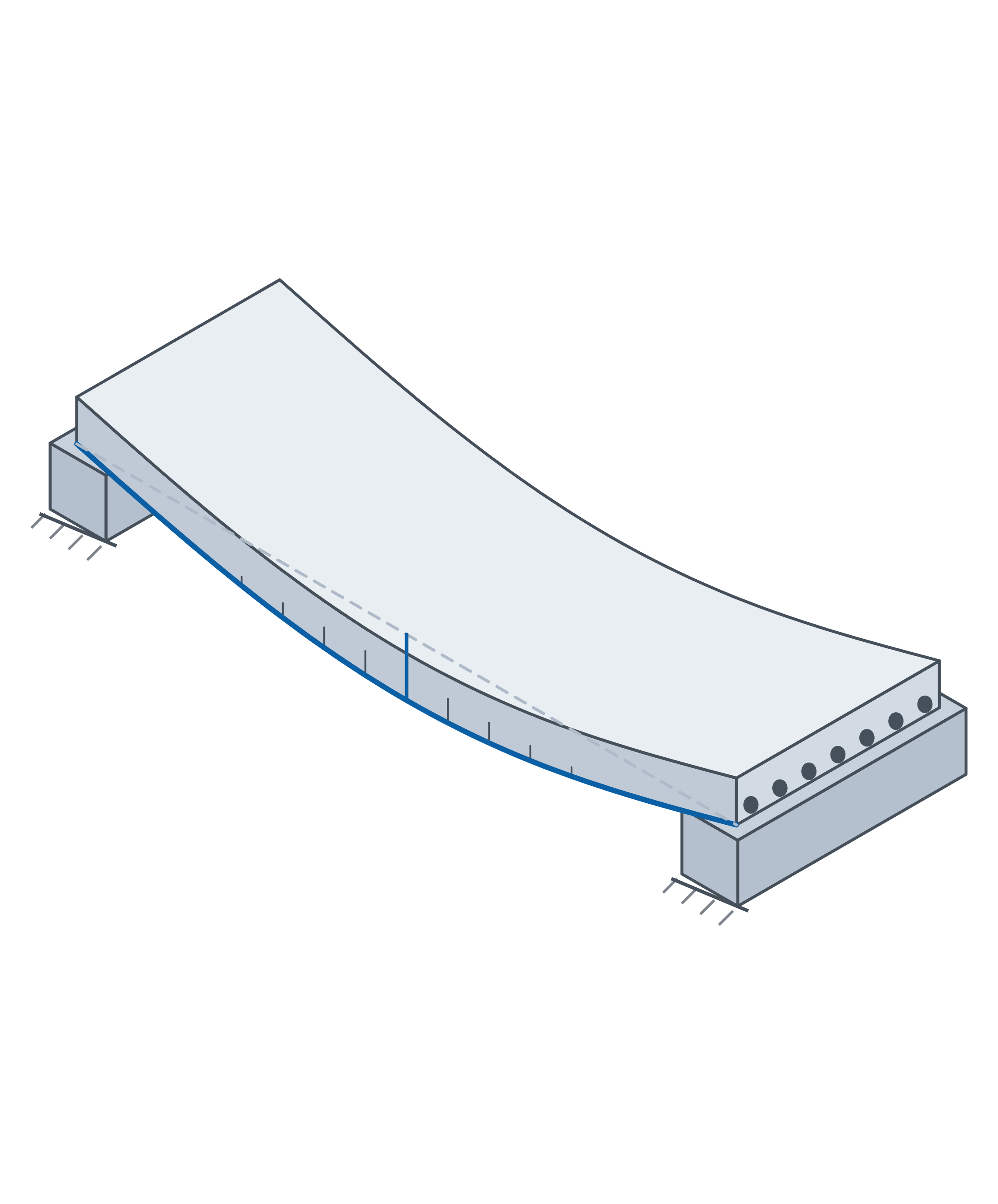
Checking the long-term deflection of a reinforced concrete slab strip acc. to EN 1992-1-1, 7.4.3, with the direct deformation analysis including creep and shrinkage:
Keywords:
deflection creep shrinkage time-dependent properties cracked section serviceability verification example |
Note
Reference: Dlubal Knowledge Base article 001935, creep coefficient φ = 2.0 and shrinkage strain εcs = -0.5 ‰. The results of RFEM agree with the reference within 1 %.
from dlubal.api import rfem, common
from math import inf, exp, sqrt
import pandas

# -------------------------------------------------------
# This example demonstrates the serviceability check of the long-term deflection of a
# reinforced concrete slab strip acc. to EN 1992-1-1, 7.4.3, with the direct deformation
# analysis of the Concrete Design add-on: cracked and uncracked stiffness, tension
# stiffening (distribution coefficient zeta), creep and shrinkage of the concrete.
#
# Reference:
#   Dlubal Knowledge Base article 001935 - Direct Deformation Analysis of Reinforced Concrete
#   Beams Considering Long-Term Effects of Creep and Shrinkage (2025).
#
#   Simply supported slab strip b/h = 1000/200 mm, span 4.21 m, C20/25, B500A,
#   bottom reinforcement 7 bars 9 mm = 4.45 cm2 (d1 = 30 mm), no top reinforcement.
#   Quasi-permanent load 6.5 + 0.3 x 2.0 + 1.0 x 1.25 = 8.35 kN/m (M = 18.50 kNm).
#   Creep coefficient phi = 2.0, total shrinkage strain eps_cs = -0.5 permille.
#   Deflection limit L/250 = 16.8 mm.
#
# Creep and shrinkage are entered in the advanced time-dependent properties of the
# cross-section through the basic values phi_0, eps_cd0 and eps_ca. RFEM evaluates them at
# the age of concrete of the serviceability configuration (50 years by default), so the basic
# values are chosen with the time functions of EN 1992-1-1, Annex B and 3.1.4 such that
# phi(t, t0) = 2.0 and eps_cs(t) = -0.5 permille at that age.
# -------------------------------------------------------


SPAN = 4.21                 # m
WIDTH, HEIGHT = 1.0, 0.20   # m
BAR_COUNT, BAR_DIAMETER = 7, 0.009
D1 = 0.030                  # m, axis distance of the bottom bars
Q_QP = 8.35e3               # N/m, quasi-permanent load
PHI = 2.0                   # creep coefficient at the considered time
EPS_CS = -0.5e-3            # total shrinkage strain at the considered time

# Time functions (EN 1992-1-1, Annex B.1 and 3.1.4) for the default ages of RFEM:
# t_s = 3 days (end of curing), t_0 = 28 days (loading), t = 50 years, RH = 50 %, C20/25.
T_S, T_0, T = 3.0, 28.0, 50 * 365.25     # days
H_0 = 2 * WIDTH * HEIGHT / (2 * (WIDTH + HEIGHT)) * 1e3     # mm, notional size (all faces drying)
BETA_H = min(1.5 * (1 + (0.012 * 50)**18) * H_0 + 250, 1500)
BETA_C = ((T - T_0) / (BETA_H + T - T_0))**0.3               # development of creep
BETA_DS = (T - T_S) / ((T - T_S) + 0.04 * sqrt(H_0**3))     # development of drying shrinkage
K_H = 1.0 - 0.15 * (H_0 - 100) / 100                         # Table 3.3, 100 mm < h0 < 200 mm
PHI_0 = PHI / BETA_C
EPS_CD0 = EPS_CS / (K_H * BETA_DS)                           # autogenous shrinkage set to zero

# Results published in the reference
REFERENCE = {
    "x_II": (46.8, "mm", "Depth of compression zone x_II"),
    "zeta": (0.757, "-", "Distribution coefficient zeta"),
    "u_z": (19.4, "mm", "Long-term deflection u_z"),
    "eta": (1.155, "-", "Design ratio u_z / (L/250)"),
}


def define_structure() -> list:

    return [

        rfem.structure_core.Material(no=1, name="C20/25"),
        rfem.structure_core.Material(no=2, name="B500A"),

        rfem.structure_core.CrossSection(
            no=1,
            name=f"R_M1 {WIDTH * 1e3:.0f}/{HEIGHT * 1e3:.0f}",
            material=1,
            advanced_time_dependent_properties_of_concrete_enabled=True,
            creep_enabled=True,
            shrinkage_enabled=True,
            # Range and resolution of the time functions (not preset when the option is enabled via the API)
            function_data_maximum_age_of_concrete=T * 86400,  # s (SI unit of time)
            function_data_number_of_steps=100,
        ),

        rfem.structure_core.Node(no=1),
        rfem.structure_core.Node(no=2, coordinate_1=SPAN),
        rfem.structure_core.Line(no=1, definition_nodes=[1, 2]),
        rfem.structure_core.Member(
            no=1,
            line=1,
            cross_section_start=1,
            concrete_durability_top=1,
            concrete_durability_bottom=1,
            concrete_durability_left=1,
            concrete_durability_right=1,
            concrete_cover_user_defined_enabled=True,
            concrete_cover=D1 - BAR_DIAMETER / 2,
            concrete_longitudinal_reinforcement_items=rfem.structure_core.Member.ConcreteLongitudinalReinforcementItemsTable(
                rows=[
                    rfem.structure_core.Member.ConcreteLongitudinalReinforcementItemsRow(
                        rebar_type=rfem.structure_core.Member.ConcreteLongitudinalReinforcementItemsRow.REBAR_TYPE_UNSYMMETRICAL,
                        material=2,
                        bar_count_unsymmetrical_top_side=0,
                        bar_count_unsymmetrical_at_side=0,
                        bar_count_unsymmetrical_bottom_side=BAR_COUNT,
                        bar_diameter_unsymmetrical_bottom_side=BAR_DIAMETER,
                        # Bars placed from the section surface: without this, RFEM places them
                        # inside an assumed stirrup and the effective depth is 10 mm smaller.
                        additional_offset_type=rfem.structure_core.Member.ConcreteLongitudinalReinforcementItemsRow.ADDITIONAL_OFFSET_TYPE_FROM_SECTION_SURFACE,
                        additional_offset_top_side=D1 - BAR_DIAMETER / 2,
                        additional_offset_bottom_side=D1 - BAR_DIAMETER / 2,
                        additional_offset_left_side=D1 - BAR_DIAMETER / 2,
                        additional_offset_right_side=D1 - BAR_DIAMETER / 2,
                        span_position_definition_format=rfem.structure_core.Member.ConcreteLongitudinalReinforcementItemsRow.SPAN_POSITION_DEFINITION_FORMAT_RELATIVE,
                        span_start_relative=0.0,
                        span_end_relative=1.0,
                    ),
                ]
            ),
        ),

        rfem.types_for_nodes.NodalSupport(
            no=1,
            nodes=[1],
            spring=common.Vector3d(x=inf, y=inf, z=inf),
            rotational_restraint=common.Vector3d(x=inf, y=0, z=0),
        ),
        rfem.types_for_nodes.NodalSupport(
            no=2,
            nodes=[2],
            spring=common.Vector3d(x=0, y=inf, z=inf),
            rotational_restraint=common.Vector3d(x=inf, y=0, z=0),
        ),
    ]


def define_loading() -> list:

    # The reference gives the quasi-permanent load directly (self-weight included).

    return [

        rfem.loading.StaticAnalysisSettings(no=1),
        rfem.loading.LoadCase(
            no=1,
            name="Quasi-permanent load",
            static_analysis_settings=1,
            self_weight_active=False,
        ),
        rfem.loading.DesignSituation(
            no=1,
            design_situation_type=rfem.loading.DesignSituation.DESIGN_SITUATION_TYPE_SLS_QUASI_PERMANENT,
        ),
        rfem.loading.LoadCombination(
            no=1,
            name="Quasi-permanent",
            design_situation=1,
            static_analysis_settings=1,
            combination_rule_str="LC1",
        ),
        rfem.loads.MemberLoad(
            no=1,
            load_case=1,
            members=[1],
            load_distribution=rfem.loads.MemberLoad.LOAD_DISTRIBUTION_UNIFORM,
            magnitude=Q_QP,
        ),
    ]


def define_concrete_design() -> list:

    return [

        rfem.concrete_design_objects.ConcreteDesignSlsConfiguration(
            no=1,
            assigned_to_all_members=True,
        ),

        # Closed interior spaces (XC1)
        rfem.reinforcement.ConcreteDurability(
            no=1,
            members=[1],
            corrosion_induced_by_carbonation_enabled=True,
            corrosion_induced_by_carbonation=rfem.reinforcement.ConcreteDurability.CORROSION_INDUCED_BY_CARBONATION_DRY_OR_PERMANENTLY_WET,
        ),

        # Supports of the deflection check (reference length L = span)
        rfem.types_for_members.DesignSupport(
            no=1,
            type=rfem.types_for_members.DesignSupport.TYPE_CONCRETE,
            assigned_to_members=[1],
            assigned_to_nodes=[1, 2],
            consider_in_deflection_design_z=True,
            consider_in_deflection_design_y=False,
        ),
    ]


def set_time_dependent_properties(rfem_app: rfem.Application) -> None:
    """
    Enters user-defined basic values of creep and shrinkage in the advanced time-dependent
    properties of the cross-section. The values of this tree are stored as text in SI units.
    """
    cross_section = rfem_app.get_object(rfem.structure_core.CrossSection(no=1))
    tree = cross_section.time_dependent_properties

    values = {
        "user_defined_basic_values": "true",
        "phi_0": str(PHI_0),
        "epsilon_cd0": str(EPS_CD0),
        "epsilon_ca_": "0",
    }

    def update(rows):
        for row in rows:
            if row.key in values:
                row.value = values[row.key]
            update(row.rows)

    update(tree.rows)
    rfem_app.update_object(
        rfem.structure_core.CrossSection(no=1, time_dependent_properties=tree)
    )

    # Read back the values evaluated by RFEM at the considered age of concrete
    cross_section = rfem_app.get_object(rfem.structure_core.CrossSection(no=1))

    def find(rows, key):
        for row in rows:
            if row.key == key:
                return row.value
            found = find(row.rows, key)
            if found is not None:
                return found

    print(f"phi_0 = {find(cross_section.time_dependent_properties.rows, 'phi_0')}, "
          f"eps_cd0 = {find(cross_section.time_dependent_properties.rows, 'epsilon_cd0')}")
    print(f"phi(t,t0) = {find(cross_section.time_dependent_properties.rows, 'phi_t_t_0_')}, "
          f"eps_cs(t) = {find(cross_section.time_dependent_properties.rows, 'epsilon_cs_t')}")


# -------------------------------------------------------
# MAIN SCRIPT
# -------------------------------------------------------

with rfem.Application() as rfem_app:

    rfem_app.create_model(name="concrete_design_deflection_creep_shrinkage")

    base_data = rfem_app.get_base_data()
    base_data.addons.concrete_design_active = True
    base_data.standards.concrete_design_standard = rfem.BaseData.Standards.CONCRETE_DESIGN_NATIONAL_ANNEX_AND_EDITION_EN_1992_CEN_2014_11_STANDARD
    rfem_app.set_base_data(base_data=base_data)

    rfem_app.delete_all_objects()
    rfem_app.create_object_list(
        objs=
            define_concrete_design() +
            define_structure() +
            define_loading()
    )
    set_time_dependent_properties(rfem_app)

    calculation_info = rfem_app.calculate_all(skip_warnings=True)
    if not calculation_info.succeeded:
        plausibility = rfem_app.plausibility_check(
            type=common.PlausibilityCheckType.PLAUSIBILITY_CHECK_PLAUSIBILITY_CHECK,
            skip_warnings=False,
        )
        raise RuntimeError(f"Calculation failed: {plausibility.message}\n{plausibility.data}")

    design_ratios_df = rfem_app.get_results(
        results_type=rfem.results.CONCRETE_DESIGN_MEMBERS_DESIGN_RATIOS,
    ).data
    summary = design_ratios_df.sort_values("design_ratio", ascending=False).drop_duplicates("design_check_type")
    print("\nGoverning design ratios per check type:")
    print(summary[["design_check_type", "design_ratio", "location_x", "design_check_description"]].to_string(index=False))

    # Deflection check acc. to 7.4.3(3) at mid-span
    check_type = "SE0400.00"
    rows = design_ratios_df[design_ratios_df["design_check_type"] == check_type]
    governing = rows.loc[rows["design_ratio"].idxmax()]
    details_df = rfem_app.get_results(
        results_type=rfem.results.CONCRETE_DESIGN_DESIGN_CHECK_DETAILS,
        filters=[rfem.results.ResultsFilter(column_id="design_check_details_id", filter_expression=str(governing["design_check_details_id"]))],
    ).data

    def value(key: str) -> float:
        return float(details_df.loc[details_df["key"] == key, "value_si"].values[0])

    print(f"\n{check_type} | {governing['design_check_description']} | x = {governing['location_x']} m")
    print(f"d = {value('d_def_z_bottom') * 1e3:.0f} mm, I_I = {value('i_y_i') * 1e8:.0f} cm4, I_II = {value('i_y_ii') * 1e8:.0f} cm4, "
          f"N_sh = {value('n_sh') / 1e3:.2f} kN, kappa_I = {value('kappa_y_i') * 1e3:.1f}, kappa_II = {value('kappa_y_ii') * 1e3:.1f}, "
          f"kappa_f = {value('kappa_y_f') * 1e3:.1f} mrad/m")

    rfem_values = {
        "x_II": value("x_ii") * 1e3,
        "zeta": value("zeta_d"),
        "u_z": value("u_z") * 1e3,
        "eta": value("eta"),
    }
    print(f"\n{'Quantity':<36}{'RFEM':>9}{'Reference':>11}{'Deviation':>11}")
    for key, (ref_value, unit, caption) in REFERENCE.items():
        deviation = (rfem_values[key] - ref_value) / ref_value * 100
        print(f"{caption + ' [' + unit + ']':<36}{rfem_values[key]:>9.3f}{ref_value:>11.3f}{deviation:>10.1f}%")
using System.Globalization;
using Google.Protobuf;
using Microsoft.Data.Analysis;
using Common = Dlubal.Api.Common;
using Rfem = Dlubal.Api.Rfem;

// -------------------------------------------------------
// This example demonstrates the serviceability check of the long-term deflection of a
// reinforced concrete slab strip acc. to EN 1992-1-1, 7.4.3, with the direct deformation
// analysis of the Concrete Design add-on: cracked and uncracked stiffness, tension
// stiffening (distribution coefficient zeta), creep and shrinkage of the concrete.
//
// Reference:
//   Dlubal Knowledge Base article 001935 - Direct Deformation Analysis of Reinforced Concrete
//   Beams Considering Long-Term Effects of Creep and Shrinkage (2025).
//
//   Simply supported slab strip b/h = 1000/200 mm, span 4.21 m, C20/25, B500A,
//   bottom reinforcement 7 bars 9 mm = 4.45 cm2 (d1 = 30 mm), no top reinforcement.
//   Quasi-permanent load 6.5 + 0.3 x 2.0 + 1.0 x 1.25 = 8.35 kN/m (M = 18.50 kNm).
//   Creep coefficient phi = 2.0, total shrinkage strain eps_cs = -0.5 permille.
//   Deflection limit L/250 = 16.8 mm.
//
// Creep and shrinkage are entered in the advanced time-dependent properties of the
// cross-section through the basic values phi_0, eps_cd0 and eps_ca. RFEM evaluates them at
// the age of concrete of the serviceability configuration (50 years by default), so the basic
// values are chosen with the time functions of EN 1992-1-1, Annex B and 3.1.4 such that
// phi(t, t0) = 2.0 and eps_cs(t) = -0.5 permille at that age.
// -------------------------------------------------------


const double SPAN = 4.21;                   // m
const double WIDTH = 1.0, HEIGHT = 0.20;    // m
const int BAR_COUNT = 7;
const double BAR_DIAMETER = 0.009;
const double D1 = 0.030;                    // m, axis distance of the bottom bars
const double Q_QP = 8.35e3;                 // N/m, quasi-permanent load
const double PHI = 2.0;                     // creep coefficient at the considered time
const double EPS_CS = -0.5e-3;              // total shrinkage strain at the considered time

// Time functions (EN 1992-1-1, Annex B.1 and 3.1.4) for the default ages of RFEM:
// t_s = 3 days (end of curing), t_0 = 28 days (loading), t = 50 years, RH = 50 %, C20/25.
const double T_S = 3.0, T_0 = 28.0, T = 50 * 365.25;          // days
const double H_0 = 2 * WIDTH * HEIGHT / (2 * (WIDTH + HEIGHT)) * 1e3;   // mm, notional size (all faces drying)
double BETA_H = Math.Min(1.5 * (1 + Math.Pow(0.012 * 50, 18)) * H_0 + 250, 1500);
double BETA_C = Math.Pow((T - T_0) / (BETA_H + T - T_0), 0.3);            // development of creep
double BETA_DS = (T - T_S) / ((T - T_S) + 0.04 * Math.Sqrt(Math.Pow(H_0, 3)));   // development of drying shrinkage
const double K_H = 1.0 - 0.15 * (H_0 - 100) / 100;                       // Table 3.3, 100 mm < h0 < 200 mm
double PHI_0 = PHI / BETA_C;
double EPS_CD0 = EPS_CS / (K_H * BETA_DS);                               // autogenous shrinkage set to zero

// Results published in the reference: key -> (value, unit, caption)
var REFERENCE = new List<(string Key, double Value, string Unit, string Caption)>
{
    ("x_II", 46.8, "mm", "Depth of compression zone x_II"),
    ("zeta", 0.757, "-", "Distribution coefficient zeta"),
    ("u_z", 19.4, "mm", "Long-term deflection u_z"),
    ("eta", 1.155, "-", "Design ratio u_z / (L/250)"),
};


static List<IMessage> DefineStructure()
{
    return new List<IMessage>
    {
        new Rfem.StructureCore.Material { No = 1, Name = "C20/25" },
        new Rfem.StructureCore.Material { No = 2, Name = "B500A" },

        new Rfem.StructureCore.CrossSection
        {
            No = 1,
            Name = string.Format(CultureInfo.InvariantCulture, "R_M1 {0:F0}/{1:F0}", WIDTH * 1e3, HEIGHT * 1e3),
            Material = 1,
            AdvancedTimeDependentPropertiesOfConcreteEnabled = true,
            CreepEnabled = true,
            ShrinkageEnabled = true,
            // Range and resolution of the time functions (not preset when the option is enabled via the API)
            FunctionDataMaximumAgeOfConcrete = T * 86400,  // s (SI unit of time)
            FunctionDataNumberOfSteps = 100,
        },

        new Rfem.StructureCore.Node { No = 1 },
        new Rfem.StructureCore.Node { No = 2, Coordinate1 = SPAN },
        new Rfem.StructureCore.Line { No = 1, DefinitionNodes = { 1, 2 } },
        new Rfem.StructureCore.Member
        {
            No = 1,
            Line = 1,
            CrossSectionStart = 1,
            ConcreteDurabilityTop = 1,
            ConcreteDurabilityBottom = 1,
            ConcreteDurabilityLeft = 1,
            ConcreteDurabilityRight = 1,
            ConcreteCoverUserDefinedEnabled = true,
            ConcreteCover = D1 - BAR_DIAMETER / 2,
            ConcreteLongitudinalReinforcementItems = new Rfem.StructureCore.Member.Types.ConcreteLongitudinalReinforcementItemsTable
            {
                Rows =
                {
                    new Rfem.StructureCore.Member.Types.ConcreteLongitudinalReinforcementItemsRow
                    {
                        RebarType = Rfem.StructureCore.Member.Types.ConcreteLongitudinalReinforcementItemsRow.Types.RebarType.Unsymmetrical,
                        Material = 2,
                        BarCountUnsymmetricalTopSide = 0,
                        BarCountUnsymmetricalAtSide = 0,
                        BarCountUnsymmetricalBottomSide = BAR_COUNT,
                        BarDiameterUnsymmetricalBottomSide = BAR_DIAMETER,
                        // Bars placed from the section surface: without this, RFEM places them
                        // inside an assumed stirrup and the effective depth is 10 mm smaller.
                        AdditionalOffsetType = Rfem.StructureCore.Member.Types.ConcreteLongitudinalReinforcementItemsRow.Types.AdditionalOffsetType.FromSectionSurface,
                        AdditionalOffsetTopSide = D1 - BAR_DIAMETER / 2,
                        AdditionalOffsetBottomSide = D1 - BAR_DIAMETER / 2,
                        AdditionalOffsetLeftSide = D1 - BAR_DIAMETER / 2,
                        AdditionalOffsetRightSide = D1 - BAR_DIAMETER / 2,
                        SpanPositionDefinitionFormat = Rfem.StructureCore.Member.Types.ConcreteLongitudinalReinforcementItemsRow.Types.SpanPositionDefinitionFormat.Relative,
                        SpanStartRelative = 0.0,
                        SpanEndRelative = 1.0,
                    },
                },
            },
        },

        new Rfem.TypesForNodes.NodalSupport
        {
            No = 1,
            Nodes = { 1 },
            SpringX = double.PositiveInfinity,
            SpringY = double.PositiveInfinity,
            SpringZ = double.PositiveInfinity,
            RotationalRestraintX = double.PositiveInfinity,
            RotationalRestraintY = 0,
            RotationalRestraintZ = 0,
        },
        new Rfem.TypesForNodes.NodalSupport
        {
            No = 2,
            Nodes = { 2 },
            SpringX = 0,
            SpringY = double.PositiveInfinity,
            SpringZ = double.PositiveInfinity,
            RotationalRestraintX = double.PositiveInfinity,
            RotationalRestraintY = 0,
            RotationalRestraintZ = 0,
        },
    };
}


static List<IMessage> DefineLoading()
{
    // The reference gives the quasi-permanent load directly (self-weight included).

    return new List<IMessage>
    {
        new Rfem.Loading.StaticAnalysisSettings { No = 1 },
        new Rfem.Loading.LoadCase
        {
            No = 1,
            Name = "Quasi-permanent load",
            StaticAnalysisSettings = 1,
            SelfWeightActive = false,
        },
        new Rfem.Loading.DesignSituation
        {
            No = 1,
            DesignSituationType = Rfem.Loading.DesignSituation.Types.DesignSituationType.SlsQuasiPermanent,
        },
        new Rfem.Loading.LoadCombination
        {
            No = 1,
            Name = "Quasi-permanent",
            DesignSituation = 1,
            StaticAnalysisSettings = 1,
            CombinationRuleStr = "LC1",
        },
        new Rfem.Loads.MemberLoad
        {
            No = 1,
            LoadCase = 1,
            Members = { 1 },
            LoadDistribution = Rfem.Loads.MemberLoad.Types.LoadDistribution.Uniform,
            Magnitude = Q_QP,
        },
    };
}


static List<IMessage> DefineConcreteDesign()
{
    return new List<IMessage>
    {
        new Rfem.ConcreteDesignObjects.ConcreteDesignSlsConfiguration
        {
            No = 1,
            AssignedToAllMembers = true,
        },

        // Closed interior spaces (XC1)
        new Rfem.Reinforcement.ConcreteDurability
        {
            No = 1,
            Members = { 1 },
            CorrosionInducedByCarbonationEnabled = true,
            CorrosionInducedByCarbonation = Rfem.Reinforcement.ConcreteDurability.Types.CorrosionInducedByCarbonation.DryOrPermanentlyWet,
        },

        // Supports of the deflection check (reference length L = span)
        new Rfem.TypesForMembers.DesignSupport
        {
            No = 1,
            Type = Rfem.TypesForMembers.DesignSupport.Types.Type.Concrete,
            AssignedToMembers = { 1 },
            AssignedToNodes = { 1, 2 },
            ConsiderInDeflectionDesignZ = true,
            ConsiderInDeflectionDesignY = false,
        },
    };
}


// Enters user-defined basic values of creep and shrinkage in the advanced time-dependent
// properties of the cross-section. The values of this tree are stored as text in SI units.
void SetTimeDependentProperties(ApplicationRfem rfemApp)
{
    var crossSection = rfemApp.get_object<Rfem.StructureCore.CrossSection>(new Rfem.StructureCore.CrossSection { No = 1 });
    var tree = crossSection.TimeDependentProperties;

    var values = new Dictionary<string, string>
    {
        ["user_defined_basic_values"] = "true",
        ["phi_0"] = PHI_0.ToString(CultureInfo.InvariantCulture),
        ["epsilon_cd0"] = EPS_CD0.ToString(CultureInfo.InvariantCulture),
        ["epsilon_ca_"] = "0",
    };

    void Update(IEnumerable<Rfem.StructureCore.CrossSection.Types.TimeDependentPropertiesTreeTableRow> rows)
    {
        foreach (var row in rows)
        {
            if (values.TryGetValue(row.Key, out string? value))
            {
                row.Value = value;
            }
            Update(row.Rows);
        }
    }

    Update(tree.Rows);
    rfemApp.update_object(
        new Rfem.StructureCore.CrossSection { No = 1, TimeDependentProperties = tree }
    );

    // Read back the values evaluated by RFEM at the considered age of concrete
    crossSection = rfemApp.get_object<Rfem.StructureCore.CrossSection>(new Rfem.StructureCore.CrossSection { No = 1 });

    static string? Find(IEnumerable<Rfem.StructureCore.CrossSection.Types.TimeDependentPropertiesTreeTableRow> rows, string key)
    {
        foreach (var row in rows)
        {
            if (row.Key == key)
            {
                return row.Value;
            }
            string? found = Find(row.Rows, key);
            if (found != null)
            {
                return found;
            }
        }
        return null;
    }

    Console.WriteLine($"phi_0 = {Find(crossSection.TimeDependentProperties.Rows, "phi_0")}, "
        + $"eps_cd0 = {Find(crossSection.TimeDependentProperties.Rows, "epsilon_cd0")}");
    Console.WriteLine($"phi(t,t0) = {Find(crossSection.TimeDependentProperties.Rows, "phi_t_t_0_")}, "
        + $"eps_cs(t) = {Find(crossSection.TimeDependentProperties.Rows, "epsilon_cs_t")}");
}


static double ToDouble(object? cell) => Convert.ToDouble(cell, CultureInfo.InvariantCulture);
static string ToText(object? cell) => cell?.ToString() ?? string.Empty;


// -------------------------------------------------------
// MAIN SCRIPT
// -------------------------------------------------------

ApplicationRfem? rfemApp = null;

try
{
    rfemApp = new ApplicationRfem();

    rfemApp.create_model(name: "concrete_design_deflection_creep_shrinkage");

    var baseData = rfemApp.get_base_data();
    baseData.Addons.ConcreteDesignActive = true;
    baseData.Standards.ConcreteDesignStandard = Rfem.BaseData.Types.Standards.Types.ConcreteDesignStandard.ConcreteDesignNationalAnnexAndEditionEn1992Cen201411Standard;
    rfemApp.set_base_data(baseData: baseData);

    rfemApp.delete_all_objects();
    rfemApp.create_object_list(
        DefineConcreteDesign()
            .Concat(DefineStructure())
            .Concat(DefineLoading())
            .ToList()
    );
    SetTimeDependentProperties(rfemApp);

    var calculationInfo = rfemApp.calculate_all(skipWarnings: true);
    if (!calculationInfo.Succeeded)
    {
        var plausibility = rfemApp.plausibility_check(
            type: Common.PlausibilityCheckType.PlausibilityCheckPlausibilityCheck,
            skipWarnings: false
        );
        throw new InvalidOperationException($"Calculation failed: {plausibility.Message}\n{plausibility.Data}");
    }

    DataFrame designRatios = rfemApp.get_results(
        resultsType: Rfem.Results.ResultsType.ConcreteDesignMembersDesignRatios
    ).Data;
    Console.WriteLine("\nGoverning design ratios per check type:");
    Console.WriteLine($"{"design_check_type",17}{"design_ratio",13}{"location_x",11}  {"design_check_description"}");
    foreach (var row in designRatios.Rows
        .GroupBy(row => ToText(row["design_check_type"]))
        .Select(group => group.OrderByDescending(row => ToDouble(row["design_ratio"])).First())
        .OrderByDescending(row => ToDouble(row["design_ratio"])))
    {
        Console.WriteLine(string.Format(CultureInfo.InvariantCulture, "{0,17}{1,13:G6}{2,11:G6}  {3}",
            row["design_check_type"], ToDouble(row["design_ratio"]), ToDouble(row["location_x"]), row["design_check_description"]));
    }

    // Deflection check acc. to 7.4.3(3) at mid-span
    string checkType = "SE0400.00";
    var governing = designRatios.Rows
        .Where(row => ToText(row["design_check_type"]) == checkType)
        .OrderByDescending(row => ToDouble(row["design_ratio"]))
        .First();
    DataFrame details = rfemApp.get_results(
        resultsType: Rfem.Results.ResultsType.ConcreteDesignDesignCheckDetails,
        filters: new List<Rfem.Results.ResultsFilter>
        {
            new Rfem.Results.ResultsFilter { ColumnId = "design_check_details_id", FilterExpression = ToText(governing["design_check_details_id"]) },
        }
    ).Data;

    double Value(string key)
    {
        return ToDouble(details.Rows.First(row => ToText(row["key"]) == key)["value_si"]);
    }

    Console.WriteLine(string.Format(CultureInfo.InvariantCulture, "\n{0} | {1} | x = {2} m",
        checkType, governing["design_check_description"], governing["location_x"]));
    Console.WriteLine(string.Format(CultureInfo.InvariantCulture,
        "d = {0:F0} mm, I_I = {1:F0} cm4, I_II = {2:F0} cm4, "
        + "N_sh = {3:F2} kN, kappa_I = {4:F1}, kappa_II = {5:F1}, "
        + "kappa_f = {6:F1} mrad/m",
        Value("d_def_z_bottom") * 1e3, Value("i_y_i") * 1e8, Value("i_y_ii") * 1e8,
        Value("n_sh") / 1e3, Value("kappa_y_i") * 1e3, Value("kappa_y_ii") * 1e3,
        Value("kappa_y_f") * 1e3));

    var rfemValues = new Dictionary<string, double>
    {
        ["x_II"] = Value("x_ii") * 1e3,
        ["zeta"] = Value("zeta_d"),
        ["u_z"] = Value("u_z") * 1e3,
        ["eta"] = Value("eta"),
    };
    Console.WriteLine($"\n{"Quantity",-36}{"RFEM",9}{"Reference",11}{"Deviation",11}");
    foreach (var (key, refValue, unit, caption) in REFERENCE)
    {
        double deviation = (rfemValues[key] - refValue) / refValue * 100;
        Console.WriteLine(string.Format(CultureInfo.InvariantCulture,
            "{0,-36}{1,9:F3}{2,11:F3}{3,10:F1}%", $"{caption} [{unit}]", rfemValues[key], refValue, deviation));
    }
}
catch (Exception ex)
{
    Console.WriteLine($"Error: {ex.Message}");
}
finally
{
    if (rfemApp != null) rfemApp.close_connection();
}