
Punching Internal Column#
|
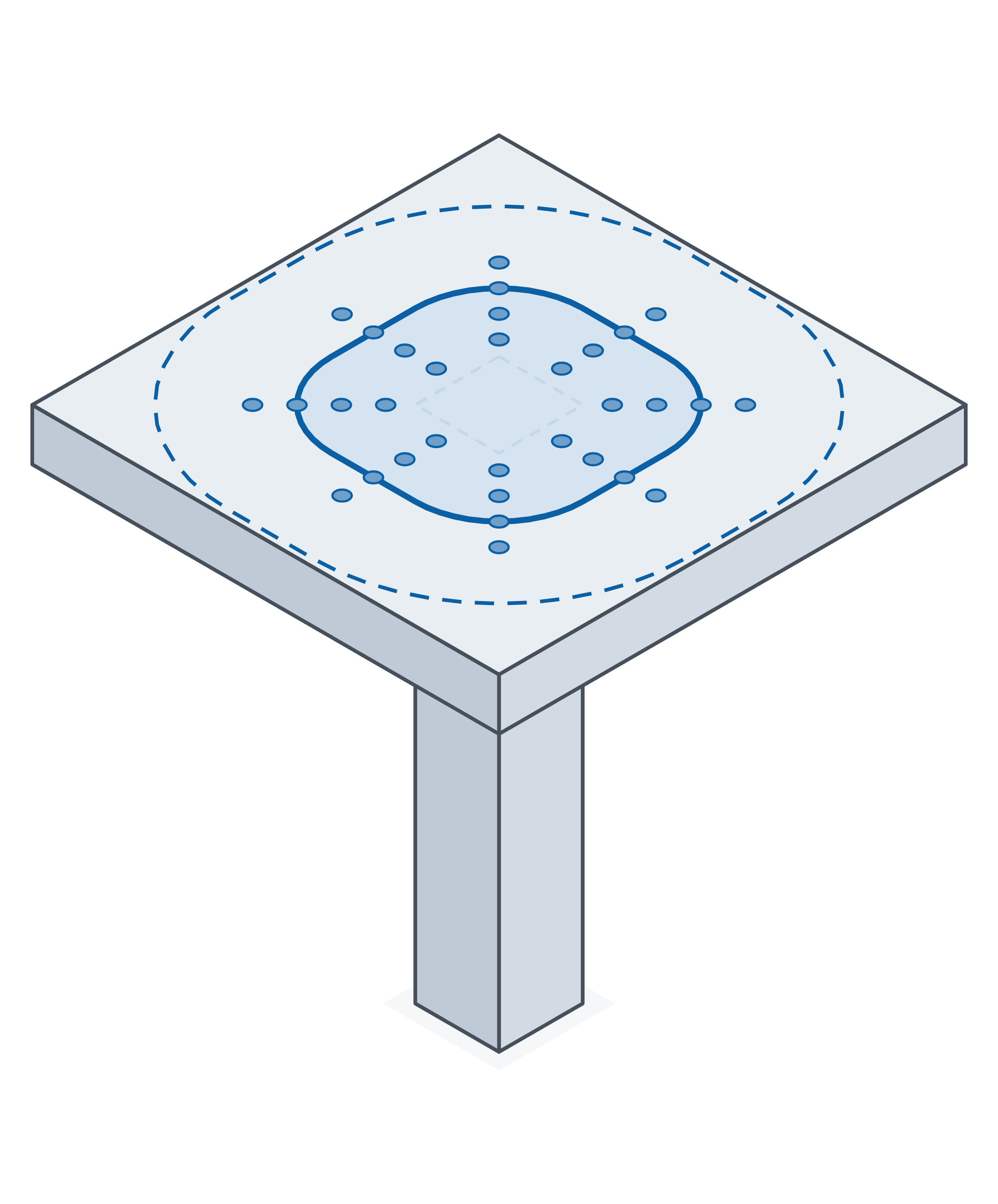
Designing a flat slab for punching shear at an internal column acc. to EN 1992-1-1 with the German National Annex, 6.4:
Keywords:
punching flat slab fictitious column surface reinforcement control perimeter shear reinforcement verification example |
Note
Reference: Dlubal Verification Example 1023, based on Example 4 of “Beispiele zur Bemessung nach Eurocode 2”, Volume 1 (DBV, 2011). The results of RFEM agree with the reference within 0.1 %.
from dlubal.api import rfem, common
from math import inf
import pandas

# -------------------------------------------------------
# This example demonstrates the punching shear design of a flat slab at an internal column
# acc. to EN 1992-1-1 with the German National Annex (DIN EN 1992-1-1/NA), 6.4:
# punching shear resistance without shear reinforcement, maximum resistance and the
# required punching shear reinforcement per perimeter.
#
# Reference:
#   Dlubal Verification Example 1023 - Flat Slab Designed According to DIN EN 1992-1-1 with NA:
#   Punching Shear Design (based on Example 4 of "Beispiele zur Bemessung nach Eurocode 2",
#   Band 1, Deutscher Beton- und Bautechnik-Verein, Ernst & Sohn 2011), column B/2.
#
#   Flat slab h = 240 mm, C35/45, B500S(B), internal column 450 x 450 mm,
#   top reinforcement 31.42 cm2/m in both directions (d_y = 180 mm, d_z = 200 mm),
#   design punching force V_Ed = 787.3 kN, beta = 1.10.
#
# Modelling:
#   Instead of the whole flat slab of the reference, one square panel of 6.75 x 6.75 m
#   centred on the column is modelled. Its edges are lines of symmetry of the slab: they
#   may move vertically but cannot rotate about their own axis. The whole panel load then
#   flows into the column, and the design load is chosen so that the support force equals
#   V_Ed of the reference.
# -------------------------------------------------------


PANEL = 6.75            # m, column grid
THICKNESS = 0.24        # m
COVER = 0.030           # m, concrete cover of the top reinforcement
COLUMN = 0.45           # m, square column
V_ED = 787.3e3          # N, design punching force of the reference
Q_D = V_ED / PANEL**2   # N/m2, design load that produces V_Ed in the column

# Results published in the reference
REFERENCE = {
    "u_1": (4.188, "m", "Basic control perimeter u1"),
    "v_ed": (1.088, "MPa", "Design shear stress v_Ed"),
    "v_rd_c": (0.929, "MPa", "Resistance without shear reinforcement v_Rd,c"),
    "v_rd_max": (1.300, "MPa", "Maximum resistance v_Rd,max = 1.4 v_Rd,c"),
    "u_out": (5.889, "m", "Outer perimeter u_out"),
    "a_sw_1": (12.45, "cm2", "Punching reinforcement, perimeter 1"),
    "a_sw_2": (6.97, "cm2", "Punching reinforcement, perimeter 2"),
    "a_sw_3": (4.98, "cm2", "Punching reinforcement, perimeter 3"),
}


def define_structure() -> list:

    a = PANEL / 2

    return [

        rfem.structure_core.Material(no=1, name="C35/45"),
        rfem.structure_core.Material(no=2, name="B500S(B)"),

        rfem.structure_core.Thickness(
            no=1,
            material=1,
            uniform_thickness=THICKNESS,
        ),

        # Slab panel centred on the column (node 5)
        rfem.structure_core.Node(no=1, coordinate_1=-a, coordinate_2=-a),
        rfem.structure_core.Node(no=2, coordinate_1=a, coordinate_2=-a),
        rfem.structure_core.Node(no=3, coordinate_1=a, coordinate_2=a),
        rfem.structure_core.Node(no=4, coordinate_1=-a, coordinate_2=a),
        rfem.structure_core.Node(no=5),

        rfem.structure_core.Line(no=1, definition_nodes=[1, 2]),
        rfem.structure_core.Line(no=2, definition_nodes=[2, 3]),
        rfem.structure_core.Line(no=3, definition_nodes=[3, 4]),
        rfem.structure_core.Line(no=4, definition_nodes=[4, 1]),

        rfem.structure_core.Surface(
            no=1,
            boundary_lines=[1, 2, 3, 4],
            thickness=1,
            is_user_defined_concrete_cover_enabled=True,
            user_defined_concrete_cover_top=COVER,
            user_defined_concrete_cover_bottom=COVER,
            concrete_durability_top=1,
            concrete_durability_bottom=1,
            reinforcement_direction_top=1,
            reinforcement_direction_bottom=1,
            surface_concrete_design_uls_configuration=1,
        ),

        # Internal column below the slab, defined as a nodal support with a fictitious column.
        # Its dimensions define the loaded area for the punching design.
        rfem.types_for_nodes.NodalSupport(
            no=1,
            user_defined_name_enabled=True,
            name="Internal column 450/450",
            nodes=[5],
            spring=common.Vector3d(x=inf, y=inf, z=inf),
            rotational_restraint=common.Vector3d(x=inf, y=inf, z=inf),
            fictitious_column_enabled=True,
            column_width_x=COLUMN,
            column_width_y=COLUMN,
            column_height=3.0,
            column_material=1,
        ),

        # Lines of symmetry: free vertically, rotation about the line axis restrained
        rfem.types_for_lines.LineSupport(
            no=1,
            user_defined_name_enabled=True,
            name="Symmetry about x",
            lines=[1, 3],
            spring=common.Vector3d(x=0, y=0, z=0),
            rotational_restraint=common.Vector3d(x=inf, y=0, z=0),
        ),
        rfem.types_for_lines.LineSupport(
            no=2,
            user_defined_name_enabled=True,
            name="Symmetry about y",
            lines=[2, 4],
            spring=common.Vector3d(x=0, y=0, z=0),
            rotational_restraint=common.Vector3d(x=0, y=inf, z=0),
        ),
    ]


def define_loading() -> list:

    return [

        rfem.loading.StaticAnalysisSettings(no=1),
        rfem.loading.LoadCase(
            no=1,
            name="Design load",
            static_analysis_settings=1,
            self_weight_active=False,
        ),
        rfem.loading.DesignSituation(
            no=1,
            design_situation_type=rfem.loading.DesignSituation.DESIGN_SITUATION_TYPE_STR_PERMANENT_AND_TRANSIENT_6_10,
        ),
        rfem.loading.LoadCombination(
            no=1,
            name="Design load",
            design_situation=1,
            static_analysis_settings=1,
            combination_rule_str="LC1",
        ),
        rfem.loads.SurfaceLoad(
            no=1,
            load_case=1,
            surfaces=[1],
            uniform_magnitude=Q_D,
        ),
    ]


def define_concrete_design() -> list:

    return [

        rfem.concrete_design_objects.ConcreteDesignUlsConfiguration(
            no=1,
            assigned_to_all_surfaces=True,
            assigned_to_all_nodes=True,
        ),

        # Closed interior spaces (XC1)
        rfem.reinforcement.ConcreteDurability(
            no=1,
            surfaces=[1],
            corrosion_induced_by_carbonation_enabled=True,
            corrosion_induced_by_carbonation=rfem.reinforcement.ConcreteDurability.CORROSION_INDUCED_BY_CARBONATION_DRY_OR_PERMANENTLY_WET,
        ),
        rfem.reinforcement.ReinforcementDirection(
            no=1,
            surfaces=[1],
        ),

        # Provided top reinforcement: 2 layers of bars 20 mm at 100 mm = 31.42 cm2/m per direction.
        # The punching resistance v_Rd,c uses the reinforcement ratio of this reinforcement.
        rfem.reinforcement.SurfaceReinforcement(
            no=1,
            surfaces=[1],
            material=2,
            location_type=rfem.reinforcement.SurfaceReinforcement.LOCATION_TYPE_ON_SURFACE,
            definition_type=rfem.reinforcement.SurfaceReinforcement.DEFINITION_TYPE_REBAR_2_LAYERS,
            rebar_diameter=0.020,
            rebar_spacing=0.100,
            orthogonal_rebar_diameter=0.020,
            orthogonal_rebar_spacing=0.100,
            alignment_top_enabled=True,
            alignment_bottom_enabled=False,
        ),
    ]


def activate_punching_node(rfem_app: rfem.Application, node_no: int) -> None:
    """
    Activates the punching design for a node in the slab. The node lies inside the surface
    only after the surface exists, so the punching attributes are set with an update.
    When they are passed to create_object together with the node, they are dropped without an error.
    """
    rfem_app.update_object(
        rfem.structure_core.Node(
            no=node_no,
            punching_design=True,
            concrete_design_ultimate_configuration=1,
        )
    )
    node = rfem_app.get_object(rfem.structure_core.Node(no=node_no))
    if not node.punching_design:
        raise RuntimeError(f"Punching design could not be activated for node {node_no}.")


def set_punching_settings(rfem_app: rfem.Application) -> None:
    """
    Uses the provided longitudinal reinforcement for the punching shear resistance
    (instead of increasing the required reinforcement automatically).
    """
    config = rfem_app.get_object(rfem.concrete_design_objects.ConcreteDesignUlsConfiguration(no=1))
    settings = config.settings_node_ec2
    common.tree_table.set_values_by_key(tree=settings, key="node_punching_shear_capacity_use_provided", values=[True])
    common.tree_table.set_values_by_key(tree=settings, key="node_punching_shear_capacity_automatically_increase_required", values=[False])
    rfem_app.update_object(
        rfem.concrete_design_objects.ConcreteDesignUlsConfiguration(no=1, settings_node_ec2=settings)
    )


# -------------------------------------------------------
# MAIN SCRIPT
# -------------------------------------------------------

with rfem.Application() as rfem_app:

    rfem_app.create_model(name="concrete_design_punching_internal_column")

    base_data = rfem_app.get_base_data()
    base_data.addons.concrete_design_active = True
    base_data.standards.concrete_design_standard = rfem.BaseData.Standards.CONCRETE_DESIGN_NATIONAL_ANNEX_AND_EDITION_EN_1992_DIN_2015_12_STANDARD
    rfem_app.set_base_data(base_data=base_data)

    rfem_app.delete_all_objects()
    rfem_app.create_object_list(
        objs=
            define_concrete_design() +
            define_structure() +
            define_loading()
    )
    activate_punching_node(rfem_app, node_no=5)
    set_punching_settings(rfem_app)

    calculation_info = rfem_app.calculate_all(skip_warnings=True)
    if not calculation_info.succeeded:
        plausibility = rfem_app.plausibility_check(
            type=common.PlausibilityCheckType.PLAUSIBILITY_CHECK_PLAUSIBILITY_CHECK,
            skip_warnings=False,
        )
        raise RuntimeError(f"Calculation failed: {plausibility.message}\n{plausibility.data}")

    # Design ratios of the punching node: UL0400.00 punching resistance without shear
    # reinforcement (v_Ed / v_Rd,c), UL0401.00 maximum punching resistance (v_Ed / v_Rd,max)
    node_ratios_df = rfem_app.get_result_table(
        table=rfem.results.CONCRETE_DESIGN_NODES_DESIGN_RATIOS_BY_NODE_TABLE,
        loading=None,
    ).data
    print("\nPunching design ratios:")
    print(node_ratios_df[["node_no", "loading", "design_ratio", "design_check_type", "design_check_description"]].to_string(index=False))

    # The required punching reinforcement is reported per perimeter; the table also holds
    # repeated rows and a summary row, so only the distinct perimeters of node 5 are kept.
    required_df = rfem_app.get_result_table(
        table=rfem.results.CONCRETE_DESIGN_REQUIRED_REINFORCEMENT_AREA_ON_NODES_BY_NODE_TABLE,
        loading=None,
    ).data
    perimeters = required_df[required_df["node_no"] == 5].drop_duplicates("perimeter_no").sort_values("distance_from_loading_area")
    print("\nRequired punching reinforcement:")
    for _, row in perimeters.iterrows():
        print(f"  {row['perimeter_no']}: A_sw = {float(row['punching_reinforcement_area_a_swi']) * 1e4:.2f} cm2"
              f" at {float(row['distance_from_loading_area']):.3f} m from the column face")

    # Design check details: resistance without shear reinforcement and required reinforcement
    details_id = int(perimeters["design_check_details_id"].iloc[0])
    details_df = rfem_app.get_results(
        results_type=rfem.results.CONCRETE_DESIGN_DESIGN_CHECK_DETAILS,
        filters=[rfem.results.ResultsFilter(column_id="design_check_details_id", filter_expression=str(details_id))],
    ).data

    def value(key: str) -> float:
        return float(details_df.loc[details_df["key"] == key, "value_si"].values[0])

    ratio_max = float(node_ratios_df.loc[node_ratios_df["design_check_type"].str.upper() == "UL0401.00", "design_ratio"].max())
    rfem_values = {
        "u_1": value("u_1"),
        "v_ed": value("nu_ed") / 1e6,
        "v_rd_c": value("nu_rd_c_req") / 1e6,
        "v_rd_max": value("nu_ed") / ratio_max / 1e6,
        "u_out": value("u_out_ef"),
        "a_sw_1": value("a_sw_req_1st") * 1e4,
        "a_sw_2": value("a_sw_req_2nd") * 1e4,
        "a_sw_3": value("a_sw_req_i") * 1e4,
    }

    print(f"\nComparison with Verification Example 1023 (beta = {value('beta'):.2f}, d = {value('d') * 1e3:.0f} mm, rho_l = {value('rho_l_req'):.4f}):")
    print(f"{'Quantity':<50}{'RFEM':>9}{'Reference':>11}{'Deviation':>11}")
    for key, (ref_value, unit, caption) in REFERENCE.items():
        deviation = (rfem_values[key] - ref_value) / ref_value * 100
        print(f"{caption + ' [' + unit + ']':<50}{rfem_values[key]:>9.3f}{ref_value:>11.3f}{deviation:>10.1f}%")
using System.Globalization;
using Google.Protobuf;
using Microsoft.Data.Analysis;
using Common = Dlubal.Api.Common;
using Rfem = Dlubal.Api.Rfem;

// -------------------------------------------------------
// This example demonstrates the punching shear design of a flat slab at an internal column
// acc. to EN 1992-1-1 with the German National Annex (DIN EN 1992-1-1/NA), 6.4:
// punching shear resistance without shear reinforcement, maximum resistance and the
// required punching shear reinforcement per perimeter.
//
// Reference:
//   Dlubal Verification Example 1023 - Flat Slab Designed According to DIN EN 1992-1-1 with NA:
//   Punching Shear Design (based on Example 4 of "Beispiele zur Bemessung nach Eurocode 2",
//   Band 1, Deutscher Beton- und Bautechnik-Verein, Ernst & Sohn 2011), column B/2.
//
//   Flat slab h = 240 mm, C35/45, B500S(B), internal column 450 x 450 mm,
//   top reinforcement 31.42 cm2/m in both directions (d_y = 180 mm, d_z = 200 mm),
//   design punching force V_Ed = 787.3 kN, beta = 1.10.
//
// Modelling:
//   Instead of the whole flat slab of the reference, one square panel of 6.75 x 6.75 m
//   centred on the column is modelled. Its edges are lines of symmetry of the slab: they
//   may move vertically but cannot rotate about their own axis. The whole panel load then
//   flows into the column, and the design load is chosen so that the support force equals
//   V_Ed of the reference.
// -------------------------------------------------------


const double PANEL = 6.75;              // m, column grid
const double THICKNESS = 0.24;          // m
const double COVER = 0.030;             // m, concrete cover of the top reinforcement
const double COLUMN = 0.45;             // m, square column
const double V_ED = 787.3e3;            // N, design punching force of the reference
const double Q_D = V_ED / (PANEL * PANEL);  // N/m2, design load that produces V_Ed in the column

// Results published in the reference: key -> (value, unit, caption)
var REFERENCE = new List<(string Key, double Value, string Unit, string Caption)>
{
    ("u_1", 4.188, "m", "Basic control perimeter u1"),
    ("v_ed", 1.088, "MPa", "Design shear stress v_Ed"),
    ("v_rd_c", 0.929, "MPa", "Resistance without shear reinforcement v_Rd,c"),
    ("v_rd_max", 1.300, "MPa", "Maximum resistance v_Rd,max = 1.4 v_Rd,c"),
    ("u_out", 5.889, "m", "Outer perimeter u_out"),
    ("a_sw_1", 12.45, "cm2", "Punching reinforcement, perimeter 1"),
    ("a_sw_2", 6.97, "cm2", "Punching reinforcement, perimeter 2"),
    ("a_sw_3", 4.98, "cm2", "Punching reinforcement, perimeter 3"),
};


static List<IMessage> DefineStructure()
{
    double a = PANEL / 2;

    return new List<IMessage>
    {
        new Rfem.StructureCore.Material { No = 1, Name = "C35/45" },
        new Rfem.StructureCore.Material { No = 2, Name = "B500S(B)" },

        new Rfem.StructureCore.Thickness
        {
            No = 1,
            Material = 1,
            UniformThickness = THICKNESS,
        },

        // Slab panel centred on the column (node 5)
        new Rfem.StructureCore.Node { No = 1, Coordinate1 = -a, Coordinate2 = -a },
        new Rfem.StructureCore.Node { No = 2, Coordinate1 = a, Coordinate2 = -a },
        new Rfem.StructureCore.Node { No = 3, Coordinate1 = a, Coordinate2 = a },
        new Rfem.StructureCore.Node { No = 4, Coordinate1 = -a, Coordinate2 = a },
        new Rfem.StructureCore.Node { No = 5 },

        new Rfem.StructureCore.Line { No = 1, DefinitionNodes = { 1, 2 } },
        new Rfem.StructureCore.Line { No = 2, DefinitionNodes = { 2, 3 } },
        new Rfem.StructureCore.Line { No = 3, DefinitionNodes = { 3, 4 } },
        new Rfem.StructureCore.Line { No = 4, DefinitionNodes = { 4, 1 } },

        new Rfem.StructureCore.Surface
        {
            No = 1,
            BoundaryLines = { 1, 2, 3, 4 },
            Thickness = 1,
            IsUserDefinedConcreteCoverEnabled = true,
            UserDefinedConcreteCoverTop = COVER,
            UserDefinedConcreteCoverBottom = COVER,
            ConcreteDurabilityTop = 1,
            ConcreteDurabilityBottom = 1,
            ReinforcementDirectionTop = 1,
            ReinforcementDirectionBottom = 1,
            SurfaceConcreteDesignUlsConfiguration = 1,
        },

        // Internal column below the slab, defined as a nodal support with a fictitious column.
        // Its dimensions define the loaded area for the punching design.
        new Rfem.TypesForNodes.NodalSupport
        {
            No = 1,
            UserDefinedNameEnabled = true,
            Name = "Internal column 450/450",
            Nodes = { 5 },
            SpringX = double.PositiveInfinity,
            SpringY = double.PositiveInfinity,
            SpringZ = double.PositiveInfinity,
            RotationalRestraintX = double.PositiveInfinity,
            RotationalRestraintY = double.PositiveInfinity,
            RotationalRestraintZ = double.PositiveInfinity,
            FictitiousColumnEnabled = true,
            ColumnWidthX = COLUMN,
            ColumnWidthY = COLUMN,
            ColumnHeight = 3.0,
            ColumnMaterial = 1,
        },

        // Lines of symmetry: free vertically, rotation about the line axis restrained
        new Rfem.TypesForLines.LineSupport
        {
            No = 1,
            UserDefinedNameEnabled = true,
            Name = "Symmetry about x",
            Lines = { 1, 3 },
            SpringX = 0,
            SpringY = 0,
            SpringZ = 0,
            RotationalRestraintX = double.PositiveInfinity,
            RotationalRestraintY = 0,
            RotationalRestraintZ = 0,
        },
        new Rfem.TypesForLines.LineSupport
        {
            No = 2,
            UserDefinedNameEnabled = true,
            Name = "Symmetry about y",
            Lines = { 2, 4 },
            SpringX = 0,
            SpringY = 0,
            SpringZ = 0,
            RotationalRestraintX = 0,
            RotationalRestraintY = double.PositiveInfinity,
            RotationalRestraintZ = 0,
        },
    };
}


static List<IMessage> DefineLoading()
{
    return new List<IMessage>
    {
        new Rfem.Loading.StaticAnalysisSettings { No = 1 },
        new Rfem.Loading.LoadCase
        {
            No = 1,
            Name = "Design load",
            StaticAnalysisSettings = 1,
            SelfWeightActive = false,
        },
        new Rfem.Loading.DesignSituation
        {
            No = 1,
            DesignSituationType = Rfem.Loading.DesignSituation.Types.DesignSituationType.StrPermanentAndTransient610,
        },
        new Rfem.Loading.LoadCombination
        {
            No = 1,
            Name = "Design load",
            DesignSituation = 1,
            StaticAnalysisSettings = 1,
            CombinationRuleStr = "LC1",
        },
        new Rfem.Loads.SurfaceLoad
        {
            No = 1,
            LoadCase = 1,
            Surfaces = { 1 },
            UniformMagnitude = Q_D,
        },
    };
}


static List<IMessage> DefineConcreteDesign()
{
    return new List<IMessage>
    {
        new Rfem.ConcreteDesignObjects.ConcreteDesignUlsConfiguration
        {
            No = 1,
            AssignedToAllSurfaces = true,
            AssignedToAllNodes = true,
        },

        // Closed interior spaces (XC1)
        new Rfem.Reinforcement.ConcreteDurability
        {
            No = 1,
            Surfaces = { 1 },
            CorrosionInducedByCarbonationEnabled = true,
            CorrosionInducedByCarbonation = Rfem.Reinforcement.ConcreteDurability.Types.CorrosionInducedByCarbonation.DryOrPermanentlyWet,
        },
        new Rfem.Reinforcement.ReinforcementDirection
        {
            No = 1,
            Surfaces = { 1 },
        },

        // Provided top reinforcement: 2 layers of bars 20 mm at 100 mm = 31.42 cm2/m per direction.
        // The punching resistance v_Rd,c uses the reinforcement ratio of this reinforcement.
        new Rfem.Reinforcement.SurfaceReinforcement
        {
            No = 1,
            Surfaces = { 1 },
            Material = 2,
            LocationType = Rfem.Reinforcement.SurfaceReinforcement.Types.LocationType.OnSurface,
            DefinitionType = Rfem.Reinforcement.SurfaceReinforcement.Types.DefinitionType.Rebar2Layers,
            RebarDiameter = 0.020,
            RebarSpacing = 0.100,
            OrthogonalRebarDiameter = 0.020,
            OrthogonalRebarSpacing = 0.100,
            AlignmentTopEnabled = true,
            AlignmentBottomEnabled = false,
        },
    };
}


// Activates the punching design for a node in the slab. The node lies inside the surface
// only after the surface exists, so the punching attributes are set with an update.
// When they are passed to create_object together with the node, they are dropped without an error.
static void ActivatePunchingNode(ApplicationRfem rfemApp, int nodeNo)
{
    rfemApp.update_object(
        new Rfem.StructureCore.Node
        {
            No = nodeNo,
            PunchingDesign = true,
            ConcreteDesignUltimateConfiguration = 1,
        }
    );
    var node = rfemApp.get_object<Rfem.StructureCore.Node>(new Rfem.StructureCore.Node { No = nodeNo });
    if (!node.PunchingDesign)
    {
        throw new InvalidOperationException($"Punching design could not be activated for node {nodeNo}.");
    }
}


// Uses the provided longitudinal reinforcement for the punching shear resistance
// (instead of increasing the required reinforcement automatically).
static void SetPunchingSettings(ApplicationRfem rfemApp)
{
    var config = rfemApp.get_object<Rfem.ConcreteDesignObjects.ConcreteDesignUlsConfiguration>(
        new Rfem.ConcreteDesignObjects.ConcreteDesignUlsConfiguration { No = 1 }
    );
    var settings = config.SettingsNodeEc2;
    Common.TreeTable.SetValuesByKey(tree: settings, key: "node_punching_shear_capacity_use_provided", values: new List<object?> { true });
    Common.TreeTable.SetValuesByKey(tree: settings, key: "node_punching_shear_capacity_automatically_increase_required", values: new List<object?> { false });
    rfemApp.update_object(
        new Rfem.ConcreteDesignObjects.ConcreteDesignUlsConfiguration { No = 1, SettingsNodeEc2 = settings }
    );
}


static double ToDouble(object? cell) => Convert.ToDouble(cell, CultureInfo.InvariantCulture);
static string ToText(object? cell) => cell?.ToString() ?? string.Empty;


// -------------------------------------------------------
// MAIN SCRIPT
// -------------------------------------------------------

ApplicationRfem? rfemApp = null;

try
{
    rfemApp = new ApplicationRfem();

    rfemApp.create_model(name: "concrete_design_punching_internal_column");

    var baseData = rfemApp.get_base_data();
    baseData.Addons.ConcreteDesignActive = true;
    baseData.Standards.ConcreteDesignStandard = Rfem.BaseData.Types.Standards.Types.ConcreteDesignStandard.ConcreteDesignNationalAnnexAndEditionEn1992Din201512Standard;
    rfemApp.set_base_data(baseData: baseData);

    rfemApp.delete_all_objects();
    rfemApp.create_object_list(
        DefineConcreteDesign()
            .Concat(DefineStructure())
            .Concat(DefineLoading())
            .ToList()
    );
    ActivatePunchingNode(rfemApp, nodeNo: 5);
    SetPunchingSettings(rfemApp);

    var calculationInfo = rfemApp.calculate_all(skipWarnings: true);
    if (!calculationInfo.Succeeded)
    {
        var plausibility = rfemApp.plausibility_check(
            type: Common.PlausibilityCheckType.PlausibilityCheckPlausibilityCheck,
            skipWarnings: false
        );
        throw new InvalidOperationException($"Calculation failed: {plausibility.Message}\n{plausibility.Data}");
    }

    // Design ratios of the punching node: UL0400.00 punching resistance without shear
    // reinforcement (v_Ed / v_Rd,c), UL0401.00 maximum punching resistance (v_Ed / v_Rd,max)
    DataFrame nodeRatios = rfemApp.get_result_table(
        table: Rfem.Results.ResultTable.ConcreteDesignNodesDesignRatiosByNodeTable,
        loading: null
    ).Data;
    Console.WriteLine("\nPunching design ratios:");
    Console.WriteLine($"{"node_no",8}{"loading",8}{"design_ratio",14}{"design_check_type",18}  {"design_check_description"}");
    foreach (var row in nodeRatios.Rows)
    {
        Console.WriteLine(string.Format(CultureInfo.InvariantCulture, "{0,8}{1,8}{2,14:G6}{3,18}  {4}",
            row["node_no"], row["loading"], ToDouble(row["design_ratio"]), row["design_check_type"], row["design_check_description"]));
    }

    // The required punching reinforcement is reported per perimeter; the table also holds
    // repeated rows and a summary row, so only the distinct perimeters of node 5 are kept.
    DataFrame required = rfemApp.get_result_table(
        table: Rfem.Results.ResultTable.ConcreteDesignRequiredReinforcementAreaOnNodesByNodeTable,
        loading: null
    ).Data;
    var perimeters = required.Rows
        .Where(row => ToText(row["node_no"]) == "5")
        .GroupBy(row => ToText(row["perimeter_no"]))
        .Select(group => group.First())
        .OrderBy(row => ToDouble(row["distance_from_loading_area"]))
        .ToList();
    Console.WriteLine("\nRequired punching reinforcement:");
    foreach (var row in perimeters)
    {
        Console.WriteLine(string.Format(CultureInfo.InvariantCulture, "  {0}: A_sw = {1:F2} cm2 at {2:F3} m from the column face",
            row["perimeter_no"], ToDouble(row["punching_reinforcement_area_a_swi"]) * 1e4, ToDouble(row["distance_from_loading_area"])));
    }

    // Design check details: resistance without shear reinforcement and required reinforcement
    long detailsId = Convert.ToInt64(ToDouble(perimeters[0]["design_check_details_id"]));
    DataFrame details = rfemApp.get_results(
        resultsType: Rfem.Results.ResultsType.ConcreteDesignDesignCheckDetails,
        filters: new List<Rfem.Results.ResultsFilter>
        {
            new Rfem.Results.ResultsFilter { ColumnId = "design_check_details_id", FilterExpression = detailsId.ToString(CultureInfo.InvariantCulture) },
        }
    ).Data;

    double Value(string key)
    {
        return ToDouble(details.Rows.First(row => ToText(row["key"]) == key)["value_si"]);
    }

    double ratioMax = nodeRatios.Rows
        .Where(row => ToText(row["design_check_type"]).ToUpperInvariant() == "UL0401.00")
        .Max(row => ToDouble(row["design_ratio"]));
    var rfemValues = new Dictionary<string, double>
    {
        ["u_1"] = Value("u_1"),
        ["v_ed"] = Value("nu_ed") / 1e6,
        ["v_rd_c"] = Value("nu_rd_c_req") / 1e6,
        ["v_rd_max"] = Value("nu_ed") / ratioMax / 1e6,
        ["u_out"] = Value("u_out_ef"),
        ["a_sw_1"] = Value("a_sw_req_1st") * 1e4,
        ["a_sw_2"] = Value("a_sw_req_2nd") * 1e4,
        ["a_sw_3"] = Value("a_sw_req_i") * 1e4,
    };

    Console.WriteLine(string.Format(CultureInfo.InvariantCulture,
        "\nComparison with Verification Example 1023 (beta = {0:F2}, d = {1:F0} mm, rho_l = {2:F4}):",
        Value("beta"), Value("d") * 1e3, Value("rho_l_req")));
    Console.WriteLine($"{"Quantity",-50}{"RFEM",9}{"Reference",11}{"Deviation",11}");
    foreach (var (key, refValue, unit, caption) in REFERENCE)
    {
        double deviation = (rfemValues[key] - refValue) / refValue * 100;
        Console.WriteLine(string.Format(CultureInfo.InvariantCulture,
            "{0,-50}{1,9:F3}{2,11:F3}{3,10:F1}%", $"{caption} [{unit}]", rfemValues[key], refValue, deviation));
    }
}
catch (Exception ex)
{
    Console.WriteLine($"Error: {ex.Message}");
}
finally
{
    if (rfemApp != null) rfemApp.close_connection();
}