
Punching Edge Column#
|
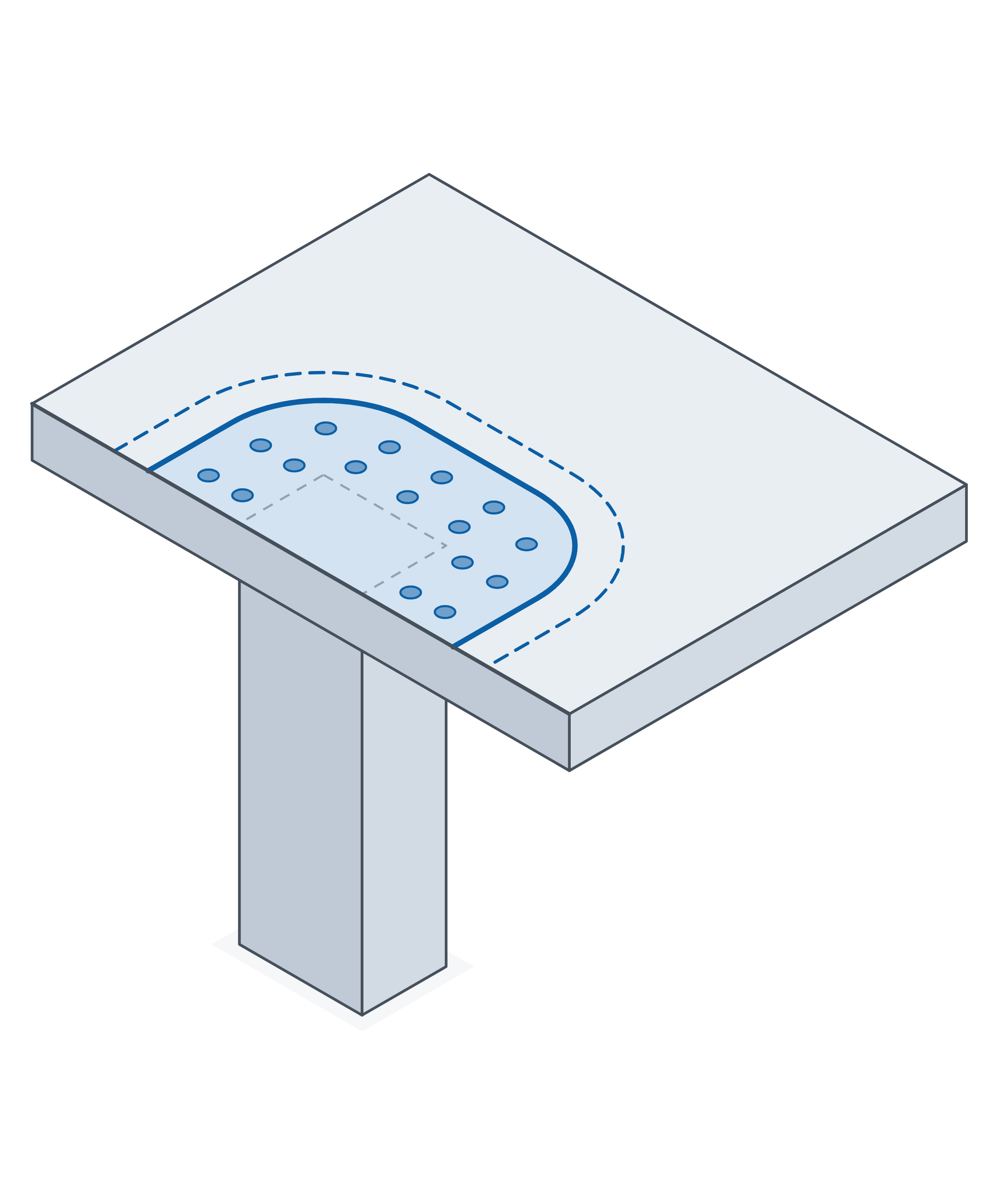
Designing a flat slab for punching shear at an edge column acc. to EN 1992-1-1, 6.4 and 9.4.3, and checking it against a hand calculation:
Keywords:
punching flat slab edge column factor beta fictitious column control perimeter shear reinforcement verification example |
Note
Reference: hand calculation acc. to EN 1992-1-1 for the punching force VEd that RFEM determines at the column, included in the script, with β = 1.4 for an edge column (Figure 6.21N). At the free edge, the control perimeters run along the column faces and end at the edge. All compared values agree within 0.1 %; RFEM places the reinforcement perimeters at whole millimetres.
The factor β is set in the ULS configuration. By default, RFEM determines it from the unbalanced moment with the full plastic shear distribution acc. to 6.4.3(3), Eq. (6.39).
Punching shear at an internal column is shown in Punching Internal Column.
from dlubal.api import rfem, common
from math import ceil, inf, pi, sqrt

# -------------------------------------------------------
# This example demonstrates the punching shear design of a flat slab at an edge column
# acc. to EN 1992-1-1 (CEN, recommended values), 6.4: the control perimeters at the free
# slab edge, the factor beta from Figure 6.21N, the punching shear resistance without
# shear reinforcement and the required punching shear reinforcement.
#
# Slab:
#   h = 250 mm, C30/37, B500S(A), top reinforcement bars 16 mm at 125 mm in both
#   directions (16.08 cm2/m), concrete cover 30 mm.
#   Edge column 400 x 600 mm (c1 = 400 mm perpendicular to the free edge, c2 = 600 mm
#   along it), flush with the slab edge, 3.0 m high, rigidly connected to the slab and
#   hinged at its base.
#   g_k = 25 kN/m3 x 0.25 m + 1.5 kN/m2 finishes, facade 5.0 kN/m on the slab edge,
#   q_k = 2.0 kN/m2 (category A), ULS acc. to Eq. (6.10): 1.35 g_k + 1.5 q_k.
#
# Modelling:
#   One bay of 6.0 x 6.0 m is modelled. The column stands in the middle of the free edge,
#   the opposite edge rests on a hinged line support (an internal wall), and the two other
#   edges are lines of symmetry at half the column spacing. The column is a fictitious
#   column of the nodal support: RFEM derives its springs from its dimensions, height and
#   end conditions.
#
# Reference:
#   Hand calculation acc. to EN 1992-1-1 for the punching force V_Ed that RFEM determines
#   at the column, with beta = 1.4 for an edge column (Figure 6.21N). A control perimeter
#   at the edge consists of the straight parts along the column faces and a semicircle,
#   e.g. u1 = c2 + 2 c1 + 2 pi d (Figure 6.15). The punching shear reinforcement follows
#   from Eq. (6.52), its extent from u_out,ef, Eq. (6.54), and its detailing from 9.4.3.
#   RFEM places the perimeters at whole millimetres (s_r = 152 mm), so A_sw differs by 0.1 %.
# -------------------------------------------------------


BAY = 6.0               # m, column spacing along the edge and span to the internal wall
THICKNESS = 0.25        # m
COVER = 0.030           # m, concrete cover of the top reinforcement
C1 = 0.40               # m, column dimension perpendicular to the free edge
C2 = 0.60               # m, column dimension along the free edge
COLUMN_HEIGHT = 3.0     # m
G_FINISHES = 1.5e3      # N/m2
G_FACADE = 5.0e3        # N/m, facade on the free edge
Q_K = 2.0e3             # N/m2, imposed load (category A)
BAR, SPACING = 0.016, 0.125     # m, top reinforcement in both directions
BETA = 1.4              # edge column, Figure 6.21N


# -------------------------------------------------------
# Hand calculation acc. to EN 1992-1-1
# -------------------------------------------------------

F_CK, F_YWK = 30e6, 500e6       # Pa
F_CD = 1.0 * F_CK / 1.5         # alpha_cc = 1.0, gamma_c = 1.5
F_YWD = F_YWK / 1.15            # gamma_s = 1.15

d_1 = THICKNESS - COVER - BAR / 2           # m, outer layer (direction 1)
d_2 = THICKNESS - COVER - BAR - BAR / 2     # m, inner layer (direction 2)
d = (d_1 + d_2) / 2                         # m, mean effective depth, Eq. (6.32)
a_s = pi * BAR**2 / 4 / SPACING             # m2/m
rho_l = sqrt(a_s / d_1 * a_s / d_2)         # Eq. (6.47), <= 0.02


def edge_perimeter(distance: float) -> float:
    """
    Returns the length of a control perimeter of the edge column at the given distance from
    the column faces: the inner face, both side faces and a semicircle round the inner corners.
    """
    return C2 + 2 * C1 + pi * distance


def hand_calculation(v_ed: float) -> dict:
    """
    Returns the punching check acc. to EN 1992-1-1, 6.4 and 9.4.3 for the punching force v_ed [N].
    """
    u_1 = edge_perimeter(2 * d)                                             # Figure 6.15
    v_ed_stress = BETA * v_ed / (u_1 * d)                                   # Eq. (6.38)

    k = min(1 + sqrt(0.200 / d), 2.0)
    v_rd_c = max(0.18 / 1.5 * k * (100 * rho_l * F_CK / 1e6)**(1 / 3),
                 0.035 * k**1.5 * sqrt(F_CK / 1e6)) * 1e6                   # Eq. (6.47), Pa
    nu = 0.6 * (1 - F_CK / 1e6 / 250)                                       # Eq. (6.6N)
    v_rd_max = 0.4 * nu * F_CD                                              # 6.4.5(3), Pa

    # Outer control perimeter, where no shear reinforcement is required, Eq. (6.54)
    u_out = BETA * v_ed / (v_rd_c * d)
    a_out = (u_out - edge_perimeter(0)) / pi                                # distance from the column faces

    # Perimeters of shear reinforcement: the first at 0.5 d, the last 1.5 d inside u_out
    # (9.4.3(4)), radial spacing at most 0.75 d (9.4.3(1)), as few perimeters as possible
    a_first, a_last = 0.5 * d, a_out - 1.5 * d
    n = ceil(round((a_last - a_first) / (0.75 * d), 6)) + 1
    s_r = (a_last - a_first) / (n - 1)

    # Required reinforcement per perimeter, Eq. (6.52) with vertical links (alpha = 90 deg)
    f_ywd_ef = min(250e6 + 0.25 * (d * 1e3) * 1e6, F_YWD)                  # Pa, Eq. (6.53) with d in mm
    a_sw = (v_ed_stress - 0.75 * v_rd_c) * u_1 * s_r / (1.5 * f_ywd_ef)

    # Minimum reinforcement, Eq. (9.11): legs on the last perimeter at a tangential spacing
    # of at most 1.5 d inside u1 (9.4.3(1))
    u_last = edge_perimeter(a_last)
    legs = ceil(u_last / (1.5 * d))
    a_sw_min_leg = 0.08 * sqrt(F_CK / 1e6) / (F_YWK / 1e6) * s_r * (u_last / legs) / 1.5
    a_sw_min = legs * a_sw_min_leg

    # Results of the hand calculation: key -> (value, unit, caption)
    return {
        "u_1": (u_1, "m", "Basic control perimeter u1"),
        "d": (d * 1e3, "mm", "Mean effective depth d"),
        "rho_l": (rho_l, "-", "Reinforcement ratio rho_l"),
        "v_rd_c": (v_rd_c / 1e6, "MPa", "Resistance without shear reinforcement v_Rd,c"),
        "v_ed": (v_ed_stress / 1e6, "MPa", "Design shear stress v_Ed = beta V_Ed / (u1 d)"),
        "eta": (v_ed_stress / v_rd_c, "-", "Design ratio v_Ed / v_Rd,c"),
        "v_rd_max": (v_rd_max / 1e6, "MPa", "Maximum resistance v_Rd,max"),
        "u_out": (u_out, "m", "Outer control perimeter u_out,ef"),
        "a_out": (a_out, "m", "Distance of u_out,ef from the column"),
        "n": (n, "-", "Number of perimeters"),
        "s_r": (s_r * 1e3, "mm", "Radial spacing s_r"),
        "f_ywd_ef": (f_ywd_ef / 1e6, "MPa", "Effective design strength f_ywd,ef"),
        "a_sw": (a_sw * 1e4, "cm2", "Punching reinforcement per perimeter A_sw"),
        "a_sw_min": (a_sw_min * 1e4, "cm2", "Minimum reinforcement per perimeter"),
    }


def define_structure() -> list:

    a = BAY / 2

    return [

        rfem.structure_core.Material(no=1, name="C30/37"),
        rfem.structure_core.Material(no=2, name="B500S(A)"),

        rfem.structure_core.Thickness(
            no=1,
            material=1,
            uniform_thickness=THICKNESS,
        ),

        # Bay with the free edge along y = 0 and the column (node 5) in the middle of it,
        # its outer face flush with the edge
        rfem.structure_core.Node(no=1, coordinate_1=-a, coordinate_2=0.0),
        rfem.structure_core.Node(no=2, coordinate_1=a, coordinate_2=0.0),
        rfem.structure_core.Node(no=3, coordinate_1=a, coordinate_2=BAY),
        rfem.structure_core.Node(no=4, coordinate_1=-a, coordinate_2=BAY),
        rfem.structure_core.Node(no=5, coordinate_1=0.0, coordinate_2=C1 / 2),

        rfem.structure_core.Line(no=1, definition_nodes=[1, 2]),
        rfem.structure_core.Line(no=2, definition_nodes=[2, 3]),
        rfem.structure_core.Line(no=3, definition_nodes=[3, 4]),
        rfem.structure_core.Line(no=4, definition_nodes=[4, 1]),

        rfem.structure_core.Surface(
            no=1,
            boundary_lines=[1, 2, 3, 4],
            thickness=1,
            is_user_defined_concrete_cover_enabled=True,
            user_defined_concrete_cover_top=COVER,
            user_defined_concrete_cover_bottom=COVER,
            concrete_durability_top=1,
            concrete_durability_bottom=1,
            reinforcement_direction_top=1,
            reinforcement_direction_bottom=1,
            surface_concrete_design_uls_configuration=1,
        ),

        # Edge column below the slab, defined as a nodal support with a fictitious column:
        # rigid at the slab, hinged at its base. RFEM derives the support springs from it,
        # and its dimensions define the loaded area for the punching design.
        rfem.types_for_nodes.NodalSupport(
            no=1,
            user_defined_name_enabled=True,
            name="Edge column 600/400",
            nodes=[5],
            fictitious_column_enabled=True,
            column_width_x=C2,
            column_width_y=C1,
            column_height=COLUMN_HEIGHT,
            column_material=1,
            column_head_support_type=rfem.types_for_nodes.NodalSupport.COLUMN_HEAD_SUPPORT_TYPE_RIGID,
            column_base_support_type=rfem.types_for_nodes.NodalSupport.COLUMN_BASE_SUPPORT_TYPE_HINGED,
        ),

        # Internal wall opposite the free edge
        rfem.types_for_lines.LineSupport(
            no=1,
            user_defined_name_enabled=True,
            name="Internal wall",
            lines=[3],
            spring=common.Vector3d(x=0, y=0, z=inf),
            rotational_restraint=common.Vector3d(x=0, y=0, z=0),
        ),

        # Lines of symmetry at half the column spacing: free vertically, rotation about the line axis restrained
        rfem.types_for_lines.LineSupport(
            no=2,
            user_defined_name_enabled=True,
            name="Symmetry",
            lines=[2, 4],
            spring=common.Vector3d(x=0, y=0, z=0),
            rotational_restraint=common.Vector3d(x=0, y=inf, z=0),
        ),
    ]


def define_loading() -> list:

    # The self-weight is applied by the load case (25 kN/m3 of C30/37).

    return [

        rfem.loading.StaticAnalysisSettings(no=1),
        rfem.loading.LoadCase(
            no=1,
            name="Permanent",
            static_analysis_settings=1,
            self_weight_active=True,
            action_category=rfem.loading.LoadCase.ACTION_CATEGORY_PERMANENT_G,
        ),
        rfem.loading.LoadCase(
            no=2,
            name="Imposed",
            static_analysis_settings=1,
            self_weight_active=False,
            action_category=rfem.loading.LoadCase.ACTION_CATEGORY_IMPOSED_LOADS_CATEGORY_A_DOMESTIC_RESIDENTIAL_AREAS_QI_A,
        ),
        rfem.loading.DesignSituation(
            no=1,
            design_situation_type=rfem.loading.DesignSituation.DESIGN_SITUATION_TYPE_STR_PERMANENT_AND_TRANSIENT_6_10,
        ),
        rfem.loading.LoadCombination(
            no=1,
            name="ULS",
            design_situation=1,
            static_analysis_settings=1,
            combination_rule_str="1.35*LC1 + 1.5*LC2",
        ),

        rfem.loads.SurfaceLoad(no=1, load_case=1, surfaces=[1], uniform_magnitude=G_FINISHES),
        rfem.loads.LineLoad(no=1, load_case=1, lines=[1], magnitude=G_FACADE),
        rfem.loads.SurfaceLoad(no=1, load_case=2, surfaces=[1], uniform_magnitude=Q_K),
    ]


def define_concrete_design() -> list:

    return [

        rfem.concrete_design_objects.ConcreteDesignUlsConfiguration(
            no=1,
            assigned_to_all_surfaces=True,
            assigned_to_all_nodes=True,
        ),

        # Closed interior spaces (XC1)
        rfem.reinforcement.ConcreteDurability(
            no=1,
            surfaces=[1],
            corrosion_induced_by_carbonation_enabled=True,
            corrosion_induced_by_carbonation=rfem.reinforcement.ConcreteDurability.CORROSION_INDUCED_BY_CARBONATION_DRY_OR_PERMANENTLY_WET,
        ),
        rfem.reinforcement.ReinforcementDirection(
            no=1,
            surfaces=[1],
        ),

        # Provided top reinforcement: 2 layers of bars 16 mm at 125 mm = 16.08 cm2/m per direction.
        # The punching resistance v_Rd,c uses the reinforcement ratio of this reinforcement.
        rfem.reinforcement.SurfaceReinforcement(
            no=1,
            surfaces=[1],
            material=2,
            location_type=rfem.reinforcement.SurfaceReinforcement.LOCATION_TYPE_ON_SURFACE,
            definition_type=rfem.reinforcement.SurfaceReinforcement.DEFINITION_TYPE_REBAR_2_LAYERS,
            rebar_diameter=BAR,
            rebar_spacing=SPACING,
            orthogonal_rebar_diameter=BAR,
            orthogonal_rebar_spacing=SPACING,
            alignment_top_enabled=True,
            alignment_bottom_enabled=False,
        ),
    ]


def activate_punching_node(rfem_app: rfem.Application, node_no: int) -> None:
    """
    Activates the punching design for a node in the slab. The node lies inside the surface
    only after the surface exists, so the punching attributes are set with an update.
    When they are passed to create_object together with the node, they are dropped without an error.
    """
    rfem_app.update_object(
        rfem.structure_core.Node(
            no=node_no,
            punching_design=True,
            concrete_design_ultimate_configuration=1,
        )
    )
    node = rfem_app.get_object(rfem.structure_core.Node(no=node_no))
    if not node.punching_design:
        raise RuntimeError(f"Punching design could not be activated for node {node_no}.")


def set_punching_settings(rfem_app: rfem.Application) -> None:
    """
    Takes the factor beta from Figure 6.21N and uses the provided longitudinal
    reinforcement for the punching shear resistance (instead of increasing the required
    reinforcement automatically).
    """
    config = rfem_app.get_object(rfem.concrete_design_objects.ConcreteDesignUlsConfiguration(no=1))
    settings = config.settings_node_ec2
    # Method for the factor beta: 0 = full plastic shear distribution acc. to 6.4.3(3),
    # Eq. (6.39) (default), 1 = constant values acc. to Figure 6.21N
    common.tree_table.set_values_by_key(tree=settings, key="node_factor_beta_estimated_according_to_clause", values=[1])
    common.tree_table.set_values_by_key(tree=settings, key="node_punching_shear_capacity_use_provided", values=[True])
    common.tree_table.set_values_by_key(tree=settings, key="node_punching_shear_capacity_automatically_increase_required", values=[False])
    rfem_app.update_object(
        rfem.concrete_design_objects.ConcreteDesignUlsConfiguration(no=1, settings_node_ec2=settings)
    )


# -------------------------------------------------------
# MAIN SCRIPT
# -------------------------------------------------------

with rfem.Application() as rfem_app:

    rfem_app.create_model(name="concrete_design_punching_edge_column")

    base_data = rfem_app.get_base_data()
    base_data.addons.concrete_design_active = True
    base_data.standards.concrete_design_standard = rfem.BaseData.Standards.CONCRETE_DESIGN_NATIONAL_ANNEX_AND_EDITION_EN_1992_CEN_2014_11_STANDARD
    rfem_app.set_base_data(base_data=base_data)

    rfem_app.delete_all_objects()
    rfem_app.create_object_list(
        objs=
            define_concrete_design() +
            define_structure() +
            define_loading()
    )
    activate_punching_node(rfem_app, node_no=5)
    set_punching_settings(rfem_app)

    calculation_info = rfem_app.calculate_all(skip_warnings=True)
    if not calculation_info.succeeded:
        plausibility = rfem_app.plausibility_check(
            type=common.PlausibilityCheckType.PLAUSIBILITY_CHECK_PLAUSIBILITY_CHECK,
            skip_warnings=False,
        )
        raise RuntimeError(f"Calculation failed: {plausibility.message}\n{plausibility.data}")

    # Design ratios of the punching node: UL0400.00 punching resistance without shear
    # reinforcement (v_Ed / v_Rd,c), UL0401.00 maximum punching resistance (v_Ed,0 / v_Rd,max)
    node_ratios_df = rfem_app.get_result_table(
        table=rfem.results.CONCRETE_DESIGN_NODES_DESIGN_RATIOS_BY_NODE_TABLE,
        loading=None,
    ).data
    print("\nPunching design ratios:")
    print(node_ratios_df[["node_no", "loading", "design_ratio", "design_check_type", "design_check_description"]].to_string(index=False))

    # The required punching reinforcement is reported per perimeter; the table also holds
    # repeated rows and a summary row, so only the distinct perimeters of node 5 are kept.
    required_df = rfem_app.get_result_table(
        table=rfem.results.CONCRETE_DESIGN_REQUIRED_REINFORCEMENT_AREA_ON_NODES_BY_NODE_TABLE,
        loading=None,
    ).data
    perimeters = required_df[required_df["node_no"] == 5].drop_duplicates("perimeter_no").sort_values("distance_from_loading_area")
    print("\nRequired punching reinforcement:")
    for _, row in perimeters.iterrows():
        print(f"  {row['perimeter_no']}: A_sw = {float(row['punching_reinforcement_area_a_swi']) * 1e4:.2f} cm2"
              f" at {float(row['distance_from_loading_area']):.3f} m from the column face")

    def get_check_details(details_id: int):
        """
        Returns a reader for the values of the design check details with the given ID.
        """
        details_df = rfem_app.get_results(
            results_type=rfem.results.CONCRETE_DESIGN_DESIGN_CHECK_DETAILS,
            filters=[rfem.results.ResultsFilter(column_id="design_check_details_id", filter_expression=str(details_id))],
        ).data
        return lambda key: float(details_df.loc[details_df["key"] == key, "value_si"].values[0])

    def get_details_id(check_type: str) -> int:
        """
        Returns the ID of the design check details of the check type at node 5.
        """
        rows = node_ratios_df[(node_ratios_df["node_no"] == 5) & (node_ratios_df["design_check_type"].str.upper() == check_type)]
        return int(rows["design_check_details_id"].iloc[0])

    resistance = get_check_details(get_details_id("UL0400.00"))
    maximum = get_check_details(get_details_id("UL0401.00"))
    reinforcement = get_check_details(int(perimeters["design_check_details_id"].iloc[0]))

    v_ed = resistance("v_ed")
    print(f"\nPunching force from RFEM: V_Ed = {v_ed / 1e3:.2f} kN, beta = {resistance('beta'):.2f}")

    rfem_values = {
        "u_1": resistance("u_1"),
        "d": resistance("d") * 1e3,
        "rho_l": resistance("rho_l_prov"),
        "v_rd_c": resistance("nu_rd_c") / 1e6,
        "v_ed": resistance("nu_ed") / 1e6,
        "eta": resistance("eta"),
        "v_rd_max": maximum("nu_rd_max") / 1e6,
        "u_out": reinforcement("u_out_ef"),
        "a_out": reinforcement("l_w_out"),
        "n": reinforcement("n"),
        "s_r": reinforcement("s_r_i") * 1e3,
        "f_ywd_ef": reinforcement("f_ywd_eff") / 1e6,
        "a_sw": reinforcement("a_sw_req_i") * 1e4,
        "a_sw_min": reinforcement("a_sw_min") * 1e4,
    }
    reference = hand_calculation(v_ed)

    print("\nComparison with the hand calculation for this force:")
    print(f"{'Quantity':<54}{'RFEM':>10}{'Hand calc.':>12}{'Deviation':>11}")
    for key, (ref_value, unit, caption) in reference.items():
        deviation = (rfem_values[key] - ref_value) / ref_value * 100
        print(f"{caption + ' [' + unit + ']':<54}{rfem_values[key]:>10.4f}{ref_value:>12.4f}{deviation:>10.1f}%")
using System.Globalization;
using Google.Protobuf;
using Microsoft.Data.Analysis;
using Common = Dlubal.Api.Common;
using Rfem = Dlubal.Api.Rfem;

// -------------------------------------------------------
// This example demonstrates the punching shear design of a flat slab at an edge column
// acc. to EN 1992-1-1 (CEN, recommended values), 6.4: the control perimeters at the free
// slab edge, the factor beta from Figure 6.21N, the punching shear resistance without
// shear reinforcement and the required punching shear reinforcement.
//
// Slab:
//   h = 250 mm, C30/37, B500S(A), top reinforcement bars 16 mm at 125 mm in both
//   directions (16.08 cm2/m), concrete cover 30 mm.
//   Edge column 400 x 600 mm (c1 = 400 mm perpendicular to the free edge, c2 = 600 mm
//   along it), flush with the slab edge, 3.0 m high, rigidly connected to the slab and
//   hinged at its base.
//   g_k = 25 kN/m3 x 0.25 m + 1.5 kN/m2 finishes, facade 5.0 kN/m on the slab edge,
//   q_k = 2.0 kN/m2 (category A), ULS acc. to Eq. (6.10): 1.35 g_k + 1.5 q_k.
//
// Modelling:
//   One bay of 6.0 x 6.0 m is modelled. The column stands in the middle of the free edge,
//   the opposite edge rests on a hinged line support (an internal wall), and the two other
//   edges are lines of symmetry at half the column spacing. The column is a fictitious
//   column of the nodal support: RFEM derives its springs from its dimensions, height and
//   end conditions.
//
// Reference:
//   Hand calculation acc. to EN 1992-1-1 for the punching force V_Ed that RFEM determines
//   at the column, with beta = 1.4 for an edge column (Figure 6.21N). A control perimeter
//   at the edge consists of the straight parts along the column faces and a semicircle,
//   e.g. u1 = c2 + 2 c1 + 2 pi d (Figure 6.15). The punching shear reinforcement follows
//   from Eq. (6.52), its extent from u_out,ef, Eq. (6.54), and its detailing from 9.4.3.
//   RFEM places the perimeters at whole millimetres (s_r = 152 mm), so A_sw differs by 0.1 %.
// -------------------------------------------------------


const double BAY = 6.0;               // m, column spacing along the edge and span to the internal wall
const double THICKNESS = 0.25;        // m
const double COVER = 0.030;           // m, concrete cover of the top reinforcement
const double C1 = 0.40;               // m, column dimension perpendicular to the free edge
const double C2 = 0.60;               // m, column dimension along the free edge
const double COLUMN_HEIGHT = 3.0;     // m
const double G_FINISHES = 1.5e3;      // N/m2
const double G_FACADE = 5.0e3;        // N/m, facade on the free edge
const double Q_K = 2.0e3;             // N/m2, imposed load (category A)
const double BAR = 0.016, SPACING = 0.125;    // m, top reinforcement in both directions
const double BETA = 1.4;              // edge column, Figure 6.21N


// -------------------------------------------------------
// Hand calculation acc. to EN 1992-1-1
// -------------------------------------------------------

const double F_CK = 30e6, F_YWK = 500e6;        // Pa
const double F_CD = 1.0 * F_CK / 1.5;           // alpha_cc = 1.0, gamma_c = 1.5
const double F_YWD = F_YWK / 1.15;              // gamma_s = 1.15

const double D_1 = THICKNESS - COVER - BAR / 2;             // m, outer layer (direction 1)
const double D_2 = THICKNESS - COVER - BAR - BAR / 2;       // m, inner layer (direction 2)
const double D = (D_1 + D_2) / 2;                           // m, mean effective depth, Eq. (6.32)
const double A_S = Math.PI * BAR * BAR / 4 / SPACING;       // m2/m
double rhoL = Math.Sqrt(A_S / D_1 * A_S / D_2);             // Eq. (6.47), <= 0.02


// Returns the length of a control perimeter of the edge column at the given distance from
// the column faces: the inner face, both side faces and a semicircle round the inner corners.
static double EdgePerimeter(double distance) => C2 + 2 * C1 + Math.PI * distance;


// Returns the punching check acc. to EN 1992-1-1, 6.4 and 9.4.3 for the punching force vEd [N].
static List<(string Key, double Value, string Unit, string Caption)> HandCalculation(double vEd, double rhoL)
{
    double u1 = EdgePerimeter(2 * D);                                       // Figure 6.15
    double vEdStress = BETA * vEd / (u1 * D);                               // Eq. (6.38)

    double k = Math.Min(1 + Math.Sqrt(0.200 / D), 2.0);
    double vRdC = Math.Max(0.18 / 1.5 * k * Math.Cbrt(100 * rhoL * F_CK / 1e6),
                           0.035 * Math.Pow(k, 1.5) * Math.Sqrt(F_CK / 1e6)) * 1e6;     // Eq. (6.47), Pa
    double nu = 0.6 * (1 - F_CK / 1e6 / 250);                               // Eq. (6.6N)
    double vRdMax = 0.4 * nu * F_CD;                                        // 6.4.5(3), Pa

    // Outer control perimeter, where no shear reinforcement is required, Eq. (6.54)
    double uOut = BETA * vEd / (vRdC * D);
    double aOut = (uOut - EdgePerimeter(0)) / Math.PI;                      // distance from the column faces

    // Perimeters of shear reinforcement: the first at 0.5 d, the last 1.5 d inside u_out
    // (9.4.3(4)), radial spacing at most 0.75 d (9.4.3(1)), as few perimeters as possible
    double aFirst = 0.5 * D, aLast = aOut - 1.5 * D;
    int n = (int)Math.Ceiling(Math.Round((aLast - aFirst) / (0.75 * D), 6)) + 1;
    double sR = (aLast - aFirst) / (n - 1);

    // Required reinforcement per perimeter, Eq. (6.52) with vertical links (alpha = 90 deg)
    double fYwdEf = Math.Min(250e6 + 0.25 * (D * 1e3) * 1e6, F_YWD);       // Pa, Eq. (6.53) with d in mm
    double aSw = (vEdStress - 0.75 * vRdC) * u1 * sR / (1.5 * fYwdEf);

    // Minimum reinforcement, Eq. (9.11): legs on the last perimeter at a tangential spacing
    // of at most 1.5 d inside u1 (9.4.3(1))
    double uLast = EdgePerimeter(aLast);
    int legs = (int)Math.Ceiling(uLast / (1.5 * D));
    double aSwMinLeg = 0.08 * Math.Sqrt(F_CK / 1e6) / (F_YWK / 1e6) * sR * (uLast / legs) / 1.5;
    double aSwMin = legs * aSwMinLeg;

    // Results of the hand calculation: key -> (value, unit, caption)
    return new List<(string Key, double Value, string Unit, string Caption)>
    {
        ("u_1", u1, "m", "Basic control perimeter u1"),
        ("d", D * 1e3, "mm", "Mean effective depth d"),
        ("rho_l", rhoL, "-", "Reinforcement ratio rho_l"),
        ("v_rd_c", vRdC / 1e6, "MPa", "Resistance without shear reinforcement v_Rd,c"),
        ("v_ed", vEdStress / 1e6, "MPa", "Design shear stress v_Ed = beta V_Ed / (u1 d)"),
        ("eta", vEdStress / vRdC, "-", "Design ratio v_Ed / v_Rd,c"),
        ("v_rd_max", vRdMax / 1e6, "MPa", "Maximum resistance v_Rd,max"),
        ("u_out", uOut, "m", "Outer control perimeter u_out,ef"),
        ("a_out", aOut, "m", "Distance of u_out,ef from the column"),
        ("n", n, "-", "Number of perimeters"),
        ("s_r", sR * 1e3, "mm", "Radial spacing s_r"),
        ("f_ywd_ef", fYwdEf / 1e6, "MPa", "Effective design strength f_ywd,ef"),
        ("a_sw", aSw * 1e4, "cm2", "Punching reinforcement per perimeter A_sw"),
        ("a_sw_min", aSwMin * 1e4, "cm2", "Minimum reinforcement per perimeter"),
    };
}


static List<IMessage> DefineStructure()
{
    const double a = BAY / 2;

    return new List<IMessage>
    {
        new Rfem.StructureCore.Material { No = 1, Name = "C30/37" },
        new Rfem.StructureCore.Material { No = 2, Name = "B500S(A)" },

        new Rfem.StructureCore.Thickness
        {
            No = 1,
            Material = 1,
            UniformThickness = THICKNESS,
        },

        // Bay with the free edge along y = 0 and the column (node 5) in the middle of it,
        // its outer face flush with the edge
        new Rfem.StructureCore.Node { No = 1, Coordinate1 = -a, Coordinate2 = 0.0 },
        new Rfem.StructureCore.Node { No = 2, Coordinate1 = a, Coordinate2 = 0.0 },
        new Rfem.StructureCore.Node { No = 3, Coordinate1 = a, Coordinate2 = BAY },
        new Rfem.StructureCore.Node { No = 4, Coordinate1 = -a, Coordinate2 = BAY },
        new Rfem.StructureCore.Node { No = 5, Coordinate1 = 0.0, Coordinate2 = C1 / 2 },

        new Rfem.StructureCore.Line { No = 1, DefinitionNodes = { 1, 2 } },
        new Rfem.StructureCore.Line { No = 2, DefinitionNodes = { 2, 3 } },
        new Rfem.StructureCore.Line { No = 3, DefinitionNodes = { 3, 4 } },
        new Rfem.StructureCore.Line { No = 4, DefinitionNodes = { 4, 1 } },

        new Rfem.StructureCore.Surface
        {
            No = 1,
            BoundaryLines = { 1, 2, 3, 4 },
            Thickness = 1,
            IsUserDefinedConcreteCoverEnabled = true,
            UserDefinedConcreteCoverTop = COVER,
            UserDefinedConcreteCoverBottom = COVER,
            ConcreteDurabilityTop = 1,
            ConcreteDurabilityBottom = 1,
            ReinforcementDirectionTop = 1,
            ReinforcementDirectionBottom = 1,
            SurfaceConcreteDesignUlsConfiguration = 1,
        },

        // Edge column below the slab, defined as a nodal support with a fictitious column:
        // rigid at the slab, hinged at its base. RFEM derives the support springs from it,
        // and its dimensions define the loaded area for the punching design.
        new Rfem.TypesForNodes.NodalSupport
        {
            No = 1,
            UserDefinedNameEnabled = true,
            Name = "Edge column 600/400",
            Nodes = { 5 },
            FictitiousColumnEnabled = true,
            ColumnWidthX = C2,
            ColumnWidthY = C1,
            ColumnHeight = COLUMN_HEIGHT,
            ColumnMaterial = 1,
            ColumnHeadSupportType = Rfem.TypesForNodes.NodalSupport.Types.ColumnHeadSupportType.Rigid,
            ColumnBaseSupportType = Rfem.TypesForNodes.NodalSupport.Types.ColumnBaseSupportType.Hinged,
        },

        // Internal wall opposite the free edge
        new Rfem.TypesForLines.LineSupport
        {
            No = 1,
            UserDefinedNameEnabled = true,
            Name = "Internal wall",
            Lines = { 3 },
            SpringX = 0,
            SpringY = 0,
            SpringZ = double.PositiveInfinity,
            RotationalRestraintX = 0,
            RotationalRestraintY = 0,
            RotationalRestraintZ = 0,
        },

        // Lines of symmetry at half the column spacing: free vertically, rotation about the line axis restrained
        new Rfem.TypesForLines.LineSupport
        {
            No = 2,
            UserDefinedNameEnabled = true,
            Name = "Symmetry",
            Lines = { 2, 4 },
            SpringX = 0,
            SpringY = 0,
            SpringZ = 0,
            RotationalRestraintX = 0,
            RotationalRestraintY = double.PositiveInfinity,
            RotationalRestraintZ = 0,
        },
    };
}


static List<IMessage> DefineLoading()
{
    // The self-weight is applied by the load case (25 kN/m3 of C30/37).

    return new List<IMessage>
    {
        new Rfem.Loading.StaticAnalysisSettings { No = 1 },
        new Rfem.Loading.LoadCase
        {
            No = 1,
            Name = "Permanent",
            StaticAnalysisSettings = 1,
            SelfWeightActive = true,
            ActionCategory = Rfem.Loading.LoadCase.Types.ActionCategory.PermanentG,
        },
        new Rfem.Loading.LoadCase
        {
            No = 2,
            Name = "Imposed",
            StaticAnalysisSettings = 1,
            SelfWeightActive = false,
            ActionCategory = Rfem.Loading.LoadCase.Types.ActionCategory.ImposedLoadsCategoryADomesticResidentialAreasQiA,
        },
        new Rfem.Loading.DesignSituation
        {
            No = 1,
            DesignSituationType = Rfem.Loading.DesignSituation.Types.DesignSituationType.StrPermanentAndTransient610,
        },
        new Rfem.Loading.LoadCombination
        {
            No = 1,
            Name = "ULS",
            DesignSituation = 1,
            StaticAnalysisSettings = 1,
            CombinationRuleStr = "1.35*LC1 + 1.5*LC2",
        },

        new Rfem.Loads.SurfaceLoad { No = 1, LoadCase = 1, Surfaces = { 1 }, UniformMagnitude = G_FINISHES },
        new Rfem.Loads.LineLoad { No = 1, LoadCase = 1, Lines = { 1 }, Magnitude = G_FACADE },
        new Rfem.Loads.SurfaceLoad { No = 1, LoadCase = 2, Surfaces = { 1 }, UniformMagnitude = Q_K },
    };
}


static List<IMessage> DefineConcreteDesign()
{
    return new List<IMessage>
    {
        new Rfem.ConcreteDesignObjects.ConcreteDesignUlsConfiguration
        {
            No = 1,
            AssignedToAllSurfaces = true,
            AssignedToAllNodes = true,
        },

        // Closed interior spaces (XC1)
        new Rfem.Reinforcement.ConcreteDurability
        {
            No = 1,
            Surfaces = { 1 },
            CorrosionInducedByCarbonationEnabled = true,
            CorrosionInducedByCarbonation = Rfem.Reinforcement.ConcreteDurability.Types.CorrosionInducedByCarbonation.DryOrPermanentlyWet,
        },
        new Rfem.Reinforcement.ReinforcementDirection
        {
            No = 1,
            Surfaces = { 1 },
        },

        // Provided top reinforcement: 2 layers of bars 16 mm at 125 mm = 16.08 cm2/m per direction.
        // The punching resistance v_Rd,c uses the reinforcement ratio of this reinforcement.
        new Rfem.Reinforcement.SurfaceReinforcement
        {
            No = 1,
            Surfaces = { 1 },
            Material = 2,
            LocationType = Rfem.Reinforcement.SurfaceReinforcement.Types.LocationType.OnSurface,
            DefinitionType = Rfem.Reinforcement.SurfaceReinforcement.Types.DefinitionType.Rebar2Layers,
            RebarDiameter = BAR,
            RebarSpacing = SPACING,
            OrthogonalRebarDiameter = BAR,
            OrthogonalRebarSpacing = SPACING,
            AlignmentTopEnabled = true,
            AlignmentBottomEnabled = false,
        },
    };
}


// Activates the punching design for a node in the slab. The node lies inside the surface
// only after the surface exists, so the punching attributes are set with an update.
// When they are passed to create_object together with the node, they are dropped without an error.
static void ActivatePunchingNode(ApplicationRfem rfemApp, int nodeNo)
{
    rfemApp.update_object(
        new Rfem.StructureCore.Node
        {
            No = nodeNo,
            PunchingDesign = true,
            ConcreteDesignUltimateConfiguration = 1,
        }
    );
    var node = rfemApp.get_object<Rfem.StructureCore.Node>(new Rfem.StructureCore.Node { No = nodeNo });
    if (!node.PunchingDesign)
    {
        throw new InvalidOperationException($"Punching design could not be activated for node {nodeNo}.");
    }
}


// Takes the factor beta from Figure 6.21N and uses the provided longitudinal
// reinforcement for the punching shear resistance (instead of increasing the required
// reinforcement automatically).
static void SetPunchingSettings(ApplicationRfem rfemApp)
{
    var config = rfemApp.get_object<Rfem.ConcreteDesignObjects.ConcreteDesignUlsConfiguration>(
        new Rfem.ConcreteDesignObjects.ConcreteDesignUlsConfiguration { No = 1 }
    );
    var settings = config.SettingsNodeEc2;
    // Method for the factor beta: 0 = full plastic shear distribution acc. to 6.4.3(3),
    // Eq. (6.39) (default), 1 = constant values acc. to Figure 6.21N
    Common.TreeTable.SetValuesByKey(tree: settings, key: "node_factor_beta_estimated_according_to_clause", values: new List<object?> { 1 });
    Common.TreeTable.SetValuesByKey(tree: settings, key: "node_punching_shear_capacity_use_provided", values: new List<object?> { true });
    Common.TreeTable.SetValuesByKey(tree: settings, key: "node_punching_shear_capacity_automatically_increase_required", values: new List<object?> { false });
    rfemApp.update_object(
        new Rfem.ConcreteDesignObjects.ConcreteDesignUlsConfiguration { No = 1, SettingsNodeEc2 = settings }
    );
}


static double ToDouble(object? cell) => Convert.ToDouble(cell, CultureInfo.InvariantCulture);
static string ToText(object? cell) => cell?.ToString() ?? string.Empty;


// -------------------------------------------------------
// MAIN SCRIPT
// -------------------------------------------------------

ApplicationRfem? rfemApp = null;

try
{
    rfemApp = new ApplicationRfem();
    ApplicationRfem app = rfemApp;

    app.create_model(name: "concrete_design_punching_edge_column");

    var baseData = app.get_base_data();
    baseData.Addons.ConcreteDesignActive = true;
    baseData.Standards.ConcreteDesignStandard = Rfem.BaseData.Types.Standards.Types.ConcreteDesignStandard.ConcreteDesignNationalAnnexAndEditionEn1992Cen201411Standard;
    app.set_base_data(baseData: baseData);

    app.delete_all_objects();
    app.create_object_list(
        DefineConcreteDesign()
            .Concat(DefineStructure())
            .Concat(DefineLoading())
            .ToList()
    );
    ActivatePunchingNode(app, nodeNo: 5);
    SetPunchingSettings(app);

    var calculationInfo = app.calculate_all(skipWarnings: true);
    if (!calculationInfo.Succeeded)
    {
        var plausibility = app.plausibility_check(
            type: Common.PlausibilityCheckType.PlausibilityCheckPlausibilityCheck,
            skipWarnings: false
        );
        throw new InvalidOperationException($"Calculation failed: {plausibility.Message}\n{plausibility.Data}");
    }

    // Design ratios of the punching node: UL0400.00 punching resistance without shear
    // reinforcement (v_Ed / v_Rd,c), UL0401.00 maximum punching resistance (v_Ed,0 / v_Rd,max)
    DataFrame nodeRatios = app.get_result_table(
        table: Rfem.Results.ResultTable.ConcreteDesignNodesDesignRatiosByNodeTable,
        loading: null
    ).Data;
    Console.WriteLine("\nPunching design ratios:");
    Console.WriteLine($"{"node_no",8}{"loading",8}{"design_ratio",14}{"design_check_type",18}  {"design_check_description"}");
    foreach (var row in nodeRatios.Rows)
    {
        Console.WriteLine(string.Format(CultureInfo.InvariantCulture, "{0,8}{1,8}{2,14:G6}{3,18}  {4}",
            row["node_no"], row["loading"], ToDouble(row["design_ratio"]), row["design_check_type"], row["design_check_description"]));
    }

    // The required punching reinforcement is reported per perimeter; the table also holds
    // repeated rows and a summary row, so only the distinct perimeters of node 5 are kept.
    DataFrame required = app.get_result_table(
        table: Rfem.Results.ResultTable.ConcreteDesignRequiredReinforcementAreaOnNodesByNodeTable,
        loading: null
    ).Data;
    var perimeters = required.Rows
        .Where(row => ToText(row["node_no"]) == "5")
        .GroupBy(row => ToText(row["perimeter_no"]))
        .Select(group => group.First())
        .OrderBy(row => ToDouble(row["distance_from_loading_area"]))
        .ToList();
    Console.WriteLine("\nRequired punching reinforcement:");
    foreach (var row in perimeters)
    {
        Console.WriteLine(string.Format(CultureInfo.InvariantCulture, "  {0}: A_sw = {1:F2} cm2 at {2:F3} m from the column face",
            row["perimeter_no"], ToDouble(row["punching_reinforcement_area_a_swi"]) * 1e4, ToDouble(row["distance_from_loading_area"])));
    }

    // Returns a reader for the values of the design check details with the given ID.
    Func<string, double> GetCheckDetails(long detailsId)
    {
        DataFrame details = app.get_results(
            resultsType: Rfem.Results.ResultsType.ConcreteDesignDesignCheckDetails,
            filters: new List<Rfem.Results.ResultsFilter>
            {
                new Rfem.Results.ResultsFilter { ColumnId = "design_check_details_id", FilterExpression = detailsId.ToString(CultureInfo.InvariantCulture) },
            }
        ).Data;
        return key => ToDouble(details.Rows.First(row => ToText(row["key"]) == key)["value_si"]);
    }

    // Returns the ID of the design check details of the check type at node 5.
    long GetDetailsId(string checkType)
    {
        var row = nodeRatios.Rows.First(row => ToText(row["node_no"]) == "5"
            && ToText(row["design_check_type"]).ToUpperInvariant() == checkType);
        return Convert.ToInt64(ToDouble(row["design_check_details_id"]));
    }

    var resistance = GetCheckDetails(GetDetailsId("UL0400.00"));
    var maximum = GetCheckDetails(GetDetailsId("UL0401.00"));
    var reinforcement = GetCheckDetails(Convert.ToInt64(ToDouble(perimeters[0]["design_check_details_id"])));

    double vEd = resistance("v_ed");
    Console.WriteLine(string.Format(CultureInfo.InvariantCulture,
        "\nPunching force from RFEM: V_Ed = {0:F2} kN, beta = {1:F2}", vEd / 1e3, resistance("beta")));

    var rfemValues = new Dictionary<string, double>
    {
        ["u_1"] = resistance("u_1"),
        ["d"] = resistance("d") * 1e3,
        ["rho_l"] = resistance("rho_l_prov"),
        ["v_rd_c"] = resistance("nu_rd_c") / 1e6,
        ["v_ed"] = resistance("nu_ed") / 1e6,
        ["eta"] = resistance("eta"),
        ["v_rd_max"] = maximum("nu_rd_max") / 1e6,
        ["u_out"] = reinforcement("u_out_ef"),
        ["a_out"] = reinforcement("l_w_out"),
        ["n"] = reinforcement("n"),
        ["s_r"] = reinforcement("s_r_i") * 1e3,
        ["f_ywd_ef"] = reinforcement("f_ywd_eff") / 1e6,
        ["a_sw"] = reinforcement("a_sw_req_i") * 1e4,
        ["a_sw_min"] = reinforcement("a_sw_min") * 1e4,
    };
    var reference = HandCalculation(vEd, rhoL);

    Console.WriteLine("\nComparison with the hand calculation for this force:");
    Console.WriteLine($"{"Quantity",-54}{"RFEM",10}{"Hand calc.",12}{"Deviation",11}");
    foreach (var (key, refValue, unit, caption) in reference)
    {
        double deviation = (rfemValues[key] - refValue) / refValue * 100;
        Console.WriteLine(string.Format(CultureInfo.InvariantCulture,
            "{0,-54}{1,10:F4}{2,12:F4}{3,10:F1}%", $"{caption} [{unit}]", rfemValues[key], refValue, deviation));
    }
}
catch (Exception ex)
{
    Console.WriteLine($"Error: {ex.Message}");
}
finally
{
    if (rfemApp != null) rfemApp.close_connection();
}