
Beam Lateral-Torsional Buckling#
|
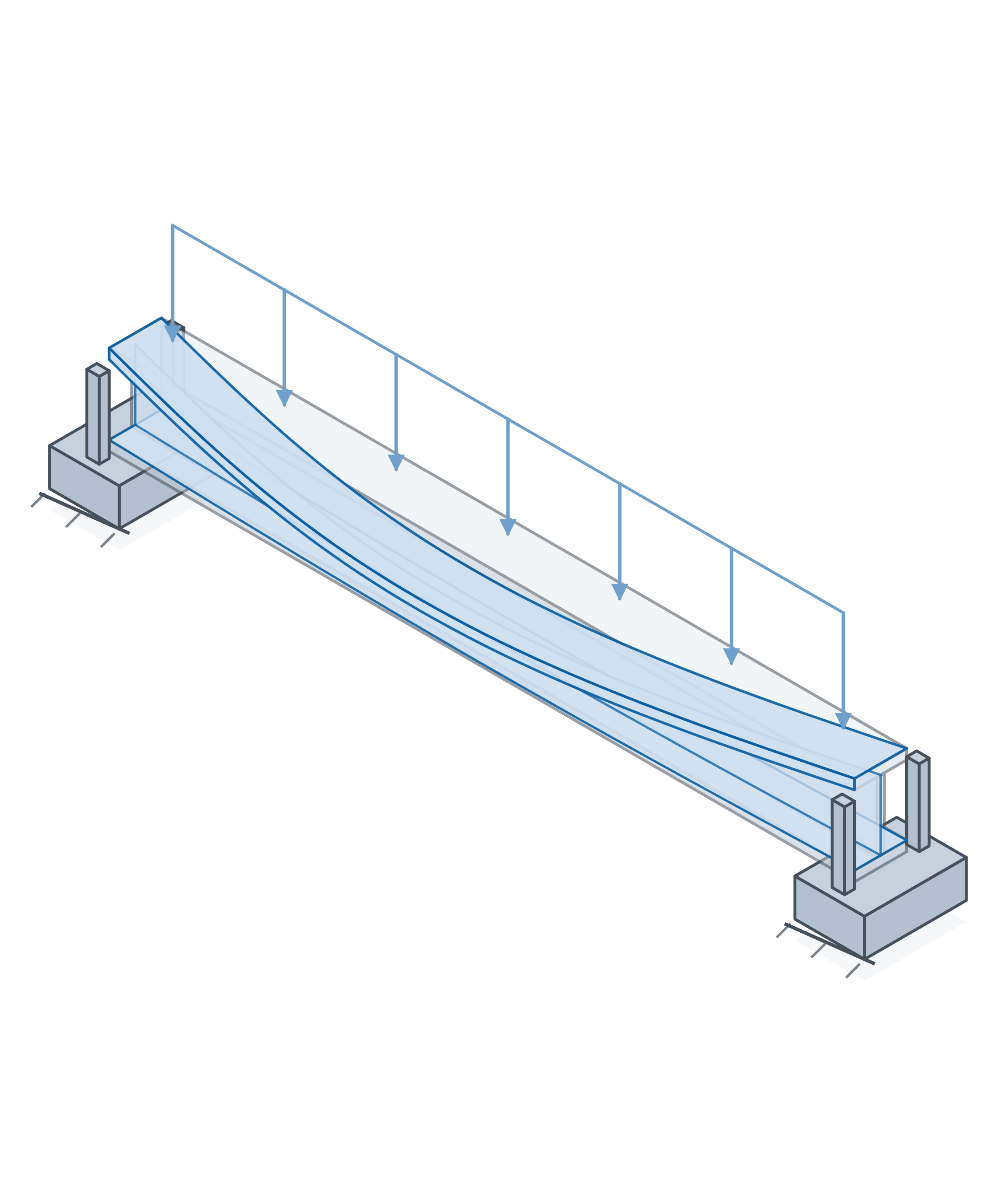
Designing a laterally unrestrained steel floor beam for bending, shear, lateral-torsional buckling acc. to EN 1993-1-1, 6.3.2, and deflection:
Keywords:
lateral-torsional buckling fork support critical moment load application point action category deflection verification example |
Note
Reference: SCI - Steel Buildings in Europe, Multi-Storey Steel Buildings, Part 4: Detailed Design, Appendix A.1. RFEM determines Mcr with an eigenvalue analysis, the reference with the C1/C2 formula, which gives a 3.5 % lower value. The deflection calculated by RFEM includes the shear deformation of the web.
from dlubal.api import rfem, common
from math import inf
import pandas

# -------------------------------------------------------
# This example demonstrates the design of a laterally unrestrained steel floor beam
# acc. to EN 1993-1-1 (CEN, recommended values): bending, shear and
# lateral-torsional buckling acc. to 6.3.2.3 (rolled sections, Eq. 6.57, factor f),
# plus the deflection check in the serviceability limit state.
#
# Reference:
#   SCI / Steel Buildings in Europe - Multi-Storey Steel Buildings,
#   Part 4: Detailed Design, Appendix A.1 "Simply supported laterally unrestrained beam"
#   (based on Access Steel SX001a-EN-EU).
#
#   IPE 330, S235, simply supported span 5.70 m with fork supports, no intermediate lateral restraint.
#   Gk = 9.56 kN/m (incl. self-weight), Qk = 6.25 kN/m, load applied on the top flange.
#   ULS: 1.35 Gk + 1.50 Qk = 22.28 kN/m.
#
# Expected deviations from the reference:
#   - RFEM determines Mcr with an eigenvalue analysis (load on the top flange),
#     the reference uses the C1/C2 formula, which gives a 3.5 % lower Mcr.
#   - The deflection in RFEM includes the shear deformation of the web.
# -------------------------------------------------------


SPAN = 5.70     # m
G_K = 9.56e3    # N/m, slab, partitions and self-weight of the beam
Q_K = 6.25e3    # N/m, imposed load

# Results published in the reference (key in the RFEM design check details: value)
REFERENCE_LTB = {
    "m_y_ed": (90.48, "kNm", "Design bending moment My,Ed"),
    "m_cr": (113.9, "kNm", "Elastic critical moment Mcr"),
    "lambdaand_773_lt": (1.288, "-", "Slenderness lambda_LT"),
    "chi_lt": (0.480, "-", "Reduction factor chi_LT"),
    "chi_lt_mod": (0.488, "-", "Modified reduction factor chi_LT,mod"),
    "m_b_rd": (92.24, "kNm", "Buckling resistance moment Mb,Rd"),
    "eta": (0.981, "-", "Design ratio"),
}
REFERENCE_DEFLECTION = 8.8  # mm, Gk + Qk


def define_structure() -> list:

    return [

        rfem.structure_core.Material(
            no=1,
            name="S235",
        ),
        rfem.structure_core.CrossSection(
            no=1,
            name="IPE 330",
            material=1,
        ),

        rfem.structure_core.Node(no=1),
        rfem.structure_core.Node(no=2, coordinate_1=SPAN),
        rfem.structure_core.Line(no=1, definition_nodes=[1, 2]),
        rfem.structure_core.Member(no=1, line=1, cross_section_start=1),

        # Fork supports: deflection and twist restrained, warping free
        rfem.types_for_nodes.NodalSupport(
            no=1,
            nodes=[1],
            spring=common.Vector3d(x=inf, y=inf, z=inf),
            rotational_restraint=common.Vector3d(x=inf, y=0, z=0),
        ),
        rfem.types_for_nodes.NodalSupport(
            no=2,
            nodes=[2],
            spring=common.Vector3d(x=0, y=inf, z=inf),
            rotational_restraint=common.Vector3d(x=inf, y=0, z=0),
        ),
    ]


def define_loading() -> list:

    # The self-weight of the beam is included in Gk of the reference, so it is
    # not generated automatically. The load combinations are defined explicitly.

    return [

        rfem.loading.StaticAnalysisSettings(no=1),

        rfem.loading.LoadCase(
            no=1,
            name="Permanent",
            static_analysis_settings=1,
            self_weight_active=False,
            action_category=rfem.loading.LoadCase.ACTION_CATEGORY_PERMANENT_G,
        ),
        rfem.loading.LoadCase(
            no=2,
            name="Imposed",
            static_analysis_settings=1,
            action_category=rfem.loading.LoadCase.ACTION_CATEGORY_IMPOSED_LOADS_CATEGORY_B_OFFICE_AREAS_QI_B,
        ),

        rfem.loading.DesignSituation(
            no=1,
            design_situation_type=rfem.loading.DesignSituation.DESIGN_SITUATION_TYPE_STR_PERMANENT_AND_TRANSIENT_6_10,
        ),
        rfem.loading.DesignSituation(
            no=2,
            design_situation_type=rfem.loading.DesignSituation.DESIGN_SITUATION_TYPE_SLS_CHARACTERISTIC,
        ),
        rfem.loading.LoadCombination(
            no=1,
            name="ULS 1.35 G + 1.5 Q",
            design_situation=1,
            static_analysis_settings=1,
            combination_rule_str="1.35*LC1 + 1.5*LC2",
        ),
        rfem.loading.LoadCombination(
            no=2,
            name="SLS G + Q",
            design_situation=2,
            static_analysis_settings=1,
            combination_rule_str="LC1 + LC2",
        ),

        rfem.loads.MemberLoad(
            no=1,
            load_case=1,
            members=[1],
            load_distribution=rfem.loads.MemberLoad.LOAD_DISTRIBUTION_UNIFORM,
            magnitude=G_K,
        ),
        rfem.loads.MemberLoad(
            no=1,
            load_case=2,
            members=[1],
            load_distribution=rfem.loads.MemberLoad.LOAD_DISTRIBUTION_UNIFORM,
            magnitude=Q_K,
        ),
    ]


def define_steel_design() -> list:

    # Lateral-torsional buckling between the fork supports (Lcr = L).
    # The default ULS configuration already applies the transverse load on the top
    # flange (destabilizing), Eq. 6.57 for rolled sections and the factor f acc. to 6.3.2.3(2).
    # Mcr is determined by RFEM with an eigenvalue analysis of the member.

    return [

        rfem.steel_design_objects.SteelDesignUlsConfiguration(
            no=1,
            assigned_to_all_members=True,
        ),
        rfem.steel_design_objects.SteelDesignSlsConfiguration(
            no=1,
            assigned_to_all_members=True,
        ),
        rfem.steel_design.SteelEffectiveLengths(
            no=1,
            members=[1],
            flexural_buckling_about_y=False,
            flexural_buckling_about_z=False,
            torsional_buckling=False,
            lateral_torsional_buckling=True,
            nodal_supports=rfem.steel_design.SteelEffectiveLengths.NodalSupportsTable(
                rows=[
                    rfem.steel_design.SteelEffectiveLengths.NodalSupportsRow(
                        no=1,
                        support_type=rfem.steel_design.SteelEffectiveLengths.NodalSupportsRow.SUPPORT_TYPE_FIXED_IN_Z_Y_AND_TORSION,
                    ),
                    rfem.steel_design.SteelEffectiveLengths.NodalSupportsRow(
                        no=2,
                        support_type=rfem.steel_design.SteelEffectiveLengths.NodalSupportsRow.SUPPORT_TYPE_FIXED_IN_Z_Y_AND_TORSION,
                    ),
                ]
            ),
        ),
    ]


def get_check_details(rfem_app: rfem.Application, design_ratios_df: pandas.DataFrame, check_type: str) -> tuple:
    """
    Returns the governing row of the given check type and the rows of the section
    'Design Check Values' of its design check details (keys are not unique across sections).
    """
    rows = design_ratios_df[design_ratios_df["design_check_type"] == check_type]
    governing = rows.loc[rows["design_ratio"].idxmax()]
    details_df = rfem_app.get_results(
        results_type=rfem.results.STEEL_DESIGN_DESIGN_CHECK_DETAILS,
        filters=[
            rfem.results.ResultsFilter(
                column_id="design_check_details_id",
                filter_expression=str(governing["design_check_details_id"]),
            )
        ],
    ).data
    start = details_df.index[details_df["key"] == "design_check_values"][0]
    return governing, details_df.loc[start:]


# Scale factors from SI units to the units used in the reference
UNIT_SCALE = {"-": 1.0, "kN": 1e3, "kNm": 1e3}


def print_comparison(check_values_df: pandas.DataFrame, reference: dict) -> None:
    """
    Prints the RFEM values next to the reference values with their deviation.
    The column 'value' holds the rounded display value as text, so the full-precision
    column 'value_si' is used and converted to the unit of the reference.
    """
    print(f"\n{'Quantity':<42}{'RFEM':>10}{'Reference':>12}{'Deviation':>11}")
    for key, (ref_value, unit, caption) in reference.items():
        row = check_values_df.loc[check_values_df["key"] == key]
        if row.empty:
            print(f"{caption + ' [' + unit + ']':<42}{'n/a':>10}{ref_value:>12.3f}")
            continue
        rfem_value = abs(float(row["value_si"].values[0])) / UNIT_SCALE[unit]
        deviation = (rfem_value - ref_value) / ref_value * 100
        print(f"{caption + ' [' + unit + ']':<42}{rfem_value:>10.3f}{ref_value:>12.3f}{deviation:>10.1f}%")


# -------------------------------------------------------
# MAIN SCRIPT
# -------------------------------------------------------

with rfem.Application() as rfem_app:

    rfem_app.create_model(name="steel_design_beam_lateral_torsional_buckling")

    base_data = rfem_app.get_base_data()
    base_data.addons.steel_design_active = True
    base_data.standards.steel_design_standard = rfem.BaseData.Standards.STEEL_DESIGN_NATIONAL_ANNEX_AND_EDITION_EN_1993_CEN_2015_06_STANDARD
    rfem_app.set_base_data(base_data=base_data)

    rfem_app.delete_all_objects()
    rfem_app.create_object_list(
        objs=
            define_structure() +
            define_loading() +
            define_steel_design()
    )

    rfem_app.calculate_all(skip_warnings=True)

    design_ratios_df = rfem_app.get_results(
        results_type=rfem.results.STEEL_DESIGN_MEMBERS_DESIGN_RATIOS,
    ).data
    summary = design_ratios_df.sort_values("design_ratio", ascending=False).drop_duplicates("design_check_type")
    print("\nGoverning design ratios per check type:")
    print(summary[["design_check_type", "loading", "design_ratio", "location_x", "design_check_description"]].to_string(index=False))

    # Lateral-torsional buckling acc. to 6.3.2
    ltb_check_type = "ST2100.00"  # Lateral torsional buckling acc. to EN 1993-1-1, 6.3.2.1
    governing, values = get_check_details(rfem_app, design_ratios_df, ltb_check_type)
    print(f"\n{ltb_check_type} | {governing['design_check_description']} | x = {governing['location_x']} m")
    print_comparison(values, REFERENCE_LTB)

    # Deflection check in the serviceability limit state (characteristic combination)
    governing, values = get_check_details(rfem_app, design_ratios_df, "SE1100.00")
    w_tot = float(values.loc[values["key"] == "w_tot_z", "value_si"].values[0]) * 1e3
    w_lim = float(values.loc[values["key"] == "w_lim_z", "value_si"].values[0]) * 1e3
    print(f"\n{governing['design_check_type']} | {governing['design_check_description']} | {governing['loading']}")
    print(f"Deflection w = {w_tot:.2f} mm (reference {REFERENCE_DEFLECTION} mm, bending only), limit L/300 = {w_lim:.1f} mm")
using System.Globalization;
using Google.Protobuf;
using Microsoft.Data.Analysis;
using Common = Dlubal.Api.Common;
using Rfem = Dlubal.Api.Rfem;

// -------------------------------------------------------
// This example demonstrates the design of a laterally unrestrained steel floor beam
// acc. to EN 1993-1-1 (CEN, recommended values): bending, shear and
// lateral-torsional buckling acc. to 6.3.2.3 (rolled sections, Eq. 6.57, factor f),
// plus the deflection check in the serviceability limit state.
//
// Reference:
//   SCI / Steel Buildings in Europe - Multi-Storey Steel Buildings,
//   Part 4: Detailed Design, Appendix A.1 "Simply supported laterally unrestrained beam"
//   (based on Access Steel SX001a-EN-EU).
//
//   IPE 330, S235, simply supported span 5.70 m with fork supports, no intermediate lateral restraint.
//   Gk = 9.56 kN/m (incl. self-weight), Qk = 6.25 kN/m, load applied on the top flange.
//   ULS: 1.35 Gk + 1.50 Qk = 22.28 kN/m.
//
// Expected deviations from the reference:
//   - RFEM determines Mcr with an eigenvalue analysis (load on the top flange),
//     the reference uses the C1/C2 formula, which gives a 3.5 % lower Mcr.
//   - The deflection in RFEM includes the shear deformation of the web.
// -------------------------------------------------------


const double SPAN = 5.70;     // m
const double G_K = 9.56e3;    // N/m, slab, partitions and self-weight of the beam
const double Q_K = 6.25e3;    // N/m, imposed load

// Results published in the reference (key in the RFEM design check details: value)
var REFERENCE_LTB = new List<(string Key, double Value, string Unit, string Caption)>
{
    ("m_y_ed", 90.48, "kNm", "Design bending moment My,Ed"),
    ("m_cr", 113.9, "kNm", "Elastic critical moment Mcr"),
    ("lambdaand_773_lt", 1.288, "-", "Slenderness lambda_LT"),
    ("chi_lt", 0.480, "-", "Reduction factor chi_LT"),
    ("chi_lt_mod", 0.488, "-", "Modified reduction factor chi_LT,mod"),
    ("m_b_rd", 92.24, "kNm", "Buckling resistance moment Mb,Rd"),
    ("eta", 0.981, "-", "Design ratio"),
};
const double REFERENCE_DEFLECTION = 8.8;  // mm, Gk + Qk


static List<IMessage> DefineStructure()
{
    return new List<IMessage>
    {
        new Rfem.StructureCore.Material
        {
            No = 1,
            Name = "S235",
        },
        new Rfem.StructureCore.CrossSection
        {
            No = 1,
            Name = "IPE 330",
            Material = 1,
        },

        new Rfem.StructureCore.Node { No = 1 },
        new Rfem.StructureCore.Node { No = 2, Coordinate1 = SPAN },
        new Rfem.StructureCore.Line { No = 1, DefinitionNodes = { 1, 2 } },
        new Rfem.StructureCore.Member { No = 1, Line = 1, CrossSectionStart = 1 },

        // Fork supports: deflection and twist restrained, warping free
        new Rfem.TypesForNodes.NodalSupport
        {
            No = 1,
            Nodes = { 1 },
            SpringX = double.PositiveInfinity,
            SpringY = double.PositiveInfinity,
            SpringZ = double.PositiveInfinity,
            RotationalRestraintX = double.PositiveInfinity,
            RotationalRestraintY = 0,
            RotationalRestraintZ = 0,
        },
        new Rfem.TypesForNodes.NodalSupport
        {
            No = 2,
            Nodes = { 2 },
            SpringX = 0,
            SpringY = double.PositiveInfinity,
            SpringZ = double.PositiveInfinity,
            RotationalRestraintX = double.PositiveInfinity,
            RotationalRestraintY = 0,
            RotationalRestraintZ = 0,
        },
    };
}


static List<IMessage> DefineLoading()
{
    // The self-weight of the beam is included in Gk of the reference, so it is
    // not generated automatically. The load combinations are defined explicitly.

    return new List<IMessage>
    {
        new Rfem.Loading.StaticAnalysisSettings { No = 1 },

        new Rfem.Loading.LoadCase
        {
            No = 1,
            Name = "Permanent",
            StaticAnalysisSettings = 1,
            SelfWeightActive = false,
            ActionCategory = Rfem.Loading.LoadCase.Types.ActionCategory.PermanentG,
        },
        new Rfem.Loading.LoadCase
        {
            No = 2,
            Name = "Imposed",
            StaticAnalysisSettings = 1,
            ActionCategory = Rfem.Loading.LoadCase.Types.ActionCategory.ImposedLoadsCategoryBOfficeAreasQiB,
        },

        new Rfem.Loading.DesignSituation
        {
            No = 1,
            DesignSituationType = Rfem.Loading.DesignSituation.Types.DesignSituationType.StrPermanentAndTransient610,
        },
        new Rfem.Loading.DesignSituation
        {
            No = 2,
            DesignSituationType = Rfem.Loading.DesignSituation.Types.DesignSituationType.SlsCharacteristic,
        },
        new Rfem.Loading.LoadCombination
        {
            No = 1,
            Name = "ULS 1.35 G + 1.5 Q",
            DesignSituation = 1,
            StaticAnalysisSettings = 1,
            CombinationRuleStr = "1.35*LC1 + 1.5*LC2",
        },
        new Rfem.Loading.LoadCombination
        {
            No = 2,
            Name = "SLS G + Q",
            DesignSituation = 2,
            StaticAnalysisSettings = 1,
            CombinationRuleStr = "LC1 + LC2",
        },

        new Rfem.Loads.MemberLoad
        {
            No = 1,
            LoadCase = 1,
            Members = { 1 },
            LoadDistribution = Rfem.Loads.MemberLoad.Types.LoadDistribution.Uniform,
            Magnitude = G_K,
        },
        new Rfem.Loads.MemberLoad
        {
            No = 1,
            LoadCase = 2,
            Members = { 1 },
            LoadDistribution = Rfem.Loads.MemberLoad.Types.LoadDistribution.Uniform,
            Magnitude = Q_K,
        },
    };
}


static List<IMessage> DefineSteelDesign()
{
    // Lateral-torsional buckling between the fork supports (Lcr = L).
    // The default ULS configuration already applies the transverse load on the top
    // flange (destabilizing), Eq. 6.57 for rolled sections and the factor f acc. to 6.3.2.3(2).
    // Mcr is determined by RFEM with an eigenvalue analysis of the member.

    return new List<IMessage>
    {
        new Rfem.SteelDesignObjects.SteelDesignUlsConfiguration
        {
            No = 1,
            AssignedToAllMembers = true,
        },
        new Rfem.SteelDesignObjects.SteelDesignSlsConfiguration
        {
            No = 1,
            AssignedToAllMembers = true,
        },
        new Rfem.SteelDesign.SteelEffectiveLengths
        {
            No = 1,
            Members = { 1 },
            FlexuralBucklingAboutY = false,
            FlexuralBucklingAboutZ = false,
            TorsionalBuckling = false,
            LateralTorsionalBuckling = true,
            NodalSupports = new Rfem.SteelDesign.SteelEffectiveLengths.Types.NodalSupportsTable
            {
                Rows =
                {
                    new Rfem.SteelDesign.SteelEffectiveLengths.Types.NodalSupportsRow
                    {
                        No = 1,
                        SupportType = Rfem.SteelDesign.SteelEffectiveLengths.Types.NodalSupportsRow.Types.SupportType.FixedInZYAndTorsion,
                    },
                    new Rfem.SteelDesign.SteelEffectiveLengths.Types.NodalSupportsRow
                    {
                        No = 2,
                        SupportType = Rfem.SteelDesign.SteelEffectiveLengths.Types.NodalSupportsRow.Types.SupportType.FixedInZYAndTorsion,
                    },
                },
            },
        },
    };
}


static double ToDouble(object? cell) => Convert.ToDouble(cell, CultureInfo.InvariantCulture);
static string ToText(object? cell) => cell?.ToString() ?? string.Empty;


// Returns the governing row of the given check type and the rows of the section
// 'Design Check Values' of its design check details (keys are not unique across sections).
static (DataFrameRow Governing, List<DataFrameRow> Values) GetCheckDetails(
    ApplicationRfem rfemApp, DataFrame designRatios, string checkType)
{
    var governing = designRatios.Rows
        .Where(row => ToText(row["design_check_type"]) == checkType)
        .OrderByDescending(row => ToDouble(row["design_ratio"]))
        .First();
    Common.Table details = rfemApp.get_results(
        resultsType: Rfem.Results.ResultsType.SteelDesignDesignCheckDetails,
        filters: new List<Rfem.Results.ResultsFilter>
        {
            new Rfem.Results.ResultsFilter
            {
                ColumnId = "design_check_details_id",
                FilterExpression = ToText(governing["design_check_details_id"]),
            },
        }
    );
    var values = details.Data.Rows
        .SkipWhile(row => ToText(row["key"]) != "design_check_values")
        .ToList();
    return (governing, values);
}


// Returns the full-precision SI value of a key, or null if the key is not listed.
static double? FindValue(List<DataFrameRow> checkValues, string key)
{
    var row = checkValues.FirstOrDefault(row => ToText(row["key"]) == key);
    return row == null ? null : ToDouble(row["value_si"]);
}


// Prints the RFEM values next to the reference values with their deviation.
// The column 'value' holds the rounded display value as text, so the full-precision
// column 'value_si' is used and converted to the unit of the reference.
static void PrintComparison(List<DataFrameRow> checkValues, List<(string Key, double Value, string Unit, string Caption)> reference)
{
    // Scale factors from SI units to the units used in the reference
    var unitScale = new Dictionary<string, double> { ["-"] = 1.0, ["kN"] = 1e3, ["kNm"] = 1e3 };

    Console.WriteLine($"\n{"Quantity",-42}{"RFEM",10}{"Reference",12}{"Deviation",11}");
    foreach (var (key, refValue, unit, caption) in reference)
    {
        double? value = FindValue(checkValues, key);
        if (value == null)
        {
            Console.WriteLine(string.Format(CultureInfo.InvariantCulture,
                "{0,-42}{1,10}{2,12:F3}", $"{caption} [{unit}]", "n/a", refValue));
            continue;
        }
        double rfemValue = Math.Abs(value.Value) / unitScale[unit];
        double deviation = (rfemValue - refValue) / refValue * 100;
        Console.WriteLine(string.Format(CultureInfo.InvariantCulture,
            "{0,-42}{1,10:F3}{2,12:F3}{3,10:F1}%", $"{caption} [{unit}]", rfemValue, refValue, deviation));
    }
}


// -------------------------------------------------------
// MAIN SCRIPT
// -------------------------------------------------------

ApplicationRfem? rfemApp = null;

try
{
    rfemApp = new ApplicationRfem();

    rfemApp.create_model(name: "steel_design_beam_lateral_torsional_buckling");

    var baseData = rfemApp.get_base_data();
    baseData.Addons.SteelDesignActive = true;
    baseData.Standards.SteelDesignStandard = Rfem.BaseData.Types.Standards.Types.SteelDesignStandard.SteelDesignNationalAnnexAndEditionEn1993Cen201506Standard;
    rfemApp.set_base_data(baseData: baseData);

    rfemApp.delete_all_objects();
    rfemApp.create_object_list(
        DefineStructure()
            .Concat(DefineLoading())
            .Concat(DefineSteelDesign())
            .ToList()
    );

    rfemApp.calculate_all(skipWarnings: true);

    Common.Table designRatios = rfemApp.get_results(
        resultsType: Rfem.Results.ResultsType.SteelDesignMembersDesignRatios
    );
    Console.WriteLine("\nGoverning design ratios per check type:");
    foreach (var row in designRatios.Data.Rows
        .GroupBy(row => ToText(row["design_check_type"]))
        .Select(group => group.OrderByDescending(row => ToDouble(row["design_ratio"])).First())
        .OrderByDescending(row => ToDouble(row["design_ratio"])))
    {
        Console.WriteLine(string.Format(CultureInfo.InvariantCulture, "{0,-12}{1,-6}{2,8:F3}{3,8:F2}  {4}",
            row["design_check_type"], row["loading"], ToDouble(row["design_ratio"]),
            ToDouble(row["location_x"]), row["design_check_description"]));
    }

    // Lateral-torsional buckling acc. to 6.3.2
    string ltbCheckType = "ST2100.00";  // Lateral torsional buckling acc. to EN 1993-1-1, 6.3.2.1
    var (governing, values) = GetCheckDetails(rfemApp, designRatios.Data, ltbCheckType);
    Console.WriteLine(string.Format(CultureInfo.InvariantCulture, "\n{0} | {1} | x = {2:0.0##############} m",
        ltbCheckType, governing["design_check_description"], ToDouble(governing["location_x"])));
    PrintComparison(values, REFERENCE_LTB);

    // Deflection check in the serviceability limit state (characteristic combination)
    (governing, values) = GetCheckDetails(rfemApp, designRatios.Data, "SE1100.00");
    double wTot = FindValue(values, "w_tot_z")!.Value * 1e3;
    double wLim = FindValue(values, "w_lim_z")!.Value * 1e3;
    Console.WriteLine($"\n{governing["design_check_type"]} | {governing["design_check_description"]} | {governing["loading"]}");
    Console.WriteLine(string.Format(CultureInfo.InvariantCulture,
        "Deflection w = {0:F2} mm (reference {1} mm, bending only), limit L/300 = {2:F1} mm",
        wTot, REFERENCE_DEFLECTION, wLim));
}
catch (Exception ex)
{
    Console.WriteLine($"Error: {ex.Message}");
}
finally
{
    if (rfemApp != null) rfemApp.close_connection();
}