
Column Flexural Buckling#
|
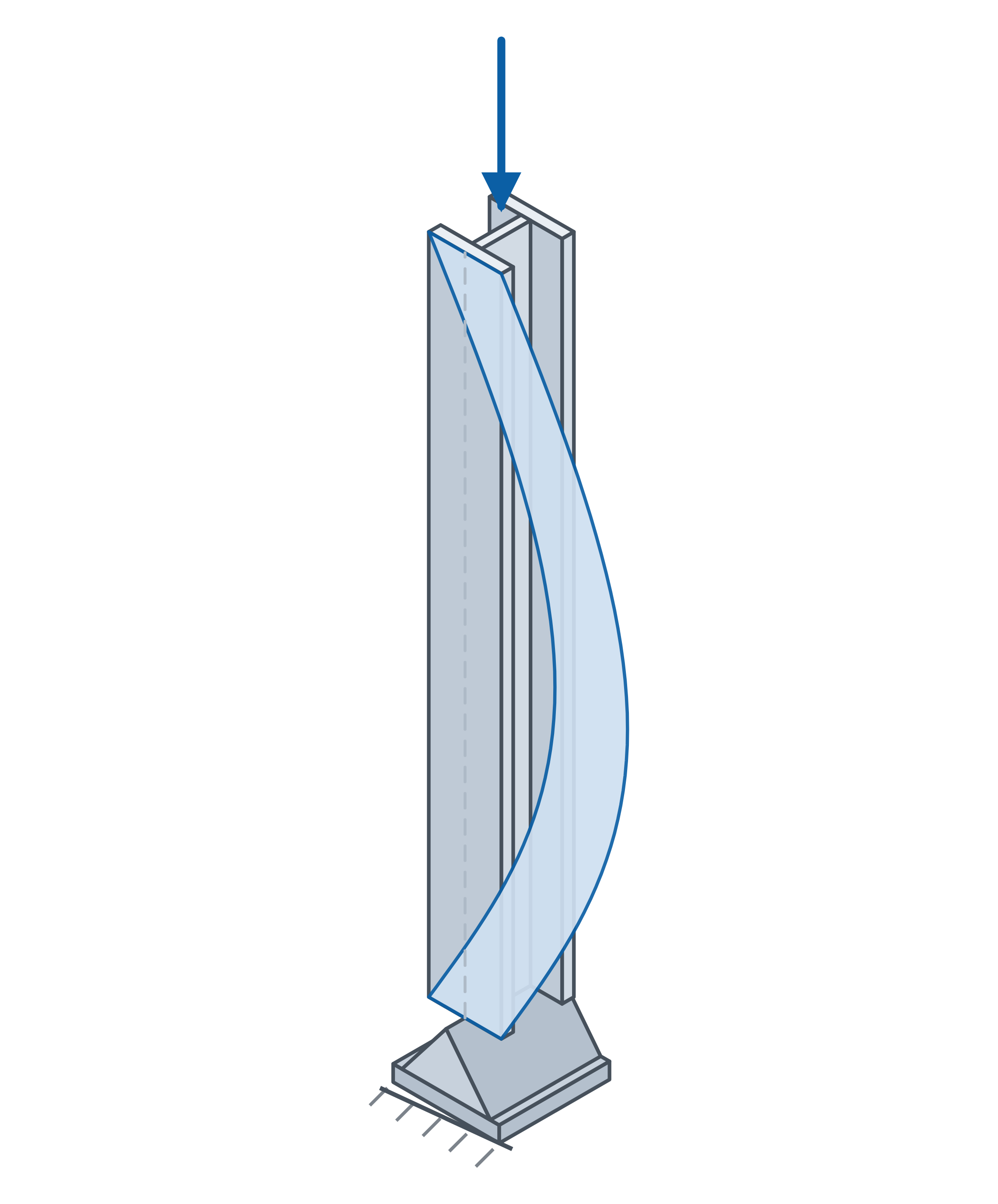
Checking a pinned steel column for flexural buckling acc. to EN 1993-1-1, 6.3.1, and comparing the result with a published worked example:
Keywords:
flexural buckling steel column effective lengths buckling resistance design check details verification example |
Note
Reference: JRC - Eurocodes: Background & Applications - Design of Steel Buildings (EUR 27346 EN, 2015), Chapter 1, Example 3. The results of RFEM agree with the reference within 0.5 %.
Effective lengths with intermediate supports are shown in Effective Lengths.
from dlubal.api import rfem, common
from math import inf
import pandas

# -------------------------------------------------------
# This example demonstrates the flexural buckling check of a pinned steel column
# in accordance with EN 1993-1-1 (CEN, recommended values).
#
# Reference:
#   JRC - Eurocodes: Background & Applications - Design of Steel Buildings
#   (EUR 27346 EN, 2015), Chapter 1, Example 3.
#
#   HEB 340, S355, pinned at both ends, L = Lcr,y = Lcr,z = 4.335 m,
#   design axial force NEd = 3326 kN (already factored), gamma_M1 = 1.0.
#
# The script creates the model, runs the steel design and compares the
# results of the governing check (flexural buckling about the minor axis)
# with the values published in the reference.
# -------------------------------------------------------


# Input data of the reference example (SI units)
COLUMN_LENGTH = 4.335   # m
N_ED = 3326e3           # N

# Results published in the reference
REFERENCE = {
    "lambdaand_773_z": (0.75, "-", "Non-dimensional slenderness about z"),
    "chi_z": (0.69, "-", "Reduction factor chi_z (buckling curve c)"),
    "n_b_z_rd": (4186.0, "kN", "Buckling resistance Nb,z,Rd"),
    "eta": (0.79, "-", "Design ratio NEd / Nb,Rd"),
}


def define_structure() -> list:

    # The column is vertical (global Z axis points downwards), pinned at the base
    # and held horizontally at the top. Torsion is restrained at the base only.

    return [

        rfem.structure_core.Material(
            no=1,
            name="S355",
        ),
        rfem.structure_core.CrossSection(
            no=1,
            name="HEB 340",
            material=1,
        ),

        rfem.structure_core.Node(
            no=1,
        ),
        rfem.structure_core.Node(
            no=2,
            coordinate_3=-COLUMN_LENGTH,
        ),
        rfem.structure_core.Line(
            no=1,
            definition_nodes=[1, 2],
        ),
        rfem.structure_core.Member(
            no=1,
            line=1,
            cross_section_start=1,
        ),

        rfem.types_for_nodes.NodalSupport(
            no=1,
            user_defined_name_enabled=True,
            name="Pinned base",
            nodes=[1],
            spring=common.Vector3d(x=inf, y=inf, z=inf),
            rotational_restraint=common.Vector3d(x=0, y=0, z=inf),
        ),
        rfem.types_for_nodes.NodalSupport(
            no=2,
            user_defined_name_enabled=True,
            name="Held horizontally",
            nodes=[2],
            spring=common.Vector3d(x=inf, y=inf, z=0),
            rotational_restraint=common.Vector3d(x=0, y=0, z=0),
        ),
    ]


def define_loading() -> list:

    # The reference gives the design axial force directly, so a single load case
    # is combined with the factor 1.0 in a user-defined load combination.

    return [

        rfem.loading.StaticAnalysisSettings(
            no=1,
        ),
        rfem.loading.LoadCase(
            no=1,
            name="Design load NEd",
            static_analysis_settings=1,
            self_weight_active=False,
        ),
        rfem.loading.DesignSituation(
            no=1,
            design_situation_type=rfem.loading.DesignSituation.DESIGN_SITUATION_TYPE_STR_PERMANENT_AND_TRANSIENT_6_10,
        ),
        rfem.loading.LoadCombination(
            no=1,
            name="NEd",
            design_situation=1,
            static_analysis_settings=1,
            combination_rule_str="LC1",
        ),

        rfem.loads.NodalLoad(
            no=1,
            load_case=1,
            nodes=[2],
            load_direction=rfem.loads.NodalLoad.LOAD_DIRECTION_GLOBAL_Z_OR_USER_DEFINED_W_TRUE_LENGTH,
            force_magnitude=N_ED,
        ),
    ]


def define_steel_design() -> list:

    # Buckling lengths follow from the member length (factor 1.0 about both axes).
    # Lateral-torsional buckling is not relevant for a column in pure compression.

    return [

        rfem.steel_design_objects.SteelDesignUlsConfiguration(
            no=1,
            assigned_to_all_members=True,
        ),
        rfem.steel_design.SteelEffectiveLengths(
            no=1,
            members=[1],
            flexural_buckling_about_y=True,
            flexural_buckling_about_z=True,
            torsional_buckling=False,
            lateral_torsional_buckling=False,
        ),
    ]


def get_governing_check(design_ratios_df: pandas.DataFrame, check_type: str) -> pandas.Series:
    """
    Returns the row with the highest design ratio for the given design check type.
    """
    rows = design_ratios_df[design_ratios_df["design_check_type"] == check_type]
    return rows.loc[rows["design_ratio"].idxmax()]


def get_design_check_values(details_df: pandas.DataFrame) -> pandas.DataFrame:
    """
    Returns only the rows of the section 'Design Check Values' of the design check details.

    The keys in the details table are not unique across its sections (for example 'i_z' is
    used for the moment of inertia as well as for the radius of gyration), so the lookup is
    restricted to the section that belongs to the design check itself.
    """
    start = details_df.index[details_df["key"] == "design_check_values"][0]
    return details_df.loc[start:]


# Scale factors from SI units to the units used in the reference
UNIT_SCALE = {"-": 1.0, "kN": 1e3, "kNm": 1e3}


def print_comparison(check_values_df: pandas.DataFrame, reference: dict) -> None:
    """
    Prints the RFEM values next to the reference values with their deviation.
    The column 'value' holds the rounded display value as text, so the full-precision
    column 'value_si' is used and converted to the unit of the reference.
    """
    print(f"\n{'Quantity':<45}{'RFEM':>12}{'Reference':>12}{'Deviation':>12}")
    for key, (ref_value, unit, caption) in reference.items():
        row = check_values_df.loc[check_values_df["key"] == key].iloc[0]
        rfem_value = float(row["value_si"]) / UNIT_SCALE[unit]
        deviation = (rfem_value - ref_value) / ref_value * 100
        print(f"{caption + ' [' + unit + ']':<45}{rfem_value:>12.3f}{ref_value:>12.3f}{deviation:>11.1f}%")


# -------------------------------------------------------
# MAIN SCRIPT
# -------------------------------------------------------

with rfem.Application() as rfem_app:

    # Initialize model
    rfem_app.create_model(name="steel_design_column_flexural_buckling")

    base_data = rfem_app.get_base_data()
    base_data.addons.steel_design_active = True
    base_data.standards.steel_design_standard = rfem.BaseData.Standards.STEEL_DESIGN_NATIONAL_ANNEX_AND_EDITION_EN_1993_CEN_2015_06_STANDARD
    rfem_app.set_base_data(base_data=base_data)

    # Create model
    rfem_app.delete_all_objects()
    rfem_app.create_object_list(
        objs=
            define_structure() +
            define_loading() +
            define_steel_design()
    )

    # Calculate model
    rfem_app.calculate_all(skip_warnings=True)

    # Design ratios of all checks, the maximum per check type
    design_ratios_df = rfem_app.get_results(
        results_type=rfem.results.STEEL_DESIGN_MEMBERS_DESIGN_RATIOS,
    ).data
    summary = design_ratios_df.sort_values("design_ratio", ascending=False).drop_duplicates("design_check_type")
    print("\nGoverning design ratios per check type:")
    print(summary[["design_check_type", "design_ratio", "design_check_description"]].to_string(index=False))

    # Details of flexural buckling about the minor axis
    check_type = "ST1300.00"  # Flexural buckling about principal z-axis acc. to EN 1993-1-1, 6.3.1
    governing = get_governing_check(design_ratios_df, check_type)
    details_df = rfem_app.get_results(
        results_type=rfem.results.STEEL_DESIGN_DESIGN_CHECK_DETAILS,
        filters=[
            rfem.results.ResultsFilter(
                column_id="design_check_details_id",
                filter_expression=str(governing["design_check_details_id"]),
            )
        ],
    ).data

    print(f"\n{check_type} | {governing['design_check_description']} | comparison with JRC Example 3:")
    print_comparison(get_design_check_values(details_df), REFERENCE)
using System.Globalization;
using Google.Protobuf;
using Microsoft.Data.Analysis;
using Common = Dlubal.Api.Common;
using Rfem = Dlubal.Api.Rfem;

// -------------------------------------------------------
// This example demonstrates the flexural buckling check of a pinned steel column
// in accordance with EN 1993-1-1 (CEN, recommended values).
//
// Reference:
//   JRC - Eurocodes: Background & Applications - Design of Steel Buildings
//   (EUR 27346 EN, 2015), Chapter 1, Example 3.
//
//   HEB 340, S355, pinned at both ends, L = Lcr,y = Lcr,z = 4.335 m,
//   design axial force NEd = 3326 kN (already factored), gamma_M1 = 1.0.
//
// The script creates the model, runs the steel design and compares the
// results of the governing check (flexural buckling about the minor axis)
// with the values published in the reference.
// -------------------------------------------------------


// Input data of the reference example (SI units)
const double COLUMN_LENGTH = 4.335;   // m
const double N_ED = 3326e3;           // N

// Results published in the reference: key -> (value, unit, caption)
var REFERENCE = new List<(string Key, double Value, string Unit, string Caption)>
{
    ("lambdaand_773_z", 0.75, "-", "Non-dimensional slenderness about z"),
    ("chi_z", 0.69, "-", "Reduction factor chi_z (buckling curve c)"),
    ("n_b_z_rd", 4186.0, "kN", "Buckling resistance Nb,z,Rd"),
    ("eta", 0.79, "-", "Design ratio NEd / Nb,Rd"),
};


static List<IMessage> DefineStructure()
{
    // The column is vertical (global Z axis points downwards), pinned at the base
    // and held horizontally at the top. Torsion is restrained at the base only.

    return new List<IMessage>
    {
        new Rfem.StructureCore.Material
        {
            No = 1,
            Name = "S355",
        },
        new Rfem.StructureCore.CrossSection
        {
            No = 1,
            Name = "HEB 340",
            Material = 1,
        },

        new Rfem.StructureCore.Node
        {
            No = 1,
        },
        new Rfem.StructureCore.Node
        {
            No = 2,
            Coordinate3 = -COLUMN_LENGTH,
        },
        new Rfem.StructureCore.Line
        {
            No = 1,
            DefinitionNodes = { 1, 2 },
        },
        new Rfem.StructureCore.Member
        {
            No = 1,
            Line = 1,
            CrossSectionStart = 1,
        },

        new Rfem.TypesForNodes.NodalSupport
        {
            No = 1,
            UserDefinedNameEnabled = true,
            Name = "Pinned base",
            Nodes = { 1 },
            SpringX = double.PositiveInfinity,
            SpringY = double.PositiveInfinity,
            SpringZ = double.PositiveInfinity,
            RotationalRestraintX = 0,
            RotationalRestraintY = 0,
            RotationalRestraintZ = double.PositiveInfinity,
        },
        new Rfem.TypesForNodes.NodalSupport
        {
            No = 2,
            UserDefinedNameEnabled = true,
            Name = "Held horizontally",
            Nodes = { 2 },
            SpringX = double.PositiveInfinity,
            SpringY = double.PositiveInfinity,
            SpringZ = 0,
            RotationalRestraintX = 0,
            RotationalRestraintY = 0,
            RotationalRestraintZ = 0,
        },
    };
}


static List<IMessage> DefineLoading()
{
    // The reference gives the design axial force directly, so a single load case
    // is combined with the factor 1.0 in a user-defined load combination.

    return new List<IMessage>
    {
        new Rfem.Loading.StaticAnalysisSettings
        {
            No = 1,
        },
        new Rfem.Loading.LoadCase
        {
            No = 1,
            Name = "Design load NEd",
            StaticAnalysisSettings = 1,
            SelfWeightActive = false,
        },
        new Rfem.Loading.DesignSituation
        {
            No = 1,
            DesignSituationType = Rfem.Loading.DesignSituation.Types.DesignSituationType.StrPermanentAndTransient610,
        },
        new Rfem.Loading.LoadCombination
        {
            No = 1,
            Name = "NEd",
            DesignSituation = 1,
            StaticAnalysisSettings = 1,
            CombinationRuleStr = "LC1",
        },

        new Rfem.Loads.NodalLoad
        {
            No = 1,
            LoadCase = 1,
            Nodes = { 2 },
            LoadDirection = Rfem.Loads.NodalLoad.Types.LoadDirection.GlobalZOrUserDefinedWTrueLength,
            ForceMagnitude = N_ED,
        },
    };
}


static List<IMessage> DefineSteelDesign()
{
    // Buckling lengths follow from the member length (factor 1.0 about both axes).
    // Lateral-torsional buckling is not relevant for a column in pure compression.

    return new List<IMessage>
    {
        new Rfem.SteelDesignObjects.SteelDesignUlsConfiguration
        {
            No = 1,
            AssignedToAllMembers = true,
        },
        new Rfem.SteelDesign.SteelEffectiveLengths
        {
            No = 1,
            Members = { 1 },
            FlexuralBucklingAboutY = true,
            FlexuralBucklingAboutZ = true,
            TorsionalBuckling = false,
            LateralTorsionalBuckling = false,
        },
    };
}


static double ToDouble(object? cell) => Convert.ToDouble(cell, CultureInfo.InvariantCulture);
static string ToText(object? cell) => cell?.ToString() ?? string.Empty;


// Returns the row with the highest design ratio for the given design check type.
static DataFrameRow GetGoverningCheck(DataFrame designRatios, string checkType)
{
    return designRatios.Rows
        .Where(row => ToText(row["design_check_type"]) == checkType)
        .OrderByDescending(row => ToDouble(row["design_ratio"]))
        .First();
}


// Returns the value of the key in the section 'Design Check Values' of the design check details.
//
// The keys in the details table are not unique across its sections (for example 'i_z' is
// used for the moment of inertia as well as for the radius of gyration), so the lookup is
// restricted to the section that belongs to the design check itself.
static double GetDesignCheckValue(DataFrame details, string key)
{
    var rows = details.Rows
        .SkipWhile(row => ToText(row["key"]) != "design_check_values")
        .Where(row => ToText(row["key"]) == key);
    return ToDouble(rows.First()["value_si"]);
}


// Prints the RFEM values next to the reference values with their deviation.
// The column 'value' holds the rounded display value as text, so the full-precision
// column 'value_si' is used and converted to the unit of the reference.
static void PrintComparison(DataFrame details, List<(string Key, double Value, string Unit, string Caption)> reference)
{
    var unitScale = new Dictionary<string, double> { ["-"] = 1.0, ["kN"] = 1e3, ["kNm"] = 1e3 };

    Console.WriteLine($"\n{"Quantity",-45}{"RFEM",12}{"Reference",12}{"Deviation",12}");
    foreach (var (key, refValue, unit, caption) in reference)
    {
        double rfemValue = GetDesignCheckValue(details, key) / unitScale[unit];
        double deviation = (rfemValue - refValue) / refValue * 100;
        Console.WriteLine(string.Format(CultureInfo.InvariantCulture,
            "{0,-45}{1,12:F3}{2,12:F3}{3,11:F1}%", $"{caption} [{unit}]", rfemValue, refValue, deviation));
    }
}


// -------------------------------------------------------
// MAIN SCRIPT
// -------------------------------------------------------

ApplicationRfem? rfemApp = null;

try
{
    rfemApp = new ApplicationRfem();

    // Initialize model
    rfemApp.create_model(name: "steel_design_column_flexural_buckling");

    var baseData = rfemApp.get_base_data();
    baseData.Addons.SteelDesignActive = true;
    baseData.Standards.SteelDesignStandard = Rfem.BaseData.Types.Standards.Types.SteelDesignStandard.SteelDesignNationalAnnexAndEditionEn1993Cen201506Standard;
    rfemApp.set_base_data(baseData: baseData);

    // Create model
    rfemApp.delete_all_objects();
    rfemApp.create_object_list(
        DefineStructure()
            .Concat(DefineLoading())
            .Concat(DefineSteelDesign())
            .ToList()
    );

    // Calculate model
    rfemApp.calculate_all(skipWarnings: true);

    // Design ratios of all checks, the maximum per check type
    Common.Table designRatios = rfemApp.get_results(
        resultsType: Rfem.Results.ResultsType.SteelDesignMembersDesignRatios
    );
    Console.WriteLine("\nGoverning design ratios per check type:");
    foreach (var row in designRatios.Data.Rows
        .GroupBy(row => ToText(row["design_check_type"]))
        .Select(group => group.OrderByDescending(row => ToDouble(row["design_ratio"])).First())
        .OrderByDescending(row => ToDouble(row["design_ratio"])))
    {
        Console.WriteLine(string.Format(CultureInfo.InvariantCulture, "{0,-12}{1,8:F3}  {2}",
            row["design_check_type"], ToDouble(row["design_ratio"]), row["design_check_description"]));
    }

    // Details of flexural buckling about the minor axis
    string checkType = "ST1300.00";  // Flexural buckling about principal z-axis acc. to EN 1993-1-1, 6.3.1
    var governing = GetGoverningCheck(designRatios.Data, checkType);
    Common.Table details = rfemApp.get_results(
        resultsType: Rfem.Results.ResultsType.SteelDesignDesignCheckDetails,
        filters: new List<Rfem.Results.ResultsFilter>
        {
            new Rfem.Results.ResultsFilter
            {
                ColumnId = "design_check_details_id",
                FilterExpression = ToText(governing["design_check_details_id"]),
            },
        }
    );

    Console.WriteLine($"\n{checkType} | {governing["design_check_description"]} | comparison with JRC Example 3:");
    PrintComparison(details.Data, REFERENCE);
}
catch (Exception ex)
{
    Console.WriteLine($"Error: {ex.Message}");
}
finally
{
    if (rfemApp != null) rfemApp.close_connection();
}