
Beam Stress from Strains#
|
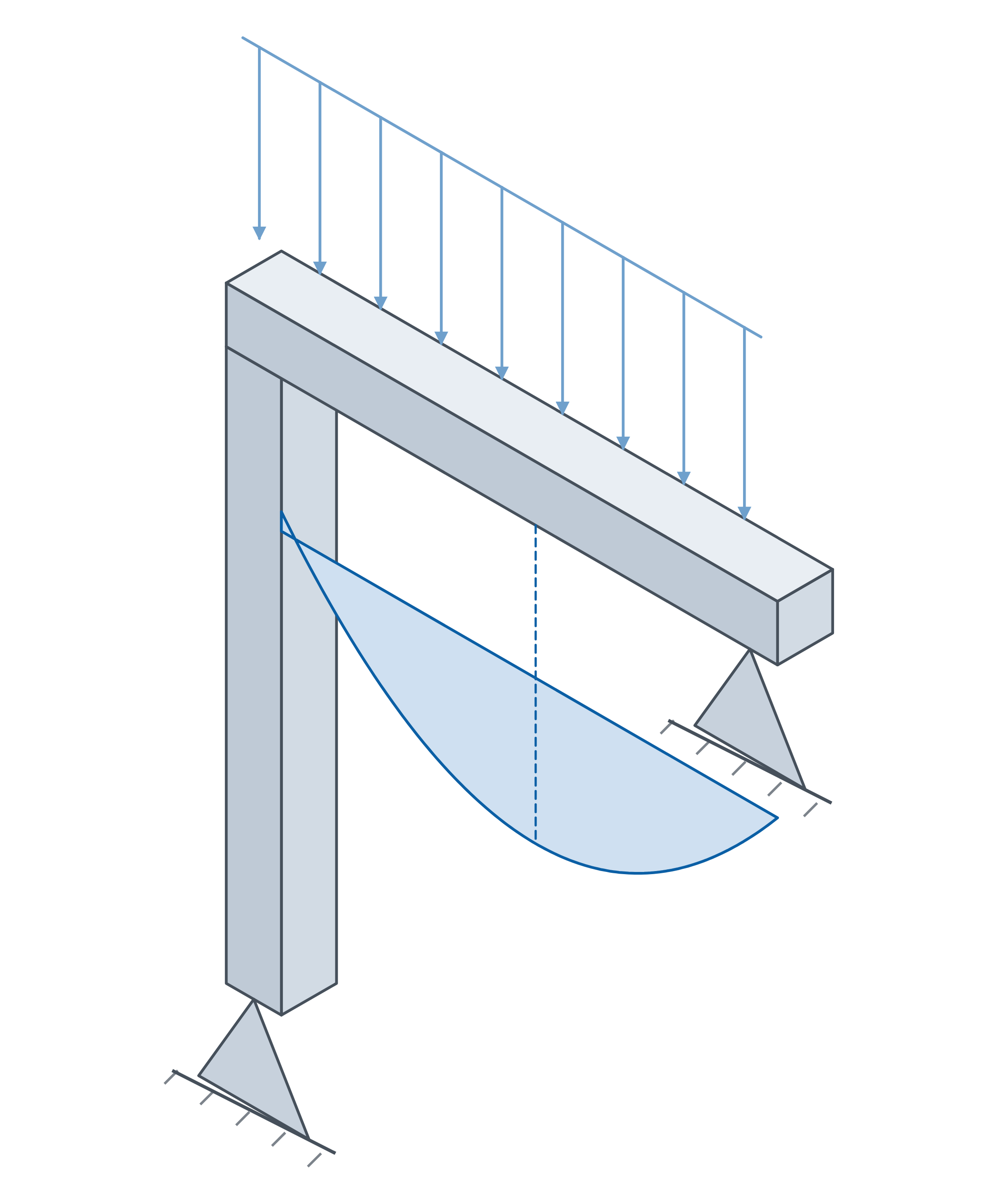
Modelling an L-frame under a distributed load and evaluating the normal stress from strains:
Keywords:
L-frame rectangular cross-section distributed load nodal support material properties member strains normal stress |
from math import inf
from dlubal.api import rfem, common

# -------------------------------------------------------
# This example demonstrates how to model two perpendicular
# beams with a rectangular cross-section. The top
# (horizontal) beam is loaded by a distributed load.
# While neglecting self-weight, the maximum normal stress
# on the horizontal beam is evaluated from member strains.
# -------------------------------------------------------

# Editable parameters (SI units)
MODEL_NAME = "beam_stress_from_strains"
MATERIAL = "S235"
CROSS_SECTION_WIDTH = 0.025        # b [m]
CROSS_SECTION_HEIGHT = 0.05        # h [m]
VERTICAL_BEAM_LENGTH = 1.0         # [m]
HORIZONTAL_BEAM_LENGTH = 1.0       # [m]
DISTRIBUTED_LOAD = 10000.0         # q [N/m] = 10 kN/m


def define_structure() -> list:
    """Define and return a list of structural objects."""

    return [
        rfem.structure_core.Material(
            no=1,
            name=MATERIAL,
        ),

        rfem.structure_core.CrossSection(
            no=1,
            type=rfem.structure_core.CrossSection.TYPE_PARAMETRIC_MASSIVE_I,
            material=1,
            b=CROSS_SECTION_WIDTH,
            h=CROSS_SECTION_HEIGHT,
            shear_stiffness_deactivated=True,
        ),

        rfem.structure_core.Node(no=1, coordinate_1=0.0, coordinate_2=0.0, coordinate_3=0.0),
        rfem.structure_core.Node(no=2, coordinate_1=0.0, coordinate_2=0.0, coordinate_3=-VERTICAL_BEAM_LENGTH),
        rfem.structure_core.Node(no=3, coordinate_1=HORIZONTAL_BEAM_LENGTH, coordinate_2=0.0, coordinate_3=-VERTICAL_BEAM_LENGTH),

        rfem.structure_core.Line(no=1, definition_nodes=[1, 2]),
        rfem.structure_core.Line(no=2, definition_nodes=[2, 3]),

        # The two members meet rigidly at node 2. That corner is what makes the
        # frame statically indeterminate: it carries part of the span moment
        # into the vertical member instead of leaving the beam simply supported.
        rfem.structure_core.Member(no=1, line=1, cross_section_start=1),
        rfem.structure_core.Member(no=2, line=2, cross_section_start=1),

        # Pinned at both far ends: translations restrained, free to rotate about
        # the global Y axis, which is the axis this frame bends about.
        rfem.types_for_nodes.NodalSupport(
            no=1,
            nodes=[1, 3],
            spring=common.Vector3d(x=inf, y=inf, z=inf),
            rotational_restraint=common.Vector3d(x=inf, y=0, z=inf),
        )
    ]


def define_loading() -> list:
    """Define and return a list of loading objects."""

    return [
        rfem.loading.StaticAnalysisSettings(no=1),

        rfem.loading.LoadCase(
            no=1,
            static_analysis_settings=1,
            self_weight_active=False,
        ),

        rfem.loads.MemberLoad(
            no=1,
            members=[2],
            load_case=1,
            load_type=rfem.loads.MemberLoad.LOAD_TYPE_FORCE,
            load_distribution=rfem.loads.MemberLoad.LOAD_DISTRIBUTION_UNIFORM,
            magnitude=DISTRIBUTED_LOAD,
        ),
    ]


with rfem.Application() as rfem_app:

    app_info = rfem_app.get_application_info()
    print(f"\nApplication Info:\n{app_info}")

    # Modelling
    rfem_app.close_all_models(save_changes=False)
    rfem_app.create_model(name=MODEL_NAME)

    rfem_app.delete_all_objects()
    rfem_app.create_object_list(define_structure() + define_loading())

    # Calculation
    calculation_info = rfem_app.calculate_all(skip_warnings=True)
    print(f"\nCalculation Info:\n{calculation_info}")

    # Results
    member_strains_df = rfem_app.get_results(
        results_type=rfem.results.STATIC_ANALYSIS_MEMBERS_STRAINS,
        filters=[
            rfem.results.ResultsFilter(column_id="member_no", filter_expression="2"),
            rfem.results.ResultsFilter(column_id="loading", filter_expression="LC1"),
        ],
    ).data

    # Material Properties
    material = rfem_app.get_object(
        rfem.structure_core.Material(no=1)
    )
    material_values_tree = material.material_values.rows[0].material_values_tree
    young_modulus = common.tree_table.get_values_by_key(
        tree=material_values_tree,
        key='e', # young_modulus
        occurrence=1
    )
    if young_modulus is None:
        raise RuntimeError("Young's modulus could not be read from the material values.")
    print(f"young_modulus: {young_modulus}")

    # Stress evaluation (horizontal beam).
    # The load acts in the global X-Z plane, so the beam bends about its local y
    # axis and the normal stress varies over the section HEIGHT. Only the axial
    # strain and that curvature contribute:
    #
    #     sigma(z) = E * (epsilon_x -+ kappa_y * h/2)   at the outer fibres
    #
    # The sign convention does not matter here, because the maximum is taken
    # over the absolute values of both fibres.
    required_columns = ["epsilon_x", "kappa_y"]
    missing = [c for c in required_columns if c not in member_strains_df.columns]
    if missing:
        raise RuntimeError(
            f"Expected columns {missing} not found. "
            f"Available columns: {list(member_strains_df.columns)}"
        )

    half_height = CROSS_SECTION_HEIGHT / 2
    sigma_top = young_modulus * (member_strains_df["epsilon_x"] - member_strains_df["kappa_y"] * half_height)
    sigma_bottom = young_modulus * (member_strains_df["epsilon_x"] + member_strains_df["kappa_y"] * half_height)

    sigma_max = max(sigma_top.abs().max(), sigma_bottom.abs().max())
    print(f"sigma_max: {sigma_max} Pa ({sigma_max / 1e6:.2f} MPa)")
using Google.Protobuf;
using System.Globalization;
using System.Linq;
using Common = Dlubal.Api.Common;
using Rfem = Dlubal.Api.Rfem;

// -------------------------------------------------------
// This example demonstrates how to model two perpendicular
// beams with a rectangular cross-section. The top
// (horizontal) beam is loaded by a distributed load.
// While neglecting self-weight, the maximum normal stress
// on the horizontal beam is evaluated from member strains.
// -------------------------------------------------------

// Editable parameters (SI units)
const string MODEL_NAME = "beam_stress_from_strains";
const string MATERIAL = "S235";
const double CROSS_SECTION_WIDTH = 0.025;
const double CROSS_SECTION_HEIGHT = 0.05;
const double VERTICAL_BEAM_LENGTH = 1.0;
const double HORIZONTAL_BEAM_LENGTH = 1.0;
const double DISTRIBUTED_LOAD = 10000.0;

static double ParseDoubleInvariant(object? value)
{
    if (value is null) return double.NaN;
    if (value is double d) return d;

    return double.TryParse(
        Convert.ToString(value, CultureInfo.InvariantCulture),
        NumberStyles.Any,
        CultureInfo.InvariantCulture,
        out var parsed
    )
        ? parsed
        : double.NaN;
}

static List<IMessage> DefineStructure()
{
    return new List<IMessage>
    {
        new Rfem.StructureCore.Material
        {
            No = 1,
            Name = MATERIAL,
        },
        new Rfem.StructureCore.CrossSection
        {
            No = 1,
            Type = Rfem.StructureCore.CrossSection.Types.Type.ParametricMassiveI,
            Material = 1,
            B = CROSS_SECTION_WIDTH,
            H = CROSS_SECTION_HEIGHT,
            ShearStiffnessDeactivated = true,
        },
        new Rfem.StructureCore.Node
        {
            No = 1,
            Coordinate1 = 0.0,
            Coordinate2 = 0.0,
            Coordinate3 = 0.0,
        },
        new Rfem.StructureCore.Node
        {
            No = 2,
            Coordinate1 = 0.0,
            Coordinate2 = 0.0,
            Coordinate3 = -VERTICAL_BEAM_LENGTH,
        },
        new Rfem.StructureCore.Node
        {
            No = 3,
            Coordinate1 = HORIZONTAL_BEAM_LENGTH,
            Coordinate2 = 0.0,
            Coordinate3 = -VERTICAL_BEAM_LENGTH,
        },
        new Rfem.StructureCore.Line
        {
            No = 1,
            DefinitionNodes = { 1, 2 },
        },
        new Rfem.StructureCore.Line
        {
            No = 2,
            DefinitionNodes = { 2, 3 },
        },
        // The two members meet rigidly at node 2. That corner is what makes the
        // frame statically indeterminate: it carries part of the span moment
        // into the vertical member instead of leaving the beam simply supported.
        new Rfem.StructureCore.Member
        {
            No = 1,
            Line = 1,
            CrossSectionStart = 1,
        },
        new Rfem.StructureCore.Member
        {
            No = 2,
            Line = 2,
            CrossSectionStart = 1,
        },
        // Pinned at both far ends: translations restrained, free to rotate about
        // the global Y axis, which is the axis this frame bends about.
        new Rfem.TypesForNodes.NodalSupport
        {
            No = 1,
            Nodes = { 1, 3 },
            Spring = new Common.Vector3d
            {
                X = double.PositiveInfinity,
                Y = double.PositiveInfinity,
                Z = double.PositiveInfinity,
            },
            RotationalRestraint = new Common.Vector3d
            {
                X = double.PositiveInfinity,
                Y = 0.0,
                Z = double.PositiveInfinity,
            },
        },
    };
}

static List<IMessage> DefineLoading()
{
    return new List<IMessage>
    {
        new Rfem.Loading.StaticAnalysisSettings
        {
            No = 1,
        },
        new Rfem.Loading.LoadCase
        {
            No = 1,
            StaticAnalysisSettings = 1,
            SelfWeightActive = false,
        },
        new Rfem.Loads.MemberLoad
        {
            No = 1,
            Members = { 2 },
            LoadCase = 1,
            LoadType = Rfem.Loads.MemberLoad.Types.LoadType.Force,
            LoadDistribution = Rfem.Loads.MemberLoad.Types.LoadDistribution.Uniform,
            Magnitude = DISTRIBUTED_LOAD,
        },
    };
}

ApplicationRfem? rfemApp = null;

try
{
    rfemApp = new ApplicationRfem();

    var appInfo = rfemApp.get_application_info();
    Console.WriteLine($"\nApplication Info:\n{appInfo}");

    rfemApp.close_all_models(saveChanges: false);
    rfemApp.create_model(name: MODEL_NAME);

    rfemApp.delete_all_objects();
    rfemApp.create_object_list(DefineStructure());
    rfemApp.create_object_list(DefineLoading());

    var calculationInfo = rfemApp.calculate_all(skipWarnings: true);
    Console.WriteLine($"\nCalculation Info:\n{calculationInfo}");

    var memberStrains = rfemApp.get_results(
        resultsType: Rfem.Results.ResultsType.StaticAnalysisMembersStrains,
        filters: new List<Rfem.Results.ResultsFilter>
        {
            new Rfem.Results.ResultsFilter { ColumnId = "member_no", FilterExpression = "2" },
            new Rfem.Results.ResultsFilter { ColumnId = "loading", FilterExpression = "LC1" },
        }
    );

    bool hasEpsilonX = memberStrains.Data.Columns.Any(c => c.Name == "epsilon_x");
    bool hasKappaY = memberStrains.Data.Columns.Any(c => c.Name == "kappa_y");
    if (!hasEpsilonX || !hasKappaY)
    {
        var available = string.Join(", ", memberStrains.Data.Columns.Select(c => c.Name));
        throw new InvalidOperationException(
            $"Expected columns 'epsilon_x' and 'kappa_y' not found. Available columns: {available}"
        );
    }

    var material = rfemApp.get_object<Rfem.StructureCore.Material>(
        new Rfem.StructureCore.Material { No = 1 }
    );
    var materialValuesTree = material.MaterialValues.Rows[0].MaterialValuesTree;
    var eValues = Common.TreeTable.GetValuesByKey(tree: materialValuesTree, key: "e", occurrence: 1);
    var youngModulus = ParseDoubleInvariant(eValues.FirstOrDefault());

    if (double.IsNaN(youngModulus))
    {
        throw new InvalidOperationException("Young's modulus could not be resolved from material values.");
    }
    Console.WriteLine($"young_modulus: {youngModulus}");

    var epsilonXCol = memberStrains.Data.Columns["epsilon_x"];
    var kappaYCol = memberStrains.Data.Columns["kappa_y"];

    double halfHeight = CROSS_SECTION_HEIGHT / 2.0;
    double sigmaMax = double.NaN;

    for (long i = 0; i < epsilonXCol.Length; i++)
    {
        double epsilonX = ParseDoubleInvariant(epsilonXCol[i]);
        double kappaY = ParseDoubleInvariant(kappaYCol[i]);

        if (double.IsNaN(epsilonX) || double.IsNaN(kappaY))
            continue;

        double sigmaTop = youngModulus * (epsilonX - kappaY * halfHeight);
        double sigmaBottom = youngModulus * (epsilonX + kappaY * halfHeight);

        double rowMax = Math.Max(Math.Abs(sigmaTop), Math.Abs(sigmaBottom));
        sigmaMax = double.IsNaN(sigmaMax) ? rowMax : Math.Max(sigmaMax, rowMax);
    }

    Console.WriteLine($"sigma_max: {sigmaMax} Pa ({sigmaMax / 1e6:F2} MPa)");
}
catch (Exception ex)
{
    Console.WriteLine($"Error: {ex.Message}");
}
finally
{
    if (rfemApp != null) rfemApp.close_connection();
}