
Snow Load Wizard#
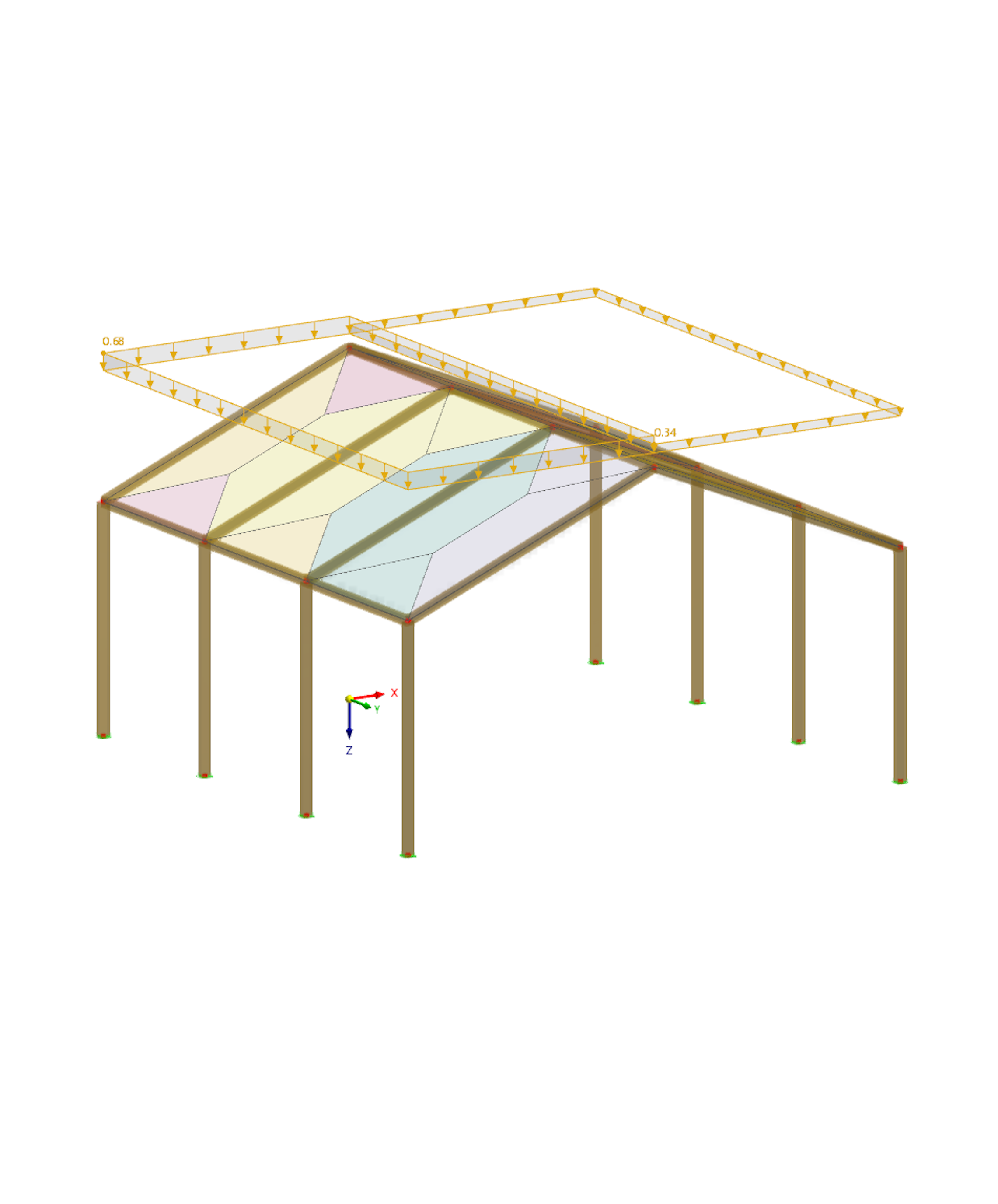
|
Generating duopitch roof snow loads from GeoZone site data with the Snow Load Wizard:
Keywords:
snow load wizard duopitch roof GeoZone Tool generate_into_load_cases |
"""Parametric duopitch (gable) roof building with a Snow Load Wizard.

Builds a multi-frame timber skeleton with a symmetric duopitch roof, then adds a
Snow Load Wizard on the two roof slopes (RFEM "Gable/Duopitch"). Each portal
frame has two columns and two rafters (eaves to ridge); longitudinal beams tie
the frames together. The model is 1D members only - the snow wizard identifies
the two roof planes from the corner nodes and loads the rafters directly.

The default parameters reproduce the reference structure:

    Building length, L   = 12.0 m   (ridge direction)
    Building width,  B   = 12.0 m   (span across the slopes)
    Eaves height         =  5.0 m
    Ridge height, H      =  7.5 m   (ground to top of roof)
    Roof pitch, theta    = atan((7.5 - 5.0) / (12.0 / 2)) = 22.62 deg

Snow Load Wizard
----------------
Base Data activates the load-wizards add-on and assigns EN 1991 (DIN). The
characteristic snow load s_k and the site altitude are fetched from the GeoZone
Tool for GEOZONE_ADDRESS and written into the wizard's standard-parameters tree
(the GUI "Parameters" tab), mirroring response_spectrum_from_geozone.py for the
seismic a_gR value.

The duopitch roof corner nodes must be given in the order RFEM expects - a walk
around the perimeter of the folded roof (see the wizard's A-F diagram):

    A front-left eaves -> B rear-left eaves -> C rear ridge ->
    D rear-right eaves -> E front-right eaves -> F front ridge

EN 1991 produces three duopitch snow arrangements (Case i balanced, Cases ii/iii
asymmetric), so the wizard must generate into three DISTINCT load cases - one per
arrangement. Reusing a load case is rejected ("Load cases for generated loads
must differ.").

This script prepares those three load cases itself and hands their numbers to the
wizard through `generate_into_load_cases`. Assigning the targets explicitly is
also what keeps the wizard off load cases it did not create: left unset, it binds
to whatever already exists in the model, in ascending number and regardless of
action category, so a permanent self-weight LC1 would end up carrying snow loads.

The opposite strategy - `generate_missing_load_cases = True`, the GUI "Generate
Load Cases" button, which makes RFEM work out the arrangements and create a load
case for each - works here too, and is what load_wizard_wind.py does. It pays off
where the arrangement count is larger (twelve for a duopitch wind wizard against
three here). Both wizards accept both strategies; the two examples show one each
rather than repeating the same script twice.

NOTE (bindings):
    Requires dlubal.api bindings that include load_wizards.SnowLoad. With the
    correct node order the TYPE_DUOPITCH wizard registers both roof planes
    (loaded_planes: 2 planes at 22.62 deg).

Units are SI: metres for geometry, Newtons for forces. RFEM uses a Z-down
convention, so structural heights map to negative Z coordinates.
"""

from dlubal.api import rfem, common, geo_zone_tool
from math import inf, radians

# -------------------------------------------------------------------------
# Editable parameters (SI units)
# -------------------------------------------------------------------------
BUILDING_LENGTH = 12.0            # m, ridge direction (global Y)
BUILDING_WIDTH = 12.0             # m, span across the slopes (global X)
EAVES_HEIGHT = 5.0                # m, ground to eaves
RIDGE_HEIGHT = 7.5                # m, ground to ridge (H)
NUMBER_OF_FRAMES = 4              # portal frames along the building length

MATERIAL = "C24"                  # timber, from the RFEM material library
CROSS_SECTION_COLUMN = "R_M1 120/240"   # 120 x 240 mm
CROSS_SECTION_RAFTER = "R_M1 100/200"   # 100 x 200 mm

# GeoZone Tool: the characteristic snow load s_k for this site is fetched from the
# GeoZone service and written into the wizard's standard-parameters tree (same
# pattern as response_spectrum_from_geozone.py, which transfers a_gR for seismic).
GEOZONE_ADDRESS = "München, Germany"
GEOZONE_COUNTRY_CODE = "DE"
SNOW_STANDARD_NAME = "EN 1991-1-3"   # preferred snow standard from the GeoZone list

def define_structure() -> list:
    """Define and return the structural objects of the duopitch building."""

    half_width = BUILDING_WIDTH / 2.0
    frame_spacing = BUILDING_LENGTH / (NUMBER_OF_FRAMES - 1)
    nodes_per_frame = 5       # left/right base, left/right eaves, ridge
    lines_per_frame = 4       # 2 columns + 2 rafters
    lines_per_bay = 3         # left eaves beam, right eaves beam, ridge beam
    first_bay_line = NUMBER_OF_FRAMES * lines_per_frame

    objects = [
        rfem.structure_core.Material(no=1, name=MATERIAL),
        rfem.structure_core.CrossSection(no=1, name=CROSS_SECTION_COLUMN, material=1),
        rfem.structure_core.CrossSection(no=2, name=CROSS_SECTION_RAFTER, material=1),
    ]

    # --- Nodes: 5 per frame (Z is negative for structural height) ---
    for f in range(NUMBER_OF_FRAMES):
        base = f * nodes_per_frame
        y = f * frame_spacing
        objects += [
            rfem.structure_core.Node(no=base + 1, coordinate_1=-half_width, coordinate_2=y, coordinate_3=0.0),
            rfem.structure_core.Node(no=base + 2, coordinate_1=half_width, coordinate_2=y, coordinate_3=0.0),
            rfem.structure_core.Node(no=base + 3, coordinate_1=-half_width, coordinate_2=y, coordinate_3=-EAVES_HEIGHT),
            rfem.structure_core.Node(no=base + 4, coordinate_1=half_width, coordinate_2=y, coordinate_3=-EAVES_HEIGHT),
            rfem.structure_core.Node(no=base + 5, coordinate_1=0.0, coordinate_2=y, coordinate_3=-RIDGE_HEIGHT),
        ]

    # --- Lines: 2 columns + 2 rafters per frame ---
    for f in range(NUMBER_OF_FRAMES):
        node = f * nodes_per_frame
        line = f * lines_per_frame
        objects += [
            rfem.structure_core.Line(no=line + 1, definition_nodes=[node + 1, node + 3]),  # left column
            rfem.structure_core.Line(no=line + 2, definition_nodes=[node + 2, node + 4]),  # right column
            rfem.structure_core.Line(no=line + 3, definition_nodes=[node + 3, node + 5]),  # left rafter
            rfem.structure_core.Line(no=line + 4, definition_nodes=[node + 4, node + 5]),  # right rafter
        ]

    # --- Lines: longitudinal beams tying consecutive frames (per bay) ---
    for bay in range(NUMBER_OF_FRAMES - 1):
        node = bay * nodes_per_frame
        line = first_bay_line + bay * lines_per_bay
        objects += [
            rfem.structure_core.Line(no=line + 1, definition_nodes=[node + 3, node + nodes_per_frame + 3]),  # left eaves
            rfem.structure_core.Line(no=line + 2, definition_nodes=[node + 4, node + nodes_per_frame + 4]),  # right eaves
            rfem.structure_core.Line(no=line + 3, definition_nodes=[node + 5, node + nodes_per_frame + 5]),  # ridge
        ]

    # --- Members: columns on CS 1, rafters and longitudinal beams on CS 2 ---
    for f in range(NUMBER_OF_FRAMES):
        line = f * lines_per_frame
        objects += [
            rfem.structure_core.Member(no=line + 1, line=line + 1, cross_section_start=1),  # left column
            rfem.structure_core.Member(no=line + 2, line=line + 2, cross_section_start=1),  # right column
            rfem.structure_core.Member(no=line + 3, line=line + 3, cross_section_start=2),  # left rafter
            rfem.structure_core.Member(no=line + 4, line=line + 4, cross_section_start=2),  # right rafter
        ]
    for bay in range(NUMBER_OF_FRAMES - 1):
        line = first_bay_line + bay * lines_per_bay
        for k in range(1, lines_per_bay + 1):
            objects.append(
                rfem.structure_core.Member(no=line + k, line=line + k, cross_section_start=2)
            )

    # --- Nodal supports: fixed column bases ---
    for f in range(NUMBER_OF_FRAMES):
        base = f * nodes_per_frame
        objects.append(
            rfem.types_for_nodes.NodalSupport(
                no=f + 1,
                nodes=[base + 1, base + 2],
                spring=common.Vector3d(x=inf, y=inf, z=inf),
                rotational_restraint=common.Vector3d(x=inf, y=inf, z=inf),
            )
        )

    return objects


def define_loading(snow_load_cases=(2, 3, 4)) -> list:
    """Define and return the loading objects (self-weight + snow arrangement cases).

    EN 1991 generates three duopitch snow arrangements (Case i balanced, Cases
    ii/iii asymmetric), each into its OWN load case - reusing one is rejected
    ("Load cases for generated loads must differ."). The wizard must target the
    same load cases (see define_snow_load_wizard).
    """

    objects = [
        rfem.loading.StaticAnalysisSettings(
            no=1,
            analysis_type=rfem.loading.StaticAnalysisSettings.ANALYSIS_TYPE_GEOMETRICALLY_LINEAR,
        ),
        rfem.loading.LoadCase(
            no=1,
            name="LC1 - Self Weight",
            static_analysis_settings=1,
            action_category=rfem.loading.LoadCase.ActionCategory.ACTION_CATEGORY_PERMANENT_G,
            self_weight_active=True,
        ),
    ]

    # Empty target load cases the Snow Load Wizard generates its arrangements into.
    for i, lc in enumerate(snow_load_cases, start=1):
        objects.append(
            rfem.loading.LoadCase(
                no=lc,
                name=f"LC{lc} - Snow (case {i})",
                static_analysis_settings=1,
            )
        )

    return objects


def define_snow_load_wizard(snow_load_cases=(2, 3, 4)) -> list:
    """Return the duopitch Snow Load Wizard for the roof.

    Corner nodes are given in RFEM's duopitch order - a perimeter walk of the
    folded roof (A B C D E F). The load zone, s_k and altitude are written later
    through the standard-parameters tree (see main), so the wizard is created
    with a placeholder load zone here.
    """

    SnowLoad = rfem.load_wizards.SnowLoad

    # Roof outer-corner nodes (5 nodes per frame: +3 eaves-left, +4 eaves-right,
    # +5 ridge) on the front frame (f = 0) and rear frame (f = NUMBER_OF_FRAMES - 1).
    # Duopitch order is a perimeter walk of the folded roof: A B C D E F.
    rear = (NUMBER_OF_FRAMES - 1) * 5
    roof_corner_nodes = [
        3,          # A front-left eaves
        rear + 3,   # B rear-left eaves
        rear + 5,   # C rear ridge
        rear + 4,   # D rear-right eaves
        4,          # E front-right eaves
        5,          # F front ridge
    ]

    # One row per snow arrangement, each targeting a distinct load case.
    generate_rows = [
        SnowLoad.GenerateIntoLoadCasesRow(no=i, checked=True, load_case=lc)
        for i, lc in enumerate(snow_load_cases, start=1)
    ]

    return [
        SnowLoad(
            no=1,
            user_defined_name_enabled=True,
            name="Snow - Duopitch",
            type=SnowLoad.TYPE_DUOPITCH,
            roof_corner_nodes=roof_corner_nodes,
            definition_type=SnowLoad.DEFINITION_TYPE_USER_DEFINED,
            load_zone=SnowLoad.LOAD_ZONE_TYPE_1,
            generate_into_load_cases=SnowLoad.GenerateIntoLoadCasesTable(rows=generate_rows),
        )
    ]


def snow_load_zone_enum(zone_value: str) -> int:
    """Map a GeoZone snow-zone value (e.g. '1a*') to a SnowLoad.LoadZone enum.

    The enum member names encode the dropdown label, so the label is recovered by
    reversing the naming convention: LOAD_ZONE_TYPE_1_A_ASTERISK -> '1a*'.
    """
    SnowLoad = rfem.load_wizards.SnowLoad
    by_label = {}
    for value in SnowLoad.LoadZone.DESCRIPTOR.values:
        label = (
            value.name.replace("LOAD_ZONE_TYPE_", "")
            .replace("_ASTERISK", "*")
            .replace("_GREATER", "")
            .replace("_A", "a")
            .replace("_", "")
        )
        by_label.setdefault(">" + label if "GREATER" in value.name else label, value.number)
    if zone_value not in by_label:
        raise ValueError(f"GeoZone snow zone {zone_value!r} has no SnowLoad.LoadZone match.")
    return by_label[zone_value]


def select_snow_zone(standards):
    """Pick the snow load-zone standard/annex/layer from a GeoZone standards list."""
    snow_zones = next(
        (group.load_zones for group in standards.type_groups if group.name.lower() == "snow"),
        None,
    )
    if not snow_zones:
        raise ValueError("No snow load-zone group found for the selected country.")
    zone = next(
        (z for z in snow_zones if z.annex.actual and z.standard.name == SNOW_STANDARD_NAME),
        next((z for z in snow_zones if z.annex.actual), snow_zones[0]),
    )
    return zone.standard.name, zone.annex.name, zone.annex.layers[0]


def fetch_snow_load_from_geozone(rfem_app):
    """Query the GeoZone Tool for the site's snow data.

    Returns (geozone_result, s_k, s_k_unit, s_k_pa, load_zone, zone_value). The
    standard-parameters tree stores s_k in SI Pa, so a kN/m2 value is scaled
    x1000; the zone value (e.g. '1a*') is mapped to a SnowLoad.LoadZone enum.
    """
    gzt = geo_zone_tool.GeoZoneTool(token=rfem_app.api_key.value)
    standards = gzt.get_load_zone_standards(
        country_code=GEOZONE_COUNTRY_CODE, language=geo_zone_tool.Language.EN
    )
    standard, annex, layer = select_snow_zone(standards)
    result = gzt.get_load_zone_characteristics(
        address=GEOZONE_ADDRESS,
        load_zone_type=geo_zone_tool.LoadZoneType.SNOW,
        standard=standard,
        annex=annex,
        layer_id=layer.id,
        language=geo_zone_tool.Language.EN,
    )
    sk_var = next(
        (v for ch in result.characteristics
         for v in ch.zone_characteristics.characteristics if v.name == "s_k"),
        None,
    )
    if sk_var is None or sk_var.calculated_value is None:
        raise ValueError("GeoZone response does not contain 's_k'.")
    sk = float(sk_var.calculated_value)
    sk_unit = (sk_var.units_html or "").replace("<sup>", "^").replace("</sup>", "")
    sk_pa = sk * 1000.0 if "kN" in sk_unit else sk
    zone_value = result.characteristics[0].zone_characteristics.zone.value
    load_zone = snow_load_zone_enum(zone_value)
    return result, sk, sk_unit, sk_pa, load_zone, zone_value


# Connect to the RFEM application
with rfem.Application() as rfem_app:

    # Create a clean model
    rfem_app.close_all_models(save_changes=False)
    rfem_app.create_model(name="duopitch_roof_building")
    rfem_app.delete_all_objects()

    # GeoZone Tool: fetch load zone, s_k and the resolved site location for
    # GEOZONE_ADDRESS (token comes from the RFEM API key).
    geozone_result, sk, sk_unit, sk_pa, load_zone, zone_value = fetch_snow_load_from_geozone(rfem_app)
    altitude = float(geozone_result.geo_location.altitude)
    zone_name = rfem.load_wizards.SnowLoad.LoadZone.DESCRIPTOR.values_by_number[load_zone].name
    print(f"\nGeoZone snow query [{GEOZONE_ADDRESS}]:")
    print(f"  load zone        = {zone_value}  ({zone_name})")
    print(f"  zone-derived s_k = {sk:.2f} {sk_unit}  (= {sk_pa:.0f} Pa)")
    print(f"  site altitude    = {altitude:.1f} m")

    # Base Data: activate the load-wizards add-on, assign EN 1991 (DIN), and
    # transfer the resolved site location. Keep the combination wizard OFF so the
    # plain snow load cases are accepted as valid generation targets.
    base_data = rfem_app.get_base_data()
    base_data.addons.load_wizards_active = True
    base_data.addons.combination_wizard_and_classification_active = False
    base_data.standards.load_wizard_standard_group = rfem.BaseData.Standards.LOAD_WIZARD_EN_1991_STANDARD_GROUP
    base_data.standards.load_wizard_standard = rfem.BaseData.Standards.LOAD_WIZARD_NATIONAL_ANNEX_AND_EDITION_EN_1991_DIN_2019_04_STANDARD
    base_data.location.altitude = altitude
    base_data.location.latitude = radians(float(geozone_result.geo_location.latitude))
    base_data.location.longitude = radians(float(geozone_result.geo_location.longitude))
    base_data.location.town_city = geozone_result.geo_location.city
    rfem_app.set_base_data(base_data=base_data)

    # Structure + load cases + Snow Load Wizard.
    rfem_app.create_object_list(define_structure() + define_loading())
    rfem_app.create_object_list(define_snow_load_wizard())

    # Write the GeoZone values into the wizard's standard-parameters tree. s_k
    # only becomes an editable row AFTER manual snow-load definition is enabled,
    # so this is a two-step write:
    #   1. enable manual mode -> update
    #   2. re-read (s_k is now editable) -> set s_k -> update
    snow = rfem_app.get_object(rfem.load_wizards.SnowLoad(no=1))
    params = snow.standard_parameters
    common.set_values_by_key(tree=params, key="load_zone", values=[load_zone])
    common.set_values_by_key(tree=params, key="a", values=[altitude])
    common.set_values_by_key(tree=params, key="manual_snow_load_definition", values=[True])
    common.set_values_by_key(tree=params, key="s_k", values=[sk_pa])
    rfem_app.update_object(rfem.load_wizards.SnowLoad(no=1, standard_parameters=params))
// Parametric duopitch (gable) roof building with a Snow Load Wizard.
//
// Builds a multi-frame timber skeleton with a symmetric duopitch roof, then adds a
// Snow Load Wizard on the two roof slopes (RFEM "Gable/Duopitch"). Each portal
// frame has two columns and two rafters (eaves to ridge); longitudinal beams tie
// the frames together. The model is 1D members only - the snow wizard identifies
// the two roof planes from the corner nodes and loads the rafters directly.
//
// The default parameters reproduce the reference structure:
//
//     Building length, L   = 12.0 m   (ridge direction)
//     Building width,  B   = 12.0 m   (span across the slopes)
//     Eaves height         =  5.0 m
//     Ridge height, H      =  7.5 m   (ground to top of roof)
//     Roof pitch, theta    = atan((7.5 - 5.0) / (12.0 / 2)) = 22.62 deg
//
// Snow Load Wizard
// ----------------
// Base Data activates the load-wizards add-on and assigns EN 1991 (DIN). The
// characteristic snow load s_k and the site altitude are fetched from the GeoZone
// Tool for GEOZONE_ADDRESS and written into the wizard's standard-parameters tree
// (the GUI "Parameters" tab), mirroring ResponseSpectrumFromGeozone.cs for the
// seismic a_gR value.
//
// The duopitch roof corner nodes must be given in the order RFEM expects - a walk
// around the perimeter of the folded roof (see the wizard's A-F diagram):
//
//     A front-left eaves -> B rear-left eaves -> C rear ridge ->
//     D rear-right eaves -> E front-right eaves -> F front ridge
//
// EN 1991 produces three duopitch snow arrangements (Case i balanced, Cases ii/iii
// asymmetric), so the wizard must generate into three DISTINCT load cases - one per
// arrangement. Reusing a load case is rejected ("Load cases for generated loads
// must differ.").
//
// Units are SI: metres for geometry, Newtons for forces. RFEM uses a Z-down
// convention, so structural heights map to negative Z coordinates.

using System.Globalization;
using System.Reflection;
using Google.Protobuf;
using Google.Protobuf.Reflection;
using GeoZoneTool;
using GeoZoneTool.Models;
using Common = Dlubal.Api.Common;
using Rfem = Dlubal.Api.Rfem;

// -------------------------------------------------------------------------
// Editable parameters (SI units)
// -------------------------------------------------------------------------
const double BUILDING_LENGTH = 12.0;          // m, ridge direction (global Y)
const double BUILDING_WIDTH = 12.0;           // m, span across the slopes (global X)
const double EAVES_HEIGHT = 5.0;              // m, ground to eaves
const double RIDGE_HEIGHT = 7.5;              // m, ground to ridge (H)
const int NUMBER_OF_FRAMES = 4;               // portal frames along the building length

const string MATERIAL = "C24";                            // timber, from the RFEM material library
const string CROSS_SECTION_COLUMN = "R_M1 0.120/0.240";   // 120 x 240 mm
const string CROSS_SECTION_RAFTER = "R_M1 0.100/0.200";   // 100 x 200 mm

// GeoZone Tool: the characteristic snow load s_k for this site is fetched from the
// GeoZone service and written into the wizard's standard-parameters tree (same
// pattern as ResponseSpectrumFromGeozone.cs, which transfers a_gR for seismic).
const string GEOZONE_ADDRESS = "München, Germany";
const string GEOZONE_COUNTRY_CODE = "DE";
const string SNOW_STANDARD_NAME = "EN 1991-1-3";   // preferred snow standard from the GeoZone list

static List<IMessage> DefineStructure()
{
    // Define and return the structural objects of the duopitch building.

    const double halfWidth = BUILDING_WIDTH / 2.0;
    const double frameSpacing = BUILDING_LENGTH / (NUMBER_OF_FRAMES - 1);
    const int nodesPerFrame = 5;       // left/right base, left/right eaves, ridge
    const int linesPerFrame = 4;       // 2 columns + 2 rafters
    const int linesPerBay = 3;         // left eaves beam, right eaves beam, ridge beam
    const int firstBayLine = NUMBER_OF_FRAMES * linesPerFrame;

    var objects = new List<IMessage>
    {
        new Rfem.StructureCore.Material { No = 1, Name = MATERIAL },
        new Rfem.StructureCore.CrossSection { No = 1, Name = CROSS_SECTION_COLUMN, Material = 1 },
        new Rfem.StructureCore.CrossSection { No = 2, Name = CROSS_SECTION_RAFTER, Material = 1 },
    };

    // --- Nodes: 5 per frame (Z is negative for structural height) ---
    for (int f = 0; f < NUMBER_OF_FRAMES; f++)
    {
        int baseNo = f * nodesPerFrame;
        double y = f * frameSpacing;
        objects.Add(new Rfem.StructureCore.Node { No = baseNo + 1, Coordinate1 = -halfWidth, Coordinate2 = y, Coordinate3 = 0.0 });
        objects.Add(new Rfem.StructureCore.Node { No = baseNo + 2, Coordinate1 = halfWidth, Coordinate2 = y, Coordinate3 = 0.0 });
        objects.Add(new Rfem.StructureCore.Node { No = baseNo + 3, Coordinate1 = -halfWidth, Coordinate2 = y, Coordinate3 = -EAVES_HEIGHT });
        objects.Add(new Rfem.StructureCore.Node { No = baseNo + 4, Coordinate1 = halfWidth, Coordinate2 = y, Coordinate3 = -EAVES_HEIGHT });
        objects.Add(new Rfem.StructureCore.Node { No = baseNo + 5, Coordinate1 = 0.0, Coordinate2 = y, Coordinate3 = -RIDGE_HEIGHT });
    }

    // --- Lines: 2 columns + 2 rafters per frame ---
    for (int f = 0; f < NUMBER_OF_FRAMES; f++)
    {
        int node = f * nodesPerFrame;
        int line = f * linesPerFrame;
        objects.Add(new Rfem.StructureCore.Line { No = line + 1, DefinitionNodes = { node + 1, node + 3 } });  // left column
        objects.Add(new Rfem.StructureCore.Line { No = line + 2, DefinitionNodes = { node + 2, node + 4 } });  // right column
        objects.Add(new Rfem.StructureCore.Line { No = line + 3, DefinitionNodes = { node + 3, node + 5 } });  // left rafter
        objects.Add(new Rfem.StructureCore.Line { No = line + 4, DefinitionNodes = { node + 4, node + 5 } });  // right rafter
    }

    // --- Lines: longitudinal beams tying consecutive frames (per bay) ---
    for (int bay = 0; bay < NUMBER_OF_FRAMES - 1; bay++)
    {
        int node = bay * nodesPerFrame;
        int line = firstBayLine + bay * linesPerBay;
        objects.Add(new Rfem.StructureCore.Line { No = line + 1, DefinitionNodes = { node + 3, node + nodesPerFrame + 3 } });  // left eaves
        objects.Add(new Rfem.StructureCore.Line { No = line + 2, DefinitionNodes = { node + 4, node + nodesPerFrame + 4 } });  // right eaves
        objects.Add(new Rfem.StructureCore.Line { No = line + 3, DefinitionNodes = { node + 5, node + nodesPerFrame + 5 } });  // ridge
    }

    // --- Members: columns on CS 1, rafters and longitudinal beams on CS 2 ---
    for (int f = 0; f < NUMBER_OF_FRAMES; f++)
    {
        int line = f * linesPerFrame;
        objects.Add(new Rfem.StructureCore.Member { No = line + 1, Line = line + 1, CrossSectionStart = 1 });  // left column
        objects.Add(new Rfem.StructureCore.Member { No = line + 2, Line = line + 2, CrossSectionStart = 1 });  // right column
        objects.Add(new Rfem.StructureCore.Member { No = line + 3, Line = line + 3, CrossSectionStart = 2 });  // left rafter
        objects.Add(new Rfem.StructureCore.Member { No = line + 4, Line = line + 4, CrossSectionStart = 2 });  // right rafter
    }
    for (int bay = 0; bay < NUMBER_OF_FRAMES - 1; bay++)
    {
        int line = firstBayLine + bay * linesPerBay;
        for (int k = 1; k <= linesPerBay; k++)
        {
            objects.Add(new Rfem.StructureCore.Member { No = line + k, Line = line + k, CrossSectionStart = 2 });
        }
    }

    // --- Nodal supports: fixed column bases ---
    for (int f = 0; f < NUMBER_OF_FRAMES; f++)
    {
        int baseNo = f * nodesPerFrame;
        objects.Add(new Rfem.TypesForNodes.NodalSupport
        {
            No = f + 1,
            Nodes = { baseNo + 1, baseNo + 2 },
            Spring = new Common.Vector3d { X = double.PositiveInfinity, Y = double.PositiveInfinity, Z = double.PositiveInfinity },
            RotationalRestraint = new Common.Vector3d { X = double.PositiveInfinity, Y = double.PositiveInfinity, Z = double.PositiveInfinity },
        });
    }

    return objects;
}

static List<IMessage> DefineLoading(int[] snowLoadCases)
{
    // Define and return the loading objects (self-weight + snow arrangement cases).
    //
    // EN 1991 generates three duopitch snow arrangements (Case i balanced, Cases
    // ii/iii asymmetric), each into its OWN load case - reusing one is rejected
    // ("Load cases for generated loads must differ."). The wizard must target the
    // same load cases (see DefineSnowLoadWizard).

    var objects = new List<IMessage>
    {
        new Rfem.Loading.StaticAnalysisSettings
        {
            No = 1,
            AnalysisType = Rfem.Loading.StaticAnalysisSettings.Types.AnalysisType.GeometricallyLinear,
        },
        new Rfem.Loading.LoadCase
        {
            No = 1,
            Name = "LC1 - Self Weight",
            StaticAnalysisSettings = 1,
            ActionCategory = Rfem.Loading.LoadCase.Types.ActionCategory.PermanentG,
            SelfWeightActive = true,
        },
    };

    // Empty target load cases the Snow Load Wizard generates its arrangements into.
    for (int i = 0; i < snowLoadCases.Length; i++)
    {
        objects.Add(new Rfem.Loading.LoadCase
        {
            No = snowLoadCases[i],
            Name = $"LC{snowLoadCases[i]} - Snow (case {i + 1})",
            StaticAnalysisSettings = 1,
        });
    }

    return objects;
}

static List<IMessage> DefineSnowLoadWizard(int[] snowLoadCases)
{
    // Return the duopitch Snow Load Wizard for the roof.
    //
    // Corner nodes are given in RFEM's duopitch order - a perimeter walk of the
    // folded roof (A B C D E F). The load zone, s_k and altitude are written later
    // through the standard-parameters tree (see main script), so the wizard is
    // created with a placeholder load zone here.

    // Roof outer-corner nodes (5 nodes per frame: +3 eaves-left, +4 eaves-right,
    // +5 ridge) on the front frame (f = 0) and rear frame (f = NUMBER_OF_FRAMES - 1).
    // Duopitch order is a perimeter walk of the folded roof: A B C D E F.
    int rear = (NUMBER_OF_FRAMES - 1) * 5;
    var roofCornerNodes = new[]
    {
        3,          // A front-left eaves
        rear + 3,   // B rear-left eaves
        rear + 5,   // C rear ridge
        rear + 4,   // D rear-right eaves
        4,          // E front-right eaves
        5,          // F front ridge
    };

    // One row per snow arrangement, each targeting a distinct load case.
    var generateIntoLoadCases = new Rfem.LoadWizards.SnowLoad.Types.GenerateIntoLoadCasesTable();
    for (int i = 0; i < snowLoadCases.Length; i++)
    {
        generateIntoLoadCases.Rows.Add(new Rfem.LoadWizards.SnowLoad.Types.GenerateIntoLoadCasesRow
        {
            No = i + 1,
            Checked = true,
            LoadCase = snowLoadCases[i],
        });
    }

    var snowLoad = new Rfem.LoadWizards.SnowLoad
    {
        No = 1,
        UserDefinedNameEnabled = true,
        Name = "Snow - Duopitch",
        Type = Rfem.LoadWizards.SnowLoad.Types.Type.Duopitch,
        DefinitionType = Rfem.LoadWizards.SnowLoad.Types.DefinitionType.UserDefined,
        LoadZone = Rfem.LoadWizards.SnowLoad.Types.LoadZone.Type1,
        GenerateIntoLoadCases = generateIntoLoadCases,
    };
    snowLoad.RoofCornerNodes.AddRange(roofCornerNodes);

    return new List<IMessage> { snowLoad };
}

static Dictionary<string, Rfem.LoadWizards.SnowLoad.Types.LoadZone> BuildSnowLoadZoneLabelMap()
{
    // Map GeoZone snow-zone labels (e.g. '1a*') onto SnowLoad.LoadZone members.
    //
    // The protobuf member names encode the dropdown label, so the label is
    // recovered by reversing the naming convention:
    // LOAD_ZONE_TYPE_1_A_ASTERISK -> '1a*'. The original proto names are read from
    // the [OriginalName] attributes the C# generator emits, which mirrors the
    // DESCRIPTOR lookup used by the Python example.

    var byLabel = new Dictionary<string, Rfem.LoadWizards.SnowLoad.Types.LoadZone>();
    var enumType = typeof(Rfem.LoadWizards.SnowLoad.Types.LoadZone);

    foreach (var field in enumType.GetFields(BindingFlags.Public | BindingFlags.Static))
    {
        var originalName = field.GetCustomAttribute<OriginalNameAttribute>()?.Name;
        if (originalName == null) continue;

        var label = originalName
            .Replace("LOAD_ZONE_TYPE_", "")
            .Replace("_ASTERISK", "*")
            .Replace("_GREATER", "")
            .Replace("_A", "a")
            .Replace("_", "");
        var key = originalName.Contains("GREATER") ? ">" + label : label;

        if (!byLabel.ContainsKey(key))
        {
            byLabel[key] = (Rfem.LoadWizards.SnowLoad.Types.LoadZone)field.GetValue(null)!;
        }
    }

    return byLabel;
}

static Rfem.LoadWizards.SnowLoad.Types.LoadZone SnowLoadZoneEnum(string zoneValue)
{
    // Map a GeoZone snow-zone value (e.g. '1a*') to a SnowLoad.LoadZone enum.
    var byLabel = BuildSnowLoadZoneLabelMap();
    if (!byLabel.TryGetValue(zoneValue, out var loadZone))
    {
        throw new InvalidOperationException($"GeoZone snow zone '{zoneValue}' has no SnowLoad.LoadZone match.");
    }
    return loadZone;
}

static string SnowLoadZoneOriginalName(Rfem.LoadWizards.SnowLoad.Types.LoadZone loadZone)
{
    // Recover the proto name of a LoadZone member (e.g. LOAD_ZONE_TYPE_1_A_ASTERISK).
    var field = typeof(Rfem.LoadWizards.SnowLoad.Types.LoadZone).GetField(loadZone.ToString());
    return field?.GetCustomAttribute<OriginalNameAttribute>()?.Name ?? loadZone.ToString();
}

static (string Standard, string Annex, LoadzoneLayerShortType Layer) SelectSnowZone(
    LoadzoneStandardsResponseType standards,
    string snowStandardName)
{
    // Pick the snow load-zone standard/annex/layer from a GeoZone standards list.
    var snowZones = standards.TypeGroups
        ?.FirstOrDefault(group => group.Name != null && group.Name.Equals("snow", StringComparison.OrdinalIgnoreCase))
        ?.Loadzones;

    if (snowZones == null || snowZones.Count == 0)
    {
        throw new InvalidOperationException("No snow load-zone group found for the selected country.");
    }

    var zone =
        snowZones.FirstOrDefault(z => z.Annex.Actual && z.Standard.Name == snowStandardName)
        ?? snowZones.FirstOrDefault(z => z.Annex.Actual)
        ?? snowZones[0];

    return (zone.Standard.Name, zone.Annex.Name, zone.Annex.Layers[0]);
}

// -------------------------------------------------------
// MAIN SCRIPT
// -------------------------------------------------------

var snowLoadCases = new[] { 2, 3, 4 };

ApplicationRfem? rfemApp = null;
try
{
    rfemApp = new ApplicationRfem();

    // Create a clean model
    rfemApp.close_all_models(saveChanges: false);
    rfemApp.create_model(name: "duopitch_roof_building");
    rfemApp.delete_all_objects();

    // GeoZone Tool: fetch load zone, s_k and the resolved site location for
    // GEOZONE_ADDRESS (token comes from the RFEM API key).
    var apiKey = new Connection(Connection.GetConfigPath()).ResolveApiKey("", "");
    using var gzt = new GeoZone(apiKey);

    var standards = await gzt.GetLoadZoneStandardsAsync(new GetLoadZoneStandardsRequest
    {
        CountryCode = GEOZONE_COUNTRY_CODE,
        Language = LanguageEnum.En,
    });

    var (snowStandard, snowAnnex, snowLayer) = SelectSnowZone(standards, SNOW_STANDARD_NAME);

    var geozoneResult = await gzt.GetLoadZoneCharacteristicsAsync(new GetZoneCharacteristicsRequest
    {
        Address = GEOZONE_ADDRESS,
        Type = LoadzoneTypeEnum.Snow,
        Standard = snowStandard,
        Annex = snowAnnex,
        LayerId = snowLayer.Id,
        Language = LanguageEnum.En,
    });

    if (geozoneResult == null)
    {
        Console.WriteLine("GeoZone returned no response.");
        return;
    }

    var skVariable = geozoneResult.Characteristics
        ?.SelectMany(ch => ch.ZoneCharacteristics.Characteristics)
        .FirstOrDefault(v => v.Name == "s_k");

    if (skVariable == null || string.IsNullOrEmpty(skVariable.CalculatedValue))
    {
        throw new InvalidOperationException("GeoZone response does not contain 's_k'.");
    }

    // The standard-parameters tree stores s_k in SI Pa, so a kN/m2 value is scaled x1000.
    var sk = double.Parse(skVariable.CalculatedValue, CultureInfo.InvariantCulture);
    var skUnit = (skVariable.UnitsHtml ?? "").Replace("<sup>", "^").Replace("</sup>", "");
    var skPa = skUnit.Contains("kN") ? sk * 1000.0 : sk;

    // The zone value (e.g. '1a*') is mapped to a SnowLoad.LoadZone enum.
    var zoneValue = geozoneResult.Characteristics![0].ZoneCharacteristics.Zone.Value;
    var loadZone = SnowLoadZoneEnum(zoneValue);

    var altitude = double.Parse(geozoneResult.GeoLocation.Altitude, CultureInfo.InvariantCulture);
    var zoneName = SnowLoadZoneOriginalName(loadZone);
    Console.WriteLine($"\nGeoZone snow query [{GEOZONE_ADDRESS}]:");
    Console.WriteLine($"  load zone        = {zoneValue}  ({zoneName})");
    Console.WriteLine($"  zone-derived s_k = {sk:F2} {skUnit}  (= {skPa:F0} Pa)");
    Console.WriteLine($"  site altitude    = {altitude:F1} m");

    // Base Data: activate the load-wizards add-on, assign EN 1991 (DIN), and
    // transfer the resolved site location. Keep the combination wizard OFF so the
    // plain snow load cases are accepted as valid generation targets.
    var baseData = rfemApp.get_base_data();
    baseData.Addons.LoadWizardsActive = true;
    baseData.Addons.CombinationWizardAndClassificationActive = false;
    baseData.Standards.LoadWizardStandardGroup = Rfem.BaseData.Types.Standards.Types.LoadWizardStandardGroup.LoadWizardEn1991StandardGroup;
    baseData.Standards.LoadWizardStandard = Rfem.BaseData.Types.Standards.Types.LoadWizardStandard.LoadWizardNationalAnnexAndEditionEn1991Din201904Standard;
    baseData.Location.Altitude = altitude;
    baseData.Location.Latitude = double.Parse(geozoneResult.GeoLocation.Latitude, CultureInfo.InvariantCulture) * Math.PI / 180.0;
    baseData.Location.Longitude = double.Parse(geozoneResult.GeoLocation.Longitude, CultureInfo.InvariantCulture) * Math.PI / 180.0;
    baseData.Location.TownCity = geozoneResult.GeoLocation.City;
    rfemApp.set_base_data(baseData: baseData);

    // Structure + load cases + Snow Load Wizard.
    rfemApp.create_object_list(DefineStructure().Concat(DefineLoading(snowLoadCases)).ToList());
    rfemApp.create_object_list(DefineSnowLoadWizard(snowLoadCases));

    // Write the GeoZone values into the wizard's standard-parameters tree. s_k
    // only becomes an editable row AFTER manual snow-load definition is enabled,
    // so this is a two-step write:
    //   1. enable manual mode -> update
    //   2. re-read (s_k is now editable) -> set s_k -> update
    var snow = rfemApp.get_object<Rfem.LoadWizards.SnowLoad>(new Rfem.LoadWizards.SnowLoad { No = 1 });
    if (snow != null)
    {
        var parameters = snow.StandardParameters;
        Common.TreeTable.SetValuesByKey(tree: parameters, key: "load_zone", values: new List<object> { (int)loadZone });
        Common.TreeTable.SetValuesByKey(tree: parameters, key: "a", values: new List<object> { altitude });
        Common.TreeTable.SetValuesByKey(tree: parameters, key: "manual_snow_load_definition", values: new List<object> { true });
        Common.TreeTable.SetValuesByKey(tree: parameters, key: "s_k", values: new List<object> { skPa });
        rfemApp.update_object(new Rfem.LoadWizards.SnowLoad { No = 1, StandardParameters = parameters });
    }
}
catch (Exception ex)
{
    Console.WriteLine($"Error: {ex.Message}");
}
finally
{
    if (rfemApp != null) rfemApp.close_connection();
}